This article covers アースソフト PT2 (Earthsoft PT2).
Overview
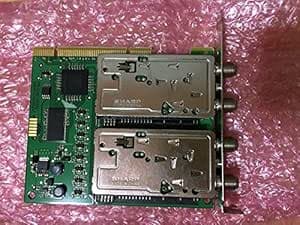
The Earthsoft PT2 is a Japanese-market digital TV tuner card that plugs into a legacy PCI slot. A single card covers all three Japanese broadcast standards — terrestrial ISDB-T, satellite ISDB-S (BS), and 110-degree CS (ISDB-C) — and carries two independent tuners, so recording two programs at once, or watching one channel while recording another, works from one slot.
The verdict up front: if you already own a desktop with a free Classic PCI slot and you are comfortable assembling drivers and recording software yourself, the PT2 is still a legitimate choice. If you are holding a recently built PC, or you expect plug-and-play behavior, it is not for you.
The card dates from around 2009. The reason people still talk about it is the three-standard, dual-tuner layout plus the ecosystem of community software built around it.
On Amazon.co.Check the retailer's page for the latest user reviews.
Read the other way, that score also tells you this is a product for people who can make it work.
Connectivity & Compatibility
The first thing to check is whether your motherboard has a free Classic PCI slot — not PCI Express. Nothing else matters until that is settled.
PCI slots have a single notch nearer the middle of the connector and differ in length and retention hardware from adjacent PCIe x1/x16 slots. Boards up to roughly the Intel 6-series and AMD 9xx era often keep one or two PCI slots; later chipset generations dropped them entirely.
Recent boards that advertise PCI usually route it through a bridge chip, which can introduce stability quirks.
Antenna input is two F-type connectors: one for terrestrial, one for BS/CS. If your home wiring carries terrestrial and satellite combined on a single cable, you need a splitter (bunpaki) to separate them into two feeds before the card.
Assuming one cable will feed both inputs is one of the most common setup failures. Some installations also require DC power to be supplied to the satellite dish somewhere in the chain, so check your booster and distributor power-pass ports as part of the wiring plan.
Power draw is modest and the card weighs 222 g, so neither PSU capacity nor slot sag is a practical concern.
Official OS support stops at Windows XP, Vista, and 7. Running it on Windows 10 or 11 is reported to be possible using community drivers and software such as BonDriver, TVTest, and EDCB, but that path assumes you will handle driver signing behavior and hand-edit configuration files yourself.
Nothing about it is vendor-guaranteed, and an OS update can break it.
Product Info
| Item | Value |
|---|---|
| Interface | PCI |
| Tuner count | 2 |
| Supported broadcasts | ISDB-T / ISDB-S / ISDB-C (110°CS) |
| Antenna input | 2× F-type (terrestrial, BS/CS) |
| Official OS support | Windows XP / Vista / 7 |
| Weight | 222 g |
Amazon.co.jp listed the card at ¥39,980 as captured on September 1, 2026.
Since the product has been out of production for years, treat that figure as reflecting leftover stock and secondhand pricing rather than an original MSRP; it moves with whatever listings happen to exist. Check the product page for the current price before buying.Check the retailer's page for the latest price.
The eBay entry carries no fixed figure and simply points at live search results.
Not a large count, but healthy for a niche expansion card, and the ratings are not polarized.
How It Compares
If your only goal is recording TV today, the real alternatives are USB tuners or newer PCIe cards with current OS support and an actual vendor behind them. The PT2 survives because it consolidates three standards and two tuners into one slot, and because existing owners can reuse their configurations and operational know-how directly.
In other words, it suits someone expanding an existing setup far better than someone starting one.
Also worth separating: despite sharing the "capture card" shelf, the PT2 is a broadcast tuner with no HDMI input. If you want to capture console gameplay or an external camera, buy an HDMI capture device instead — this mix-up happens often.
Things to Check Before Buying
The slot. Most motherboards sold in 2026 have no PCI slot at all.
PCIe-to-PCI adapters exist but are not guaranteed, and timing-sensitive tuner hardware is exactly where such adapters tend to misbehave. Sourcing an older machine as a dedicated recording box is the more dependable route.
The software. Official support ended at Windows 7.
Getting it running on a current OS means relying on community work — free, but entirely at your own risk. If reading through setup guides and editing config files by hand sounds unpleasant, a supported modern tuner will serve you better.
It is a used product. Expect no manufacturer warranty.
Capacitors and connectors age, and some listings offer no returns even for dead-on-arrival units. ¥39,980 (captured September 1, 2026) is not a small amount for an unwarranted card from over a decade ago — the same budget buys several current external tuners.
No 4K. The new 4K/8K satellite broadcasts are out of scope. This is a card for conventional ISDB broadcasts only.
Finally, listing metadata on marketplaces occasionally carries fields from a different product. If the price looks wildly out of line with the product class, or the brand fields disagree with the title, verify the item against the product photo and title before ordering.
FAQ
Q. Will it fit my new PC? A.
Not if the board only has PCI Express. The connectors are physically different — check your motherboard manual for a "PCI" slot.
Q. Does it work on Windows 11? A.
Official support ends at Windows 7. Community drivers and recording software are reported to work, but with no guarantee and with setup you must research yourself.
Q. Can it really record two programs at once? A.
Yes by specification — there are two tuners. Actual behavior depends on how your recording software is configured.
Q. Is one antenna cable enough?
A. No. There are separate terrestrial and BS/CS inputs, so combined household wiring needs a splitter.
Q. Can it record 4K broadcasts?
A. No. It handles ISDB-T / ISDB-S / ISDB-C only.
Best Use Cases
- Anyone wanting all three standards on one card — no separate terrestrial and satellite cards, saving slots and power.
- Existing users of this style of setup — configurations and know-how transfer directly, which makes it sensible as an expansion or spare.
- Heavy users of simultaneous recording — the dual-tuner design is the whole point here.
Not recommended for people with current-generation PCs only, anyone who values official support, anyone chasing 4K broadcasts, or anyone expecting it to work the moment it is seated. Choose a current USB or PCIe tuner instead.
Product Disclosure (Amazon)
- Manufacturer: アースソフト
- ASIN: B002WLP190
- Note: This article covers a manufacturer-made product based on Amazon listing details.