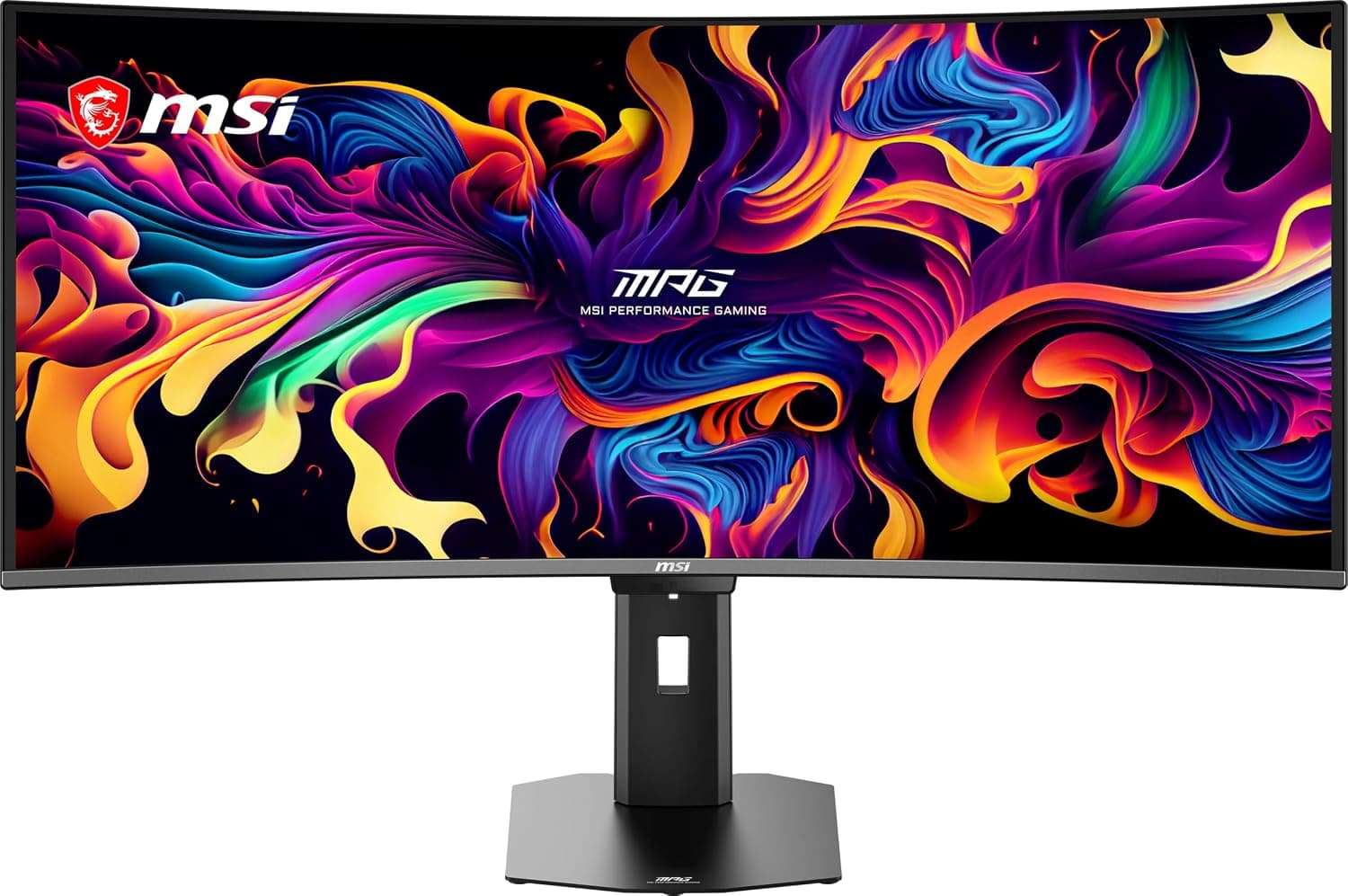
This article covers the MSI MPG 341CQR QD-OLED X36 34インチ 3440 x 1440 (UWQHD) ゲーミングモニター 360Hz アダプティブ同期 HDR対応 HDMI VESAマウント可能 チルト 4面スリムベゼル 0.03ms ブラック, a flagship 34-inch ultrawide that pairs a 5th-generation QD-OLED panel with a 360Hz refresh rate.
Below we work through the requirements it places on your PC and the compromises you have to accept.
Overview
The short version: this panel is for people who want competitive refresh rates and cinematic contrast from a single display. It runs 3440x1440 (21:9) at 360Hz with a 0.03ms GtG response time and carries VESA DisplayHDR True Black 500.
Because QD-OLED switches off light at the pixel level, the raised blacks and halo artifacts of backlit panels simply do not occur.
The 5th-generation panel uses an RGB stripe subpixel layout, which reduces the color fringing on text that earlier QD-OLED displays were criticized for. That matters if the same screen has to handle documents and code, not only games.
Everything else about it - price, desk space, GPU requirements - is firmly enthusiast territory.
Compatibility Guide
Video inputs are HDMI 2.1 and DisplayPort.
The spec sheet referenced here does not state the DisplayPort version, which is worth knowing: driving 3440x1440 at 360Hz over DisplayPort 1.4 class bandwidth normally assumes DSC (Display Stream Compression).
If 360Hz is not selectable, check the input you are using and whether the cable is a certified one before blaming the monitor.
For consoles, the supplied compatibility note says HDMI 2.1 works well with PS5 and Xbox Series X.
One caveat: as of writing, the PS5 does not output ultrawide 21:9. It will connect and display, but in 16:9 with pillarbox bars on each side.
The full width is really a PC benefit, and only in games that support 21:9. HDMI 2.1 bandwidth can carry 4K/120Hz class signals, but this panel is 3440x1440, so that is the resolution you get.
There is no USB-C input. If you want one cable for video, power delivery and a USB hub from a laptop, this is not that monitor.
The stand offers tilt only - no height adjustment and no swivel. It does support VESA 100x100mm, so if you need the panel at eye level, budget for a monitor arm from the start rather than treating it as an afterthought.
Adaptive sync is listed as supported, but the spec sheet does not say whether it carries a specific certification such as G-SYNC Compatible. If that matters to you, confirm on the product page before ordering.
What Your PC Needs for 360Hz
The pixel math makes the decision easier. 3440x1440 is about 4.95 million pixels - roughly 1.34x a 2560x1440 panel (3.69 million) and about 2.39x a 1920x1080 panel (2.07 million).
At identical settings, expect it to be about a third heavier than 1440p and more than twice as heavy as 1080p.
In practice only lightweight competitive titles will actually saturate 360Hz. Heavy open-world games, especially with ray tracing enabled, typically land in the 100-200fps range even on high-end hardware.
That does not make the headroom useless: having the variable refresh ceiling well above your frame rate keeps the picture stable when frame times fluctuate.
Product Info
| Item | Value |
|---|---|
| Panel type | QD-OLED (5th generation) |
| Panel size | 34 inches |
| Resolution | 3440x1440 (UWQHD) |
| Aspect ratio | 21:9 |
| Refresh rate | 360Hz |
| Response time | 0.03ms (GtG) |
| HDR certification | VESA DisplayHDR True Black 500 |
| Video inputs | HDMI 2.1, DisplayPort |
| VESA mount | 100x100mm |
| Stand adjustment | Tilt only |
The captured price was 171,891 yen on Amazon.co.jp as of 21 July 2026.
Prices move with stock and sales, so check the listing for the current figure. Note that the entry recorded as the overseas price holds the same yen amount and the same product page, so there is no real domestic-versus-import comparison available here.
The marketplace (eBay) entry has no price at all and simply points to listings.
User ratings stood at 3.8 out of 5 stars (76% positive) from 13 reviews as of July 2026.
Thirteen is a small sample: a couple of posts can swing the average noticeably. Read what the low scores actually complain about - a defective unit is a different signal from a misunderstood specification - rather than trusting the star count.
The monitor is described as a late-2025 release with a standard three-year warranty including the panel. OLED warranties often spell out how burn-in is handled, and at this price it is worth reading those terms yourself before buying.
How It Compares
Several 34-inch 3440x1440 QD-OLED monitors now exist, and the differences come down to panel generation and refresh rate. This model's case rests on 360Hz plus the 5th-generation RGB stripe layout.
Whether that justifies replacing a previous-generation panel (most sit around 240Hz) depends on whether your games actually exceed 240fps today. If they do not, the upgrade belongs in the GPU, not the display.
If you are undecided on size, the alternatives point in different directions: a 49-inch super ultrawide for more horizontal space, or a large 16:9 OLED for resolution and window area. And if competitive play is the only priority, a 24-inch 1080p high-refresh panel remains the rational pick - lighter on the GPU and less eye movement.
Who It Is For
- Competitive FPS and racing players - 360Hz with a 0.03ms GtG response keeps moving objects clean, provided the GPU can feed it.
- Players who want one screen for games and film - DisplayHDR True Black 500 on QD-OLED pays off in horror, open-world and dark cinematic content.
- People who game and work on the same display - the RGB stripe layout reduces text fringing, and 21:9 suits two side-by-side windows.
- Anyone already using a monitor arm - that neutralizes the tilt-only stand entirely.
Before You Buy
21:9 is not universal. Supported titles gain field of view; unsupported games and standard video get pillarbox bars.
Some competitive titles deliberately limit what ultrawide shows for fairness reasons. Check the games you actually play before committing.
Burn-in risk never reaches zero on OLED. Static elements - taskbars, HUDs, streaming overlays - are the worst case.
Auto-hiding the taskbar, using dark themes, setting a short display-off timer and enabling the pixel shift and panel refresh features cuts practical risk substantially. If your main use is eight hours a day of the same static work screen, buy an LCD instead.
No USB-C and a tilt-only stand are the complaints that surface later. Laptop users and anyone with tight desk constraints should price in a monitor arm as part of the total cost.
Watch for listing errors. Part of the referenced product data mentioned a VGA port that appears nowhere in the specification table.
An analog VGA input on a 360Hz 5th-gen QD-OLED panel is implausible, so treat it as a listing mistake; the duplicated price fields are the same kind of artifact. Verify the product and its ports from the title, the images and the manufacturer specs before ordering.
Measure your desk. A 34-inch 21:9 panel is typically around 80cm wide, and a curved panel changes how much depth you need.
Confirm the exact dimensions and weight from the product page.
FAQ
Q. What GPU do I need for 360Hz? A.
It depends on the title. With about 2.39x the pixels of 1080p, holding 360fps in heavy games is out of reach even for current flagships.
Treat the headroom as a benefit for lightweight competitive games.
Q. Can I connect a PS5 or Xbox Series X? A.
Yes, via HDMI 2.1.
But the PS5 does not output 21:9 as of writing, so you get black bars at the sides. The full width is mainly a PC benefit.
Q. Is text easy to read? A.
The 5th-generation RGB stripe layout reduces the fringing seen on earlier panels. It is still not a display you would buy purely for long document sessions.
Q. Can I run a laptop over a single USB-C cable? A.
No. There is no USB-C input; use HDMI or DisplayPort and power the laptop separately.
Q. Can I adjust the height?
A. The stand tilts only. It supports VESA 100x100mm, so add a monitor arm if you need height or swivel.
Product Disclosure (Amazon)
- Manufacturer: MSI
- Seller: Amazon US
- Fulfilled by: Amazon US
- ASIN: B0GL9NWNTQ
- Note: This article covers a manufacturer-made product based on Amazon listing details.