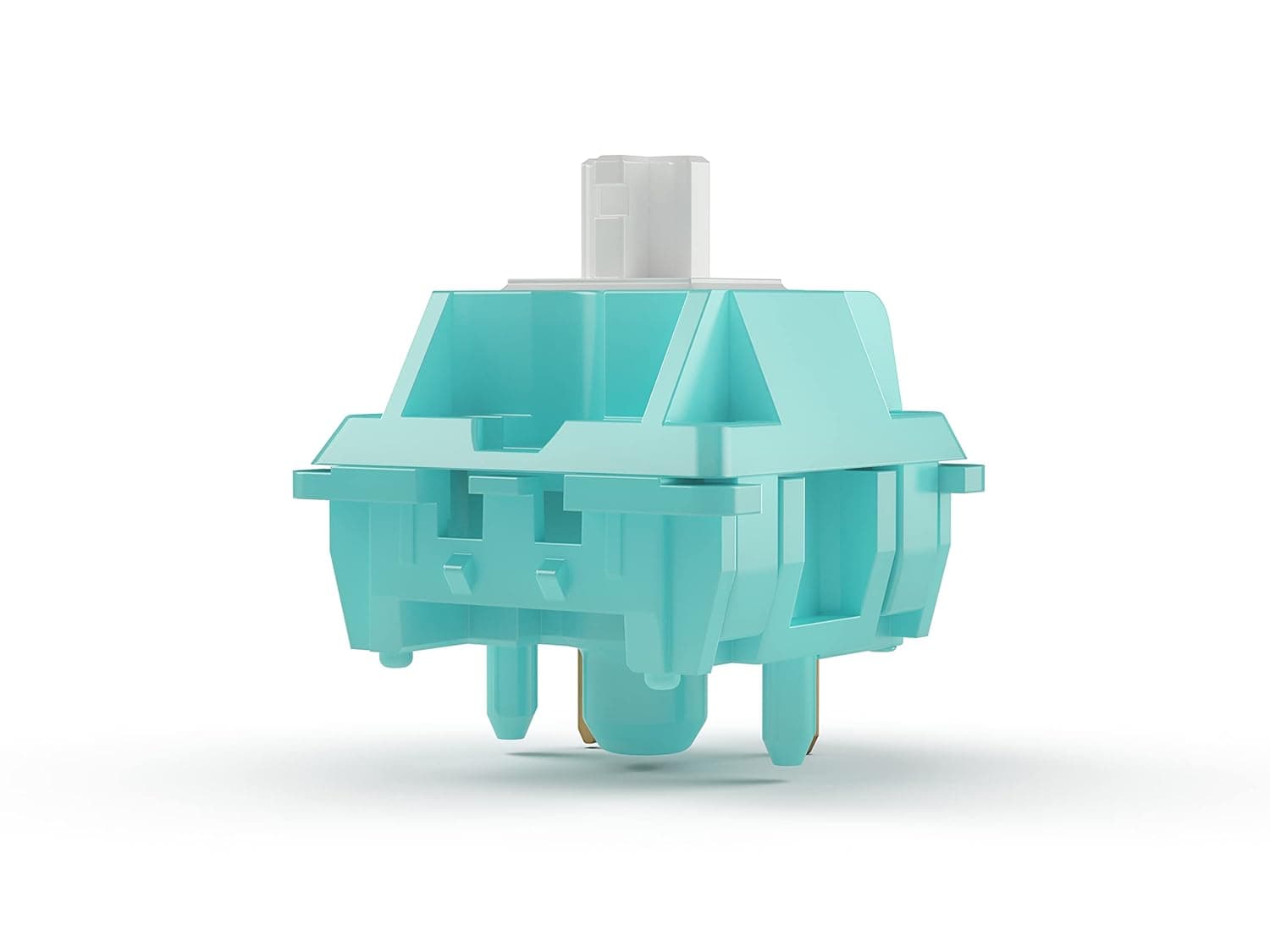
Glorious Lynx 5-Pin Factory-Lubed Linear Keyboard Switches, 36-Pack is for people who want to change how their keyboard feels without disassembling it. This article looks at whether 36 switches is actually enough, what the 5-pin versus 3-pin difference means in practice, and who should skip this product entirely.
Overview
The Glorious Lynx is a factory-lubed linear switch for hot-swap keyboards. Being linear, it has no tactile bump and no click — resistance simply builds evenly from the top of the stroke to bottom-out.
The short version: this fits people who already own a hot-swap board, don't want to hand-lube switches, but are bothered by the scratchiness of stock switches.
On Amazon.co.jp the listing showed 615 reviews at 4.5 out of 5 stars (roughly 90% positive) as of June 2026 — a meaningful sample size for a bare switch product.
Keep in mind that low ratings in this category often come from buyers who didn't check socket compatibility, so the compatibility section below matters more than the star count.
One thing to be clear about: this is a bag of 36 switches, not a keyboard. If your board has switches soldered to the PCB, buying this means starting with a soldering iron.
Compatibility Guide
The stem is a Cherry MX-compatible cross mount, so any MX keycap set fits. The compatibility question is not about keycaps — it's about the socket on your PCB.
| Check | This product | Common mistake |
|---|---|---|
| Pin count | 5-pin (2 metal contacts + 2 plastic alignment legs + center boss) | 3-pin boards need the 2 legs clipped |
| Sockets | Cherry MX / Gateron / Kailh hot-swap sockets | Not usable on solder-only PCBs |
| Keyboards | Glorious GMMK series, most MX-compatible hot-swap boards | GMMK1 (3-pin) requires clipping |
| Quantity | 36 per pack | A 104-key full-size needs 3 packs |
| Voltage / current | 5V / 500mA | Not a practical concern for keyboards |
| Materials | Polycarbonate, nylon PA12, POM, nickel plating | Housing material affects sound |
The 5-pin versus 3-pin distinction confuses newcomers. A 5-pin switch has two plastic legs on the underside in addition to the two metal contacts; those legs keep the switch upright even in plateless builds.
A 3-pin PCB — the GMMK1 is one — has no holes for those legs, so you must clip them flush with nippers before installing. Only the two metal contacts carry signal, so clipping changes nothing electrically.
Clipping takes seconds per switch, but you repeat it 36 times — 72 if you bought two packs. If a cut leaves a stub, the switch sits proud of the PCB and key heights end up uneven.
Use flush-cut nippers and run a finger over the base afterward to check. If that process sounds unappealing, buy switches sold as 3-pin from the start.
For plateless DIY kits the 5-pin design is an advantage: with no plate holding switches straight, the alignment legs do that job instead.
Product Info
The core spec is linear, 5-pin, factory-lubed, 36 per pack. The housing uses polycarbonate and nylon PA12, the stem POM, and the contacts are nickel-plated.
Polycarbonate housings generally lean toward a higher, clearer sound signature, though the actual result depends heavily on your case material, mounting style, and keycap thickness — no switch guarantees a particular sound on its own.
The listed dimension of "about 1 x 1 x 2 mm per switch" is clearly a data error. A real MX-compatible switch housing is around 15mm, and a 1mm switch does not exist.
Treat that figure as a unit or decimal mistake and don't design around it; check the manufacturer's documentation if you need exact dimensions.
Pricing has moved a lot between captures. As captured on 12 June 2026 the price was ¥1,990; as captured on 27 August 2026 the same ASIN showed ¥4,840.
That works out to roughly ¥55 per switch at the lower figure and about ¥134 at the higher one. A seller change or stock shift most likely explains the gap.
So planning a build around "¥55 per switch" may not hold — check the live price on the product page first, then do the pack math below. Both figures above are capture-time prices and change with sales and seller changes.
To find pack count, divide your key count by 36 and round up. A 60% board (61 keys) needs 2 packs.
A tenkeyless (87 keys) needs 3, and a full-size (104 keys) also needs 3. Note that 2 packs (72 switches) leaves a tenkeyless 15 short — that's the easy mistake.
Budgeting one spare pack is wise if you expect to damage a switch during swapping.
The listing is on Amazon.co.jp (ASIN: B09315SRHY). eBay listings exist but show no fixed price, so treat those as reference only.
How It Compares
Factory-lubed linears are a crowded category now — Gateron Oil King and Ink variants, several Akko linears, and Cherry's newer pre-lubed lines all offer the same out-of-the-box experience. The Lynx's advantages are documentation alignment if you own a GMMK board, and the small 36-count pack letting you try one box before committing.
That same small pack works against you at volume. Compared per switch against 90- or 110-count bulk bags from other brands, the winner flips depending on pack pricing.
If you're building a full-size board, calculate "switches needed ÷ pack quantity × pack price" for both options before deciding.
Feel itself is hard to compare numerically here: actuation force and travel distance aren't in this product's data, so claims that it's lighter or heavier than a competitor would be guesswork. Sample packs of a few switches are the cheapest way to find out.
Installation Notes
The swap is straightforward: pull the keycap, grip the switch's top and bottom tabs with a switch puller, lift straight up, check the new switch's pins are straight, and press it in vertically. Budget 30 to 60 minutes for a full board.
One failure mode dominates: bent pins. Contacts sometimes fold inward in transit, and forcing such a switch in either snaps the pin or bends it inside the socket, producing a dead key.
Inspect the base before inserting and confirm both contacts run straight and parallel; straighten any bent ones gently with tweezers. If a key doesn't register after install, pull it and inspect rather than pressing harder.
Factory lubing still has unit-to-unit variance. A few switches out of a batch may show audible spring ping — normal for this class of product.
Place those on less-used positions or hand-lube just those few; there's no need to redo the whole set.
Best Use Cases
- Owners of hot-swap keyboards — no soldering, and a switch puller is the only tool required. This is the easiest feel-changing mod available.
- People who don't want to hand-lube — skips lube, brush, switch opener, and several hours of work. The more you value that time, the better this looks.
- Quieter environments — linears produce no click, though bottom-out noise remains. It isn't silent.
- GMMK series users — GMMK2 and later accept 5-pin switches with no modification.
- Plateless DIY builders — the alignment legs keep switches straight without a plate.
Before You Buy
The listing's pin count contradicts itself. This product is specified as 5-pin, yet the product page title states "3-pin." That difference decides whether you need nippers.
Before ordering, zoom into the product images and check the switch underside yourself: two plastic legs means 5-pin; only two metal contacts and a center boss means 3-pin. Amazon listing metadata is seller-entered and errors like this are common.
The listed dimensions are similarly wrong, as noted above.
Price volatility is real. The same ASIN was captured at ¥1,990 (12 June 2026) and ¥4,840 (27 August 2026).
At the higher figure, per-switch cost is about ¥134 and the value argument largely disappears. Judge it against whatever price is live when you buy.
Count your keys first. Trying to fill an 87-key tenkeyless with two packs (72 switches) is the most common mistake here.
Non-hot-swap boards need soldering. You can technically use these, but only after desoldering every existing switch.
Pull one keycap: if you see a round socket around the switch, you're hot-swap.
Linear isn't for everyone. If you're used to tactile or clicky feedback, linears can feel heavy and increase typos because nothing signals actuation before bottom-out.
If you've never used linears, try a few samples before buying 36.
Pre-lubed doesn't mean perfect. Variance remains; expecting 36 identical-feeling switches sets the bar too high.
FAQ
Q. How do I check if these fit my keyboard? A.
Pull one keycap. A round socket around the switch base means hot-swap.
If the switch is soldered to the PCB, these won't fit without rework.
Q. Can I force a 5-pin switch into a 3-pin board? A.
No. There are no holes for the plastic legs, and forcing it damages the PCB or switch.
Clip both legs flush first — it has no electrical effect.
Q. How many packs for a full-size board? A.
Three packs (108 switches) for 104 keys. A tenkeyless (87 keys) also needs three; two packs fall short.
A 61-key 60% board needs two.
Q. Do my keycaps still fit?
A. Yes — the MX-compatible cross stem accepts standard MX keycaps.
Q. Do I need to add my own lube? A.
Generally no. Only touch up the occasional switch with noticeable spring ping.
If you plan to relube everything, unlubed switches are cheaper.
Q. What's the review rating? A.
615 reviews at 4.5 out of 5 stars (about 90%) on Amazon.co.jp as of June 2026.
Check your socket type before weighing the rating, since many low scores come from compatibility mistakes.
Product Disclosure (Amazon)
- Manufacturer: GLORIOUS
- Seller: AIQA Market
- Fulfilled by: AIQA Market
- ASIN: B09315SRHY
- Note: This article covers a manufacturer-made product based on Amazon listing details.