The EPOMAKER Wisteria V2 Linear 38gf Switch Set — sold in Japan as EPOMAKER Wisteria V2リニア38gfキーボードスイッチセット ライトディフューザー付き 潤滑済み 5ピンクリーミースイッチ — is built around one idea: a light linear switch you can drop in straight from the bag. This article digs into what the spec numbers actually feel like, and the pitfalls buyers hit after ordering.
Overview
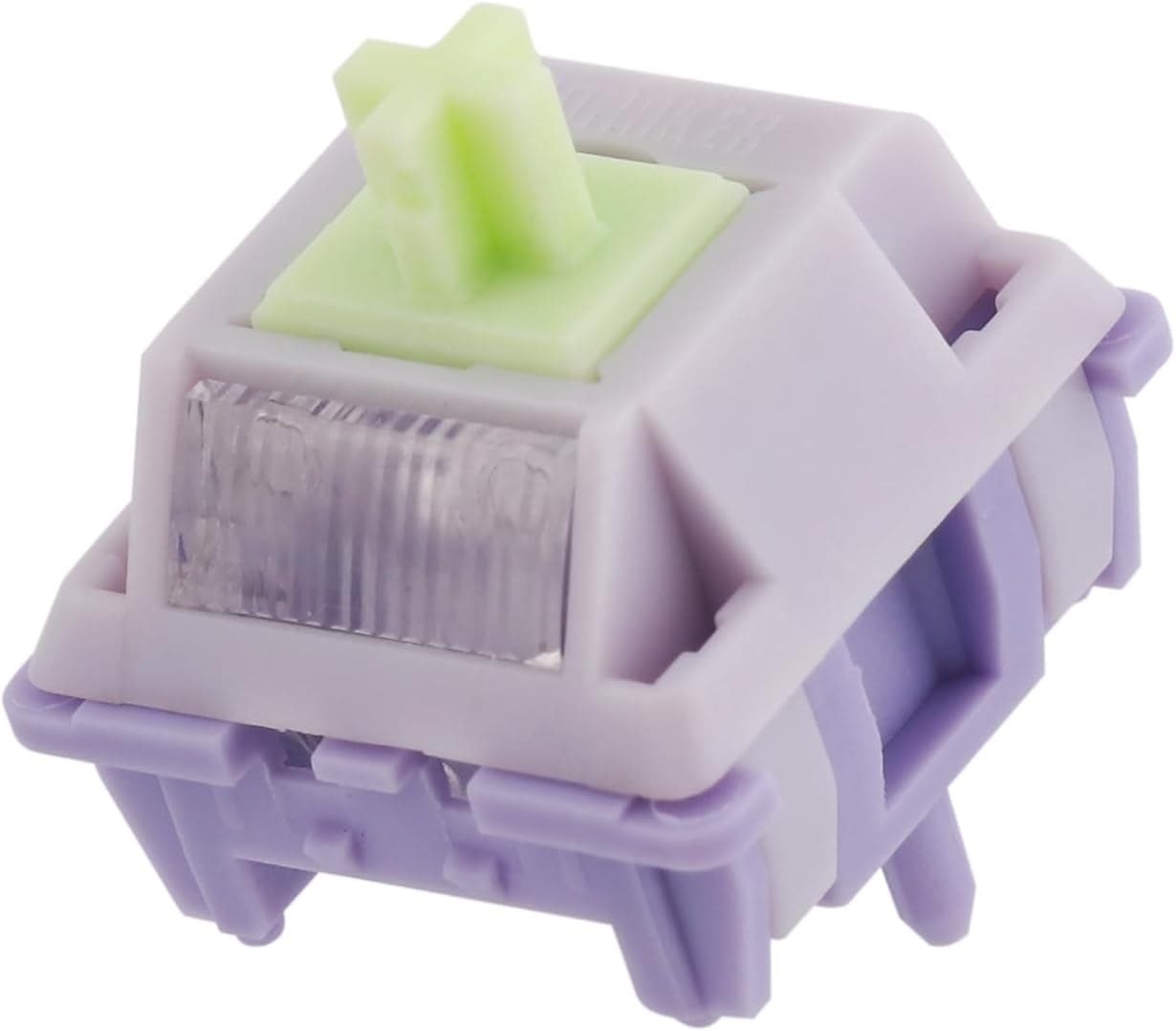
Wisteria V2 is a linear switch with a 38gf actuation force, lubricated at the factory. The stem is a POM+PTFE blend, the housing is PC on top and PA66 on the bottom.
The design goal is a stroke smooth enough that you never need to lube or film it yourself.
The honest summary: this suits people who want the result, not the process. If you enjoy hand-lubing springs and swapping stems, factory lube fixes your starting point — and re-lubing an already-lubed switch is more work than finishing a dry one.
38gf is genuinely light by mechanical switch standards. Common red-style linears are usually rated around 45g, so treat 38gf as the light end of the scale.
That helps over long typing sessions, but it trades against accidental keypresses.
Compatibility Guide
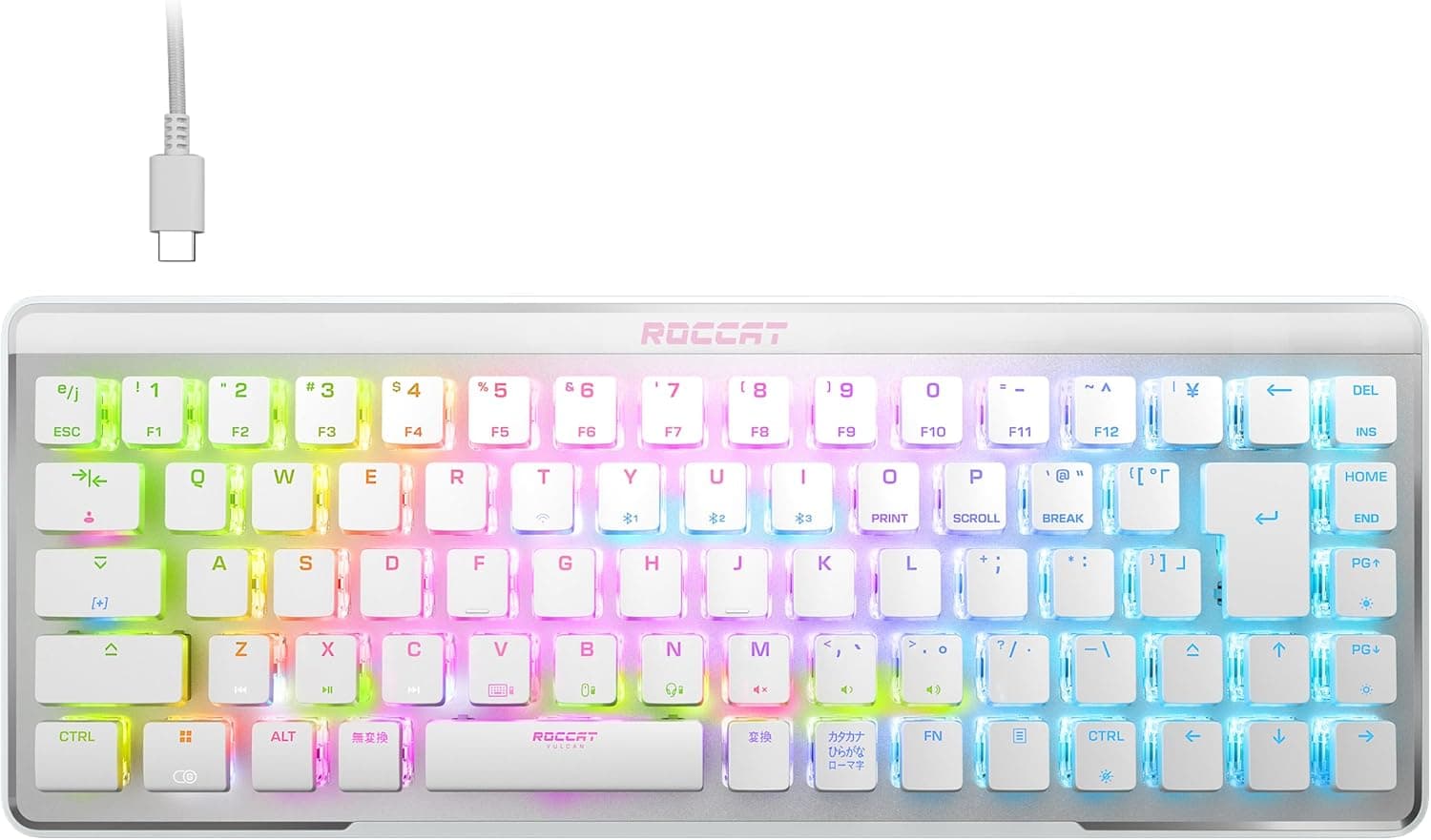
The stated compatibility is MX-style keycaps and 5-pin PCB-mount keyboards, with pins to be clipped for 3-pin boards. Here is what that means in practice.
| Check | This product | Common mistake |
|---|---|---|
| Stem | MX cross stem | Low-profile, Topre, or optical-only keycaps will not fit |
| Pins | 5-pin | On 3-pin boards, clip the two outer plastic legs |
| Mounting | PCB-mount oriented | Fits plate boards fine, but non-hotswap PCBs need soldering |
| LED | Built-in LED slot | Diffuser only helps if your PCB has per-key RGB |
Check first whether your keyboard is hotswap. Switch-swap guides often skip this.
Without hotswap sockets you need a soldering iron and desoldering braid. With them, a switch puller and keycap puller are the only tools required.
A 5-pin switch has two locating legs beside the central stem. Forcing it into a 3-hole socket bends pins and causes dead keys.
Clip the outer legs with flush cutters instead — and test one switch before you cut all 35, because the cut is not reversible.
The light diffuser spreads per-key RGB from the PCB more evenly toward the keycap. That only pays off if your board has RGB LEDs and you use translucent or shine-through caps.
On single-color or unlit boards, the diffuser does effectively nothing. Confirm your board's lighting spec before buying for this feature.
Product Info
Specs: linear switch type, 38gf actuation force, 5 pins, POM+PTFE stem, PC upper and PA66 bottom housing, MX cross-stem keycap compatibility, built-in light diffuser, factory lubrication, 100 million keystroke rated lifespan, 35 pieces per pack.
Price was ¥2,971 on Amazon.co.jp as captured on 2026-09-04.
Prices move, so check the product page for the current figure before ordering; sales and coupons shift the real cost too.
User rating, captured the same day, was 4.7 out of 5 stars across 135 reviews — a 94% favorable score.
135 reviews is a workable sample for a switch set, though switch ratings track personal weight preference closely, so the reasons behind low scores tell you more than the average does.
The 35-piece count is the number to watch. A 60% layout is roughly 61 keys, 65% about 68, TKL about 87, and full-size around 104.
One pack cannot fill any of them. A 60% or 65% build needs two packs; TKL or full-size needs three.
At ¥2,971 per pack as captured, a 65% board costs roughly double the sticker figure. Budget from your key count, not from one pack.
Sound and Feel
Within what the specs support, here is the likely character. PTFE is self-lubricating, so a POM+PTFE stem tends to reduce stem-on-housing scratchiness; combined with factory lube, expect the smoother, creamier end of linear.
PA66 nylon bottom housings are generally associated with a lower, rounder bottom-out sound, while the PC upper adds some brightness. Read that pairing as a tightened bottom-out with the top end left open.
Final sound still depends heavily on case material, plate, and foam — switches alone do not decide it.
The 100-million-keystroke rating is high as a manufacturer figure, but in practice dust ingress and spring fatigue change the feel long before the rated life matters. Treat it as a durability indicator, not a guarantee.
Installation Steps
- Confirm your board is hotswap.
If not, this is a soldering job. 2.
Pull keycaps, then pull switches straight up. Angled pulls damage sockets.
Inspect every switch's pins before insertion; straighten bent pins with tweezers.
On 3-pin boards, clip the outer plastic legs — test with one switch first.
Press in vertically until it clicks home.
Angled insertion is the top cause of dead keys. 6.
Run a key tester on all keys before putting caps back on.
Best Use Cases
- First-time switch swappers — factory lube means no grease, brush, or switch opener needed. At around ¥2,971 as captured in September 2026, a 35-piece pack is a low-commitment way to try a light linear.
- Long-session typists — 38gf is measurably light, so less force per keystroke and less finger strain over a workday of writing or data entry.
- Per-key RGB owners — the built-in diffuser matters when paired with translucent or shine-through keycaps.
- People who want a quieter board — linears have no click mechanism, so they skew quieter than tactile or clicky switches (quieter, not silent).
Things to Know Before Buying
35 pieces will not fill a keyboard. Even a 61-key 60% board needs two packs.
If you assumed one pack builds a board, you will come up short. Count your layout's keys and budget from there.
38gf is not for everyone. If you rest your fingers on the keys or type heavily, expect more accidental inputs.
Lightness trades against accuracy. Buying one pack and trying the main cluster first is a reasonable hedge.
Linear means no feedback bump. There is no tactile event mid-travel, so if you type by feel — or want clear confirmation in games — this will feel vague.
That is preference, not a defect.
Factory lube is rarely perfectly uniform. As a general rule with factory-lubed switches, a few units in a batch can feel slightly scratchy.
Fixing that means opening and re-lubing those pieces. If that work is unacceptable to you, try to test the feel before committing.
The diffuser is environment-dependent. With no RGB LEDs, or with fully opaque doubleshot PBT caps, you get almost nothing from it.
Verify light actually reaches your caps before choosing this switch for lighting.
Verify the listing yourself. This article draws on the Amazon.co.jp listing (ASIN B0CWLGNFK3, captured 2026-09-04).
Marketplace listings occasionally mix in another product's specs or price. Before ordering, confirm from the images and title that you are getting the 38gf, 5-pin, 35-piece version — EPOMAKER tends to offer variants with different weights and pack counts, which makes mix-ups easy.
FAQ
Q. Will these fit my keyboard as-is? A.
Yes if it is hotswap and MX-compatible. On 3-hole sockets, clip the outer legs.
On non-hotswap PCBs you will need to solder.
Q. Is one 35-piece pack enough?
A. No. 60% (~61 keys) and 65% (~68 keys) need two packs; TKL (~87) and full-size (~104) need three.
Q. How light is 38gf? A.
Clearly on the light side — common red-style linears are rated around 45g. Heavy typists will see more accidental presses.
Q. Do I need to add lube?
A. No. They ship lubed and are meant to be used as-is. Re-lube only the occasional piece that feels scratchy.
Q. Are stabilizers included?
A. No. This is switches only. Shift and spacebar feel depends on your board's stabilizers.
Q. Are these silent switches? A.
They skew quieter than clicky or tactile switches, but they have no dedicated silencing mechanism — bottom-out noise remains. For true silence, look at silent-linear switches.
Product Disclosure (Amazon)
- Manufacturer: EPOMAKER
- Seller: Epomaker-JP
- Fulfilled by: Amazon
- ASIN: B0CWLGNFK3
- Note: This article covers a manufacturer-made product based on Amazon listing details.