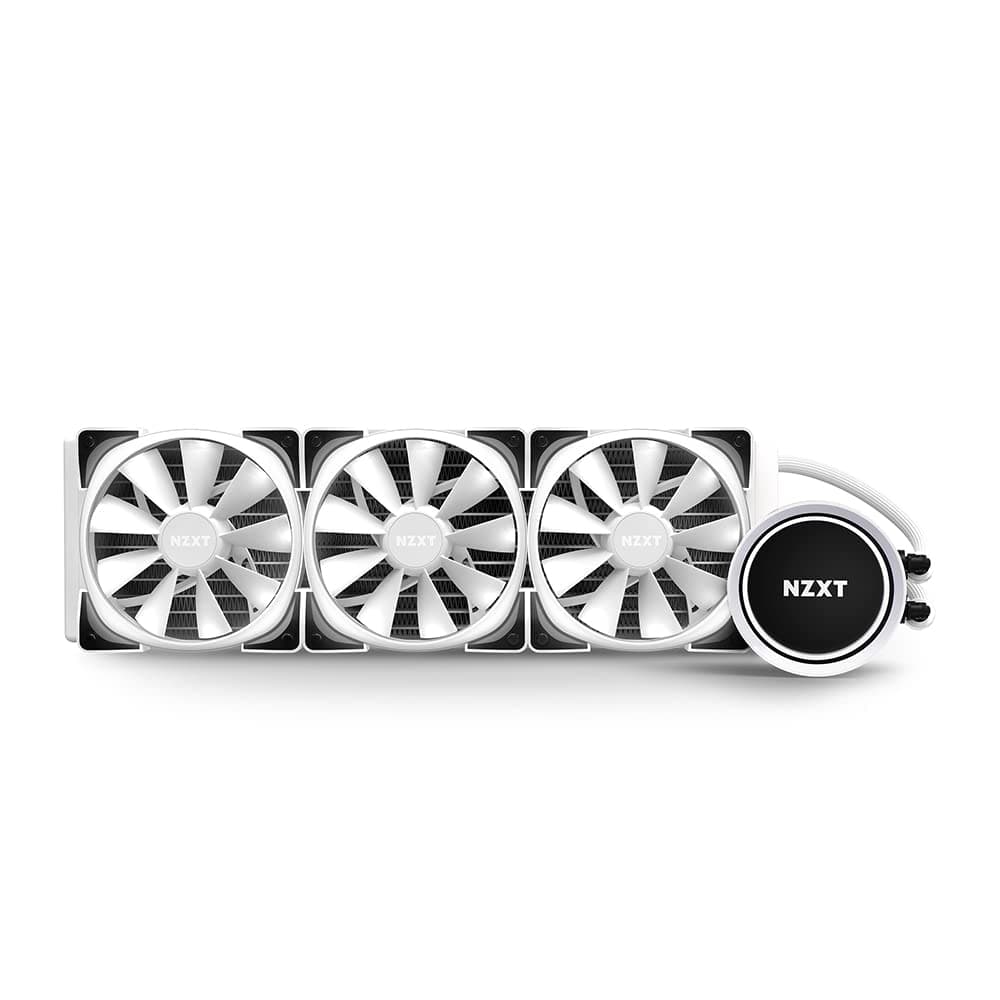
This review covers the NZXT KRAKEN X63 280mm RGB簡易水冷CPUクーラー, a 280mm all-in-one liquid cooler pairing a large radiator with an addressable RGB ring on the pump block. The goal here is practical: which cases it actually fits, what the published numbers mean, and where you should compromise.
Overview
The short answer: this cooler suits mid-tower or larger builds where you want cooling and lighting handled by one part. Published figures are 1500 RPM maximum fan speed, 21 dBA noise, 1.97 kg, and a 6-year warranty.Check the retailer's page for the latest user reviews.
A 280mm radiator assumes two 140mm fans. Compared with a 240mm (2 x 120mm) unit, the extra radiator and fan area lets you move the same heat at lower RPM.
The real benefit is not "it cools more" but "it stays quiet at the same temperature." Treat 21 dBA as a lab figure under specific conditions, not as what your room will sound like.
If you judge purely on cooling per yen, a dual-tower air cooler at a similar price often lands at comparable temperatures. The reasons to pick an AIO are clearance around the memory slots, the look on top of the CPU, and the freedom to exhaust heat straight out of the case — not raw thermal capacity.
Compatibility Guide
Supported sockets are Intel LGA 1700 / 1200 / 115X and AMD AM5 / AM4. The block and radiator are joined by rubber tubing, which routes reasonably freely.
In practice, though, people get caught out by case dimensions rather than sockets.
Check four things. Does the case spec sheet explicitly list 280mm radiator support?
Where is that support — top or front? (Many cases allow only 240mm on top and 280mm at the front.) If mounting on top, is there room above the board for the VRM heatsink and EPS 8-pin?
If mounting at the front, do drive cages or intake fans get in the way?
The spec table lists "280mm (351 x 211 x 160 mm)" — those three figures look like packaged dimensions rather than the bare radiator. Cross-check the actual radiator size against the case maker's support table and the product page.
Planning around box dimensions is how a cooler that would have fit gets ruled out, or vice versa.
Power draw is trivial and does not affect PSU sizing. The listed "5 V / 4.56 W" most likely describes the addressable lighting rather than the pump itself; either way it is not a figure to build a power budget on.
RGB control runs through NZXT CAM, which is Windows software. On Linux or macOS you cannot change lighting patterns or pump curves and the unit runs at its defaults.
HUE 2 connectors allow tying in other RGB parts, but mismatched connector types and voltages (5V ARGB versus 12V RGB) destroy hardware — never force an adapter.
Product Info
All figures below are manufacturer claims, not measured results.
| Item | Value | What it means |
|---|---|---|
| Type | AIO liquid | Has a pump — one more moving part than air |
| Radiator | 280mm | Two 140mm fans; case support is mandatory |
| Max speed | 1500 RPM | Normal ceiling for 140mm; audible at full tilt |
| Noise | 21 dBA | Lab figure under set conditions, not silence |
| Sockets | LGA 1700/1200/115X, AM5/AM4 | Bracket generation varies by batch |
| Connector | 3-pin | Conflicts with the PWM claim; check the plug |
| Weight | 1.97 kg | Mount with the radiator well supported |
| Warranty | 6 years | Long for an AIO; keep proof of purchase |
As captured in May 2026, Amazon listed ¥29,980, the NZXT store (US) $149.99, and an eBay (US) listing $99.99.
All are point-in-time values that move with sales and stock. The Japanese street price sitting above US list reflects currency and import costs plus the pricing swings typical of a product whose successor generation is already shipping.
Check the current price on the product page before buying.
The box includes Intel and AMD mounting kits, fan clips, and thermal compound. The bundled paste means you can build without extra purchases, but keep a tube on hand if you expect to remount later.
How It Compares
Every major brand sells a 280mm AIO, and since performance largely follows radiator area and fans, the class is tightly packed. The real deciding factors are whether the control software matches your ecosystem, whether you like the block's look, and warranty length.
Six years is strong for this price bracket.
If you are torn between 280mm and 360mm, decide based on the case, not the CPU. Plenty of "360mm compatible" cases starve a front-mounted radiator of airflow.
If 280mm fits cleanly, running it with fan headroom is quieter than squeezing in a larger unit.
If you want neither RGB nor software control, a same-price dual-tower air cooler deserves a look. No pump means one fewer failure point and a decade of neglect is fine.
The choice comes down to whether the aesthetics and mounting freedom are worth the premium.
Installation Notes
Keep the pump below the top of the radiator. Top-mounted as exhaust, or front-mounted with the tubes exiting low, keeps air bubbles away from the pump and reduces the risk of rattling later.
Tighten mounting screws diagonally and gradually. That 1.97 kg hangs on the board permanently, so assemble with the case laid flat and stand it up afterwards.
Never substitute longer radiator screws — they puncture the fins and cause leaks.
Best Use Cases
- Mid-tower or larger cases with confirmed 280mm mounting, top or front
- Gaming and content-creation rigs under sustained CPU load that need quiet, not just cold
- Builders standardizing lighting around NZXT's control software
- Anyone avoiding clearance conflicts between a large air cooler and memory or the side panel
- Buyers who place real value on a 6-year warranty
It is not for Mini-ITX or small-form-factor builds, for people who dislike background software, or for buyers optimizing purely for cooling per yen.
Things to Consider
Confirm case clearance first. Cases without 280mm support are common, and compact chassis rarely take one.
If the spec sheet says "up to 240mm," this cooler is out. Five minutes of checking beats a return.
The connector spec is contradictory. The table lists a 3-pin connector while the description mentions PWM control.
3-pin (DC) and 4-pin (PWM) regulate speed differently, and a 3-pin fan left on a PWM-mode header can run flat out permanently. Check the actual plug in the product photos and set the BIOS/UEFI fan mode to match.
Most "it isn't as quiet as advertised" complaints trace back here.
Bracket contents vary by batch. LGA 1700 and AM5 are listed as supported, but long-running products ship in revisions and the box you receive may not include every bracket.
Verify your socket is named on the listing before ordering.
Listing data does not always match the product. Marketplace spec fields get generated or reused automatically; dimensions may reflect packaging, or values from another variant may slip in.
Judge from the product images, title, and the manufacturer's own specification.
A pump is a wear item. Liquid cooling adds a moving part, and over years permeation through the tubing slowly reduces coolant.
Six years of coverage is reassuring, but it means "covered if it fails," not "will not fail." Keep your receipt.
Also note that with a flagship CPU pinned at full load, a 280mm unit will hit a ceiling — revisiting power limits pays off more than upsizing the cooler.
FAQ
Q. How do I know it fits my case? A.
Look for explicit 280mm radiator support in the case spec sheet, and note whether that is the top or front. Do not plan around the three dimensions in the spec table — those appear to include packaging.
Q. Does it work on LGA 1700 or AM5 out of the box? A.
Both are listed as supported, but bracket contents can differ between production batches. Confirm the socket is stated on the listing you are buying from.
Q. What happens if I skip CAM? A.
Cooling still works, but you lose granular control over lighting and pump/fan behavior. CAM is Windows software, so other operating systems run the defaults.
Q. Air or liquid? A.
At the same price, absolute temperatures are often close to a dual-tower air cooler. Choose the AIO for memory and side-panel clearance, the look above the CPU, and venting heat directly out of the case.
Q. Is 21 dBA really silent? A.
No. It is a lab figure under set conditions.
Real perceived noise depends on your fan curve — the advantage of 280mm is how much of the low-RPM range you can live in.
Q. Which price should I trust? A.
Every figure here was captured in May 2026. AIO pricing swings with stock and promotions, so check the product page for the current number.