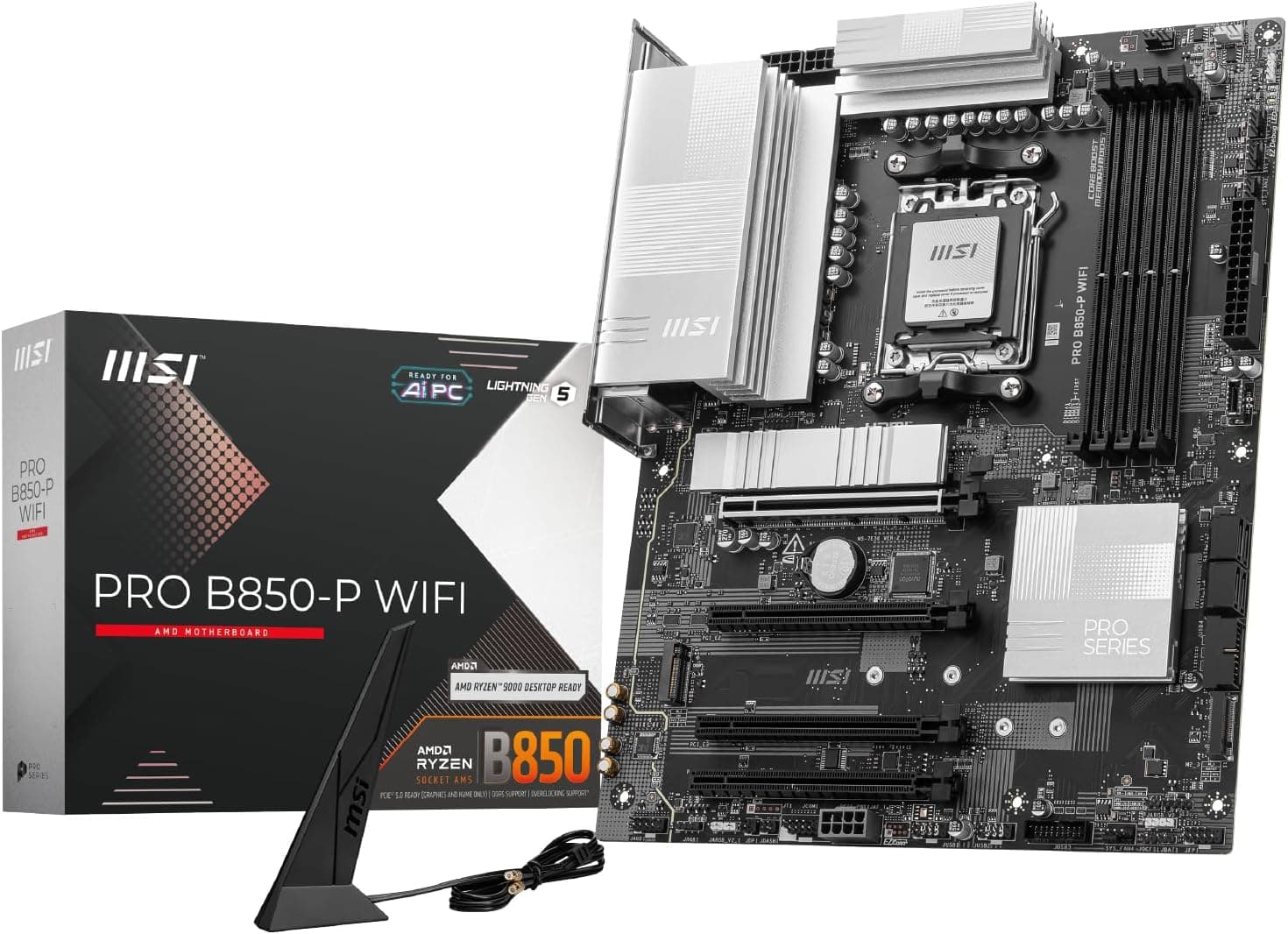
This article covers MSI PRO B850-P WIFI ATXマザーボード MB6693.
Overview
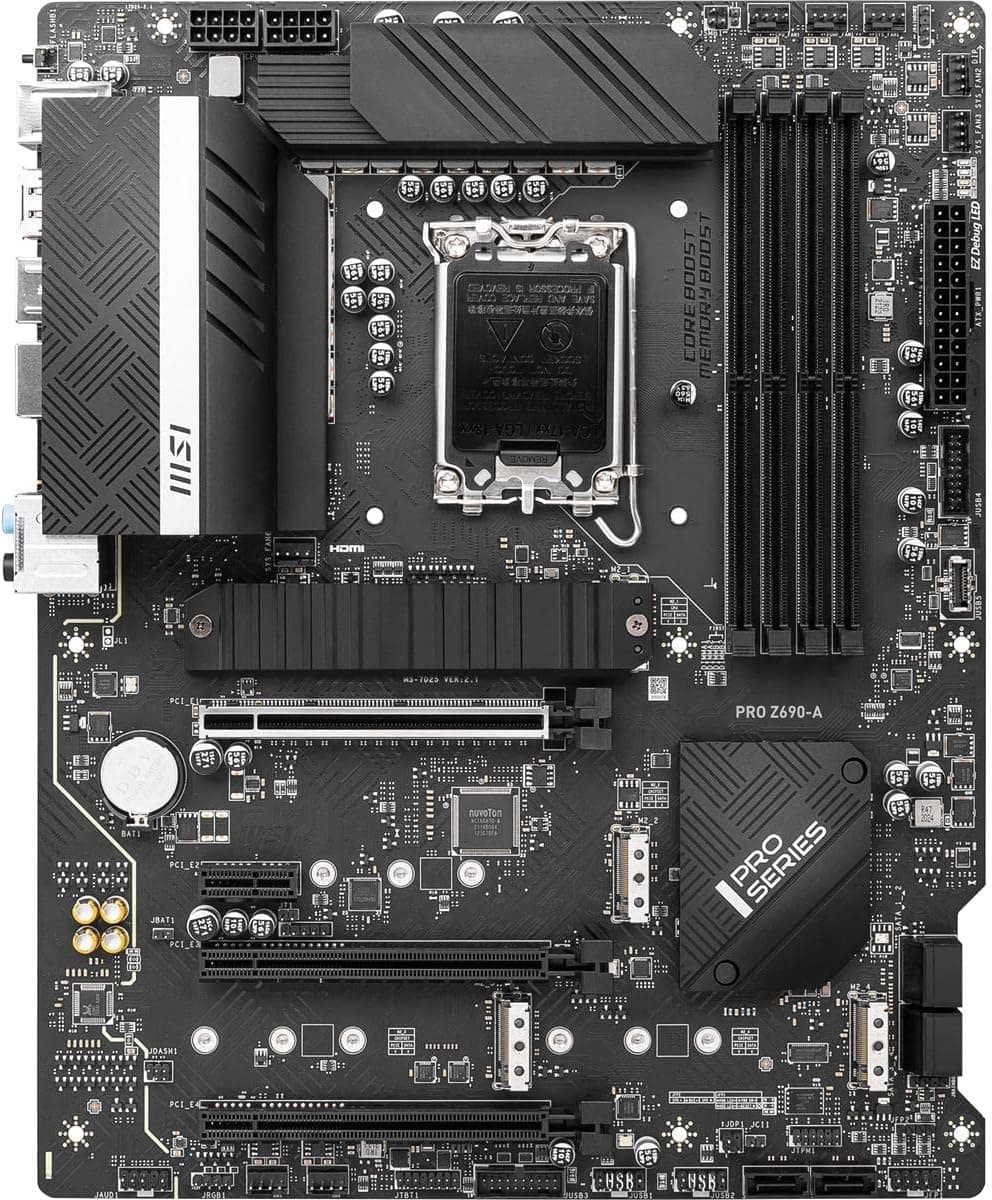
MSI's PRO series expands with the PRO B850-P WIFI, an ATX motherboard built around the AMD B850 chipset. It supports Socket AM5 processors including Ryzen 9000, 8000, and 7000 series, and pairs them with DDR5 memory for a modern, high-performance platform. The standout feature is its silver-white heatsink design, which gives the board a clean, minimalist look that fits well in white-themed builds. Under the hood, a 12-phase DRPS VRM and an extended heatsink reaching the rear I/O ensure stable power delivery even for Ryzen 9-class CPUs. Positioned in the mid-range segment, the PRO B850-P WIFI offers PCIe 5.0 support, Wi-Fi 7, and ample USB connectivity—enough for most gamers and creators without stepping up to the more expensive X870 series.
Compatibility Guide
CPU socket is AM5, compatible with AMD Ryzen 9000 (Granite Ridge), 8000 (Phoenix), and 7000 (Raphael) series processors. Memory is DDR5 only—no DDR4 support. Four DIMM slots support up to 192GB with speeds up to DDR5-8200+(OC). The board uses the standard ATX form factor, fitting most mid-tower and full-tower cases. Power connectors include a 24-pin ATX main, an 8-pin EPS, and a 4-pin EPS. For high-end CPUs, connecting both EPS headers is recommended. Storage options: three M.2 slots—one PCIe 5.0 x4 (primary), one PCIe 4.0 x4, and one PCIe 4.0 x2—plus four SATA 6Gbps ports. Expansion slots: one PCIe 5.0 x16, one PCIe 4.0 x16 (x4 electrical), and two PCIe 3.0 x1.
Product Info
Released in late 2024, the MSI PRO B850-P WIFI carries a 3-year manufacturer warranty in Japan. Pricing sits around ¥25,000–¥30,000, which is typical for a B850 board with this feature set. Key specs: AMD B850 chipset, 12-phase DRPS VRM, DDR5-8200+(OC) memory support, 5GbE LAN, Wi-Fi 7 with Bluetooth 5.4, 7.1ch HD Audio. Rear I/O includes two USB 3.2 Gen 2 Type-C ports, one USB 3.2 Gen 2 Type-A, one USB 3.2 Gen 1 Type-A, and four USB 2.0. Front panel headers provide one USB 3.2 Gen 1 Type-C, four USB 3.2 Gen 1 Type-A, and four USB 2.0. Market positioning: mid-range. It lacks USB4 and has fewer chipset PCIe lanes than X870/X870E, but offers excellent value for single-GPU gaming and general productivity builds.
Best Use Cases
Mid-to-high-end gaming PC with Ryzen 9000/7000 PCIe 5.0 support means no bottleneck with RTX 4070-class or higher GPUs. DDR5 memory and solid VRM make it a great foundation for 1440p or 4K gaming. Not ideal for multi-GPU setups or those needing USB4. White-themed PC build The silver-white heatsinks complement white cases and white graphics cards beautifully. The clean design appeals to builders who prefer a subtle, non-RGB look. If you want a black board, consider MSI's PRO B650 black models. Early adopter of Wi-Fi 7 Built-in Wi-Fi 7 (802.11be) supports up to 5.8Gbps with a compatible router. The 5GbE LAN port is also great for fast NAS transfers. Note that Wi-Fi 7 routers are still expensive, so Wi-Fi 6E may suffice for now. Stable workstation for content creation The robust 12-phase VRM and large heatsink keep the system stable during long renders or encodes. ECC memory is not supported, but for typical creative workloads (video editing, 3D modeling), this board is more than capable. For mission-critical ECC or IPMI, look at WRX90/Threadripper platforms.
Things to Consider
Compared to X870/X870E boards, the B850 chipset offers fewer PCIe lanes and lacks USB4. If you plan to run multiple NVMe SSDs at full speed or need USB4 for high-speed external storage, step up to an X870E board. DDR5 overclocking stability depends on the CPU's memory controller and the memory kit itself. While the board officially supports DDR5-8200+(OC), reaching those speeds reliably may require careful tuning. Always check the QVL list before buying high-speed memory. The third M.2 slot runs at PCIe 4.0 x2, halving the bandwidth. Use the first (PCIe 5.0) or second (PCIe 4.0 x4) slot for your primary SSD to avoid performance bottlenecks. ## FAQ
Q: Is this motherboard overkill for a Ryzen 5 7600? A: Not at all. The Ryzen 5 7600 is a 65W CPU, and the 12-phase VRM handles it with ease. The board leaves plenty of headroom for a future upgrade to a Ryzen 9 9950X, making it a good long-term investment. Q: Do I need a PCIe 5.0 graphics card? A: No. Current GPUs like the RTX 40-series and RX 7000-series use PCIe 4.0 x16, and there's no real gaming benefit from PCIe 5.0 yet. However, having a PCIe 5.0 slot future-proofs your build for next-gen GPUs. Q: Does the board come with M.2 screws? A: It uses MSI's EZ M.2 Clip II tool-less design. No screws are needed; the package includes three clips and a remover. Just snap the SSD into place.
Product Disclosure (Amazon)
- Manufacturer: MSI
- Seller: Amazon.co.jp
- Fulfilled by: Amazon.co.jp
- ASIN: B0BVWB869H
- Note: This article covers a manufacturer-made product based on Amazon listing details.