Overview
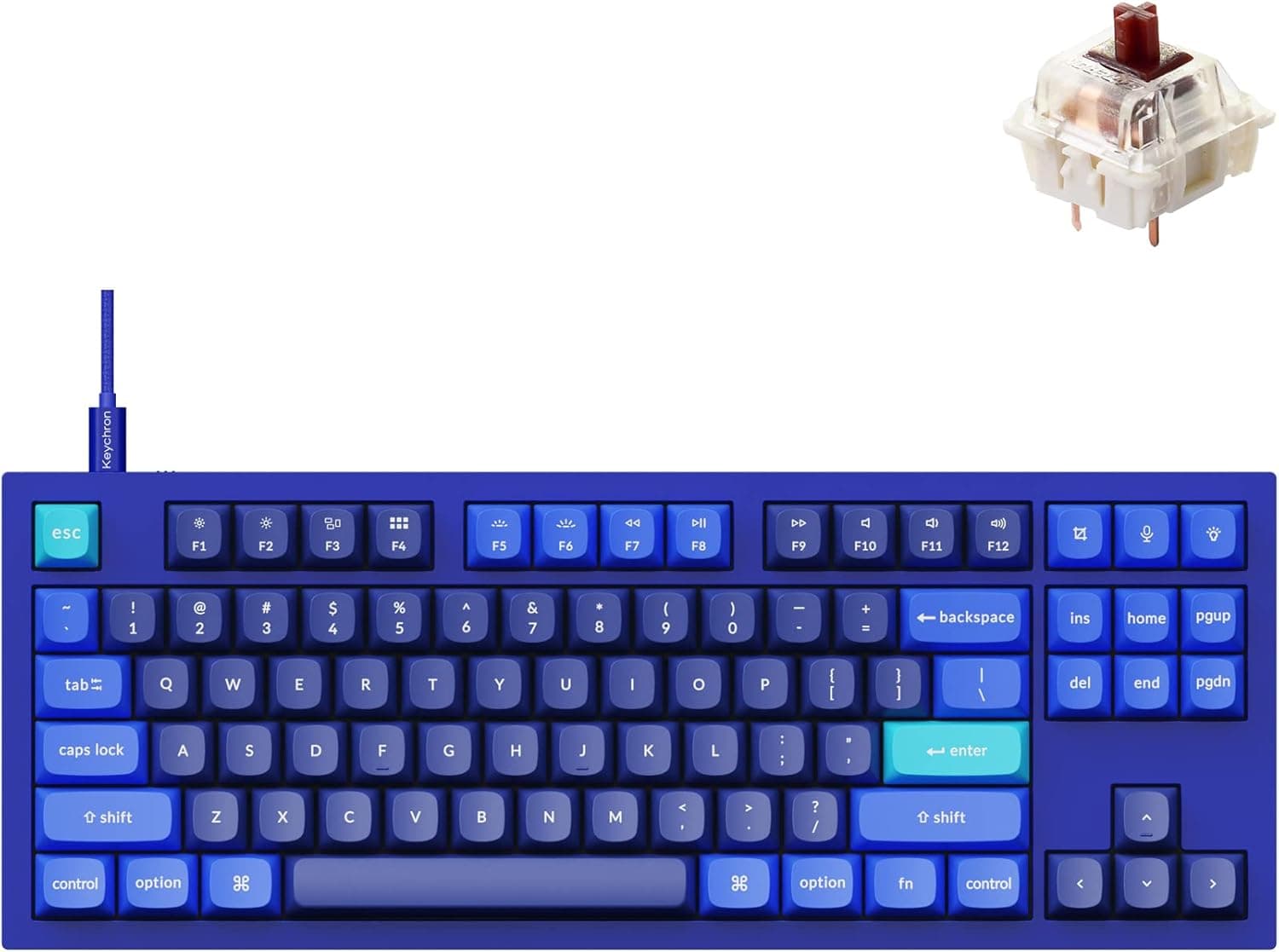
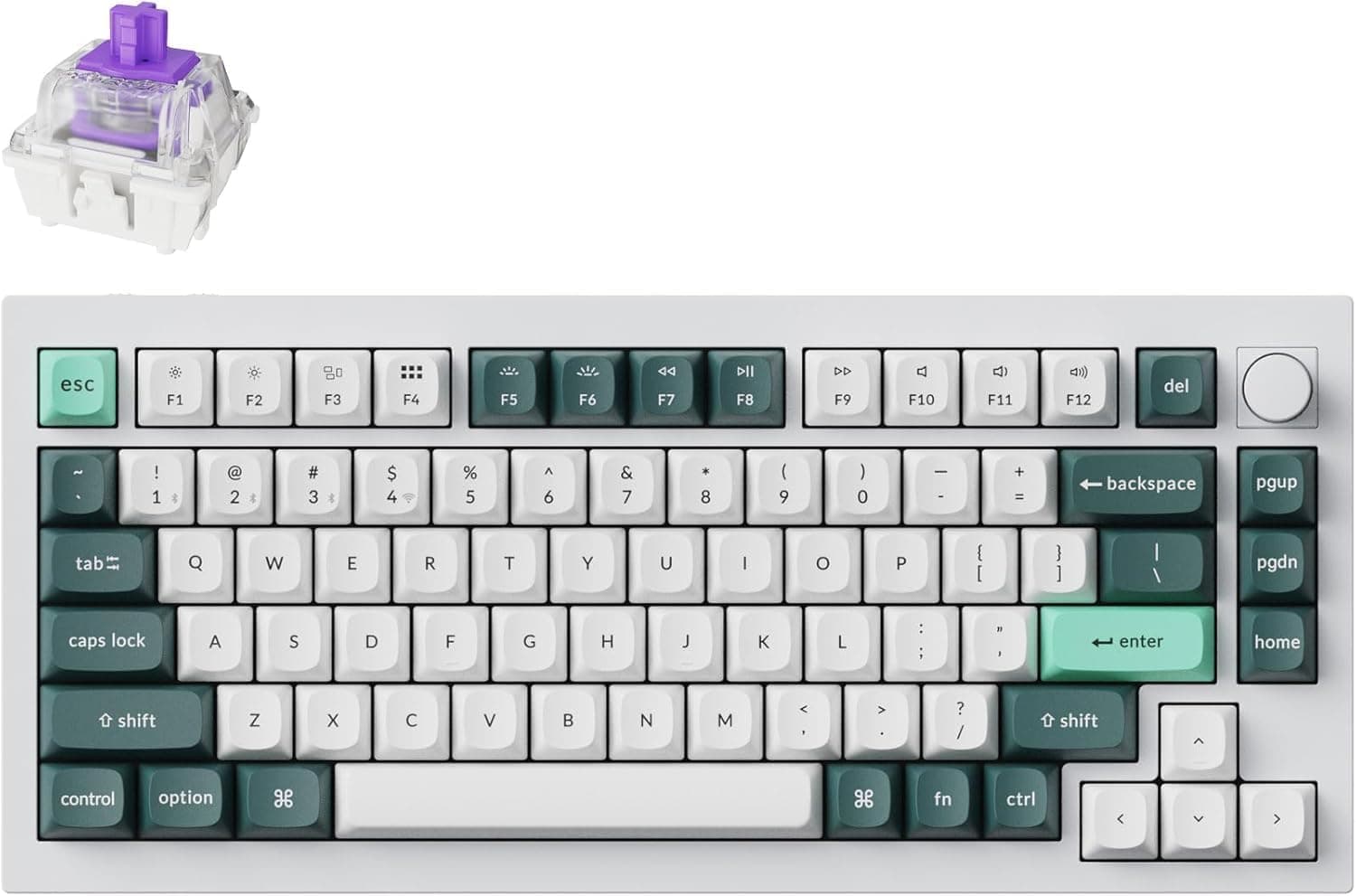
The Keychron Q1 HE is a 75% (81-key) wireless custom keyboard built around Gateron double-rail magnetic (Hall effect) switches. The short version: it targets people who want rapid trigger but refuse to give up the feel of a proper metal keyboard.
Where most Hall effect boards are lightweight plastic wired units, this one uses a full aluminum body with a double-gasket mount and supports three connection modes — USB-C wired, 2.4GHz, and Bluetooth.
Because the switches read magnetic field changes rather than physical contacts, travel is measured continuously. The specified actuation range is 0.2–3.8mm, adjustable in 0.1mm steps, and the 2.4GHz link is rated at a 1000Hz polling rate.
On Amazon.co.jp, as captured on June 2, 2026, the listing showed 27 reviews at 4.1 out of 5 stars (roughly 82% positive) — a small sample, but a consistent one.
What Hall Effect Switches Actually Change
A conventional mechanical switch is binary: press past a fixed point and it registers. A magnetic switch reports depth as a number, which enables two things:
- Free actuation point selection. Anywhere from 0.2mm to 3.8mm in 0.1mm increments. Shallow settings register the instant you touch a key; deeper settings resist accidental inputs.
- Rapid trigger. The key releases the moment you lift slightly and re-fires as soon as you push back down, without needing a full return. This matters most for counter-strafing in FPS titles.
Neither feature is universally good. The shallower you go, the more phantom inputs you get from simply resting your fingers.
The practical approach is separate profiles for gaming and typing.
Compatibility Guide
Windows, macOS, and Linux are supported, with customization handled through the Keychron Launcher app. The points most likely to trip you up:
| Item | Spec | Why it matters |
|---|---|---|
| Layout | US (ANSI), 75% / 81 keys | Not a JIS layout |
| Dimensions | 328 × 145 × 50 mm | 50mm tall — very thick for a keyboard |
| Connection | USB-C / 2.4GHz / Bluetooth | 2.4GHz needs the dongle; don't lose it |
| Keycaps | PBT | Replacements must fit a 75% layout |
| Hot-swap | Yes | Treat it as magnetic switches only |
| Mount | Double gasket | Sound and feel depend on gasket firmness |
The most overlooked spec is the 50mm height. Even with a typing angle, your wrists sit high, so plan on a palm rest from day one rather than discovering the need later.
The layout is the real decision point for anyone coming from a JIS keyboard: symbol positions move, and there are no dedicated IME toggle keys, so input switching has to be remapped or handled by a utility.
Hot-swap deserves a caveat too. The sockets are designed for magnetic switches; standard MX-compatible mechanical switches should not be expected to work.
If you are buying on the assumption that your existing switch collection carries over, that assumption is wrong.
The firmware is described as QMK-based, but HE-model configuration is centered on Keychron Launcher. If you are counting on porting an existing VIA/QMK configuration, verify current support on the product page before buying.
Product Info
| Item | Value |
|---|---|
| Switch | Gateron double-rail magnetic (Hall effect) |
| Actuation range | 0.2–3.8mm (0.1mm steps) |
| Polling rate | 1000Hz (2.4GHz) |
| Connection | USB-C / 2.4GHz / Bluetooth |
| Dimensions | 328 × 145 × 50 mm |
| Keycap material | PBT |
| Backlight | RGB |
| Layout | US (ANSI), 75% (81 keys) |
| Hot-swappable | Yes |
| Mount type | Double gasket |
On pricing: Amazon.co.jp showed ¥40,491 as captured on June 2, 2026.
Read that as a snapshot, not a current price — stock and sales move it constantly. An eBay US listing showed $180.00 as captured on July 15, 2026, but parallel imports carry different warranty terms, so price alone is a poor comparison.
We also found a figure recorded against this listing that is an order of magnitude below what this product class costs. That almost certainly reflects a different variant, a barebones configuration, or a mis-scraped item, so it is not quoted here.
Always confirm on the page that the price shown matches the variant you have selected.
Review data, as of June 2, 2026: 27 reviews, 4.1 out of 5 (about 82% positive).
With only 27 ratings, one or two poor scores move the average — read the review text about layout, weight, and app usability rather than trusting the star count.
How It Compares
Hall effect keyboards now span roughly ¥10,000 to ¥40,000. Positioning this one:
- Cheapest path to magnetic switches — plenty of plastic-bodied wired 75% boards deliver the same rapid trigger behavior.
- Paying for feel and build — the aluminum case plus gasket mount is what the premium buys. That is the reason to pick this board.
- Chasing raw latency numbers — wired-only models advertising 8kHz polling exist. 1000Hz is plenty in practice, but it is not the headline number.
This is a both-worlds product, not a spec-sheet champion.
Best Use Cases
- FPS and action players who benefit directly from rapid trigger and fine actuation tuning.
- People who game and type long hours on one board — profiles let you run deep actuation for writing and shallow for play.
- Users already comfortable with US (ANSI) — this is a prerequisite, not a preference.
- Buyers who care about desk aesthetics and rigidity — a 328 × 145 × 50mm aluminum slab is a stationary tool.
- Mac and Windows switchers who want one keyboard across machines.
Before You Buy
1. It is a US (ANSI) board. Coming from JIS means relearning symbol positions and rebuilding your IME toggle.
Consider this first if it is a work keyboard.
2. It is not portable. Wireless here means fewer cables, not a travel board.
At 50mm tall in aluminum, a palm rest is effectively mandatory.
3. Do not overestimate hot-swap. Your existing MX mechanical switches will not carry over. Replacement means other magnetic switches.
4. Do not set actuation too shallow. 0.2mm is a catalog minimum, not a recommendation.
Start near 1.5mm and tighten only until phantom inputs appear.
5. Rapid trigger is restricted in some competitive contexts. If you compete, check the ruleset for your title or league beforehand.
6. Verify the listing yourself. Variants (switch choice, knob, barebones vs.
assembled) change both contents and price, and we saw an implausibly low figure recorded against this listing. Match the product images, title, and selected variant before ordering.
7. Check warranty and seller. Domestic authorized stock and parallel imports differ in support and warranty handling.
FAQ
Q. Is rapid trigger genuinely noticeable? A.
In FPS titles with constant direction changes, yes. In MMOs, RTS, or single-player action, much less so — there the aluminum build and typing feel become the real reasons to buy.
Q. Is there a Japanese layout version? A.
The configuration covered here is US (ANSI). Availability of other layouts varies by batch; check the product page.
Q. Can I install my own mechanical switches? A.
Assume no. The board detects magnetic field changes, so only comparable magnetic switches apply.
Q. Does it work fully on Mac? A.
Windows, macOS, and Linux are supported, with customization via Keychron Launcher. Confirm included Mac keycaps and modifier arrangements on the product page.
Q. Bluetooth or 2.4GHz?
A. Use 2.4GHz (1000Hz) for gaming. Treat Bluetooth as the multi-device and no-dongle option.
Q. How quiet is it? A.
The double-gasket mount and PBT caps generally sound more subdued than a plastic gaming board, but aluminum is not silent. For a genuinely quiet office board, look at silence-focused models.
Product Disclosure (Amazon)
- Manufacturer: Keychron
- Seller: EM-IRVINE
- Fulfilled by: Amazon
- ASIN: B0DCGK6FNQ
- Note: This article covers a manufacturer-made product based on Amazon listing details.