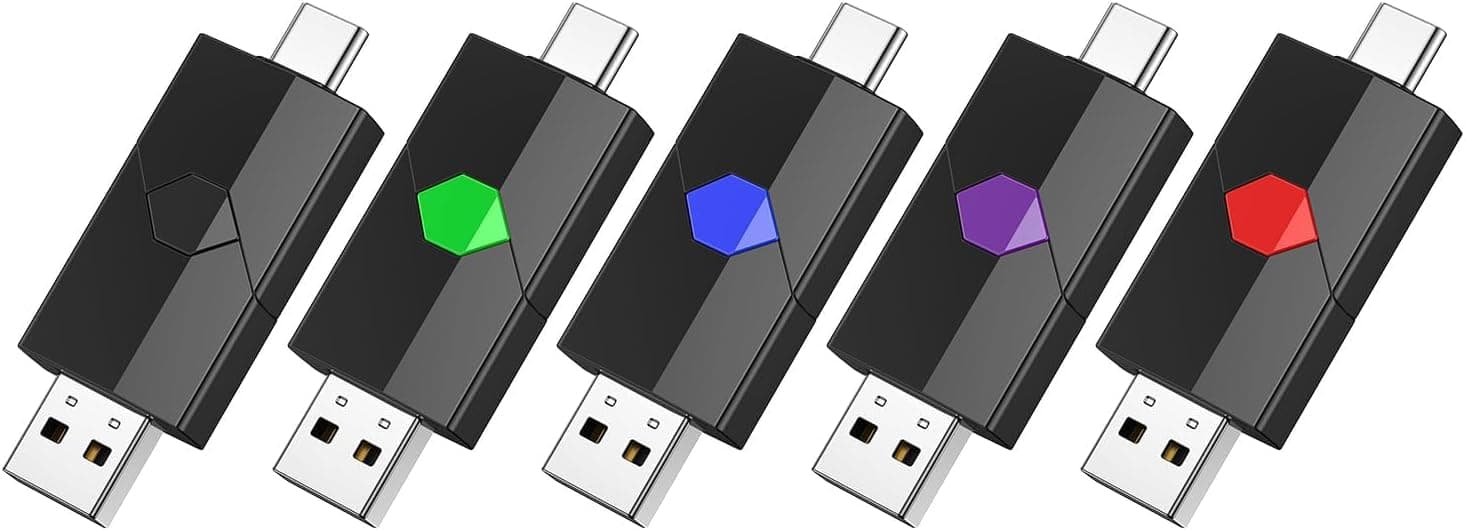
The darkFlash 1GB USB 2.0 flash drive with Type-C/OTG adapter — listed on Japanese storefronts as 1GB USBフラッシュドライブメモリースティックサムドライブペンジャンプドライブ Uディスク Type-C — pairs an unusually small 1GB capacity with a bundled Type-C/OTG adapter and a capless rotating clip.
This article looks at where that tiny capacity is an advantage and who should stay away. The short answer: it is a poor general-purpose flash drive, but a genuinely handy tool if you have one specific job for it.
Overview
The drive uses a USB 2.0 interface with rated speeds of 15-20 MB/s read and 7-9 MB/s write.
Capacity is listed as 1GB with roughly 950MB actually usable — the familiar gap between decimal gigabytes used on packaging and the binary gigabytes your OS reports. That shortfall is normal, not a defect, so do not panic when the formatted size looks smaller than advertised.
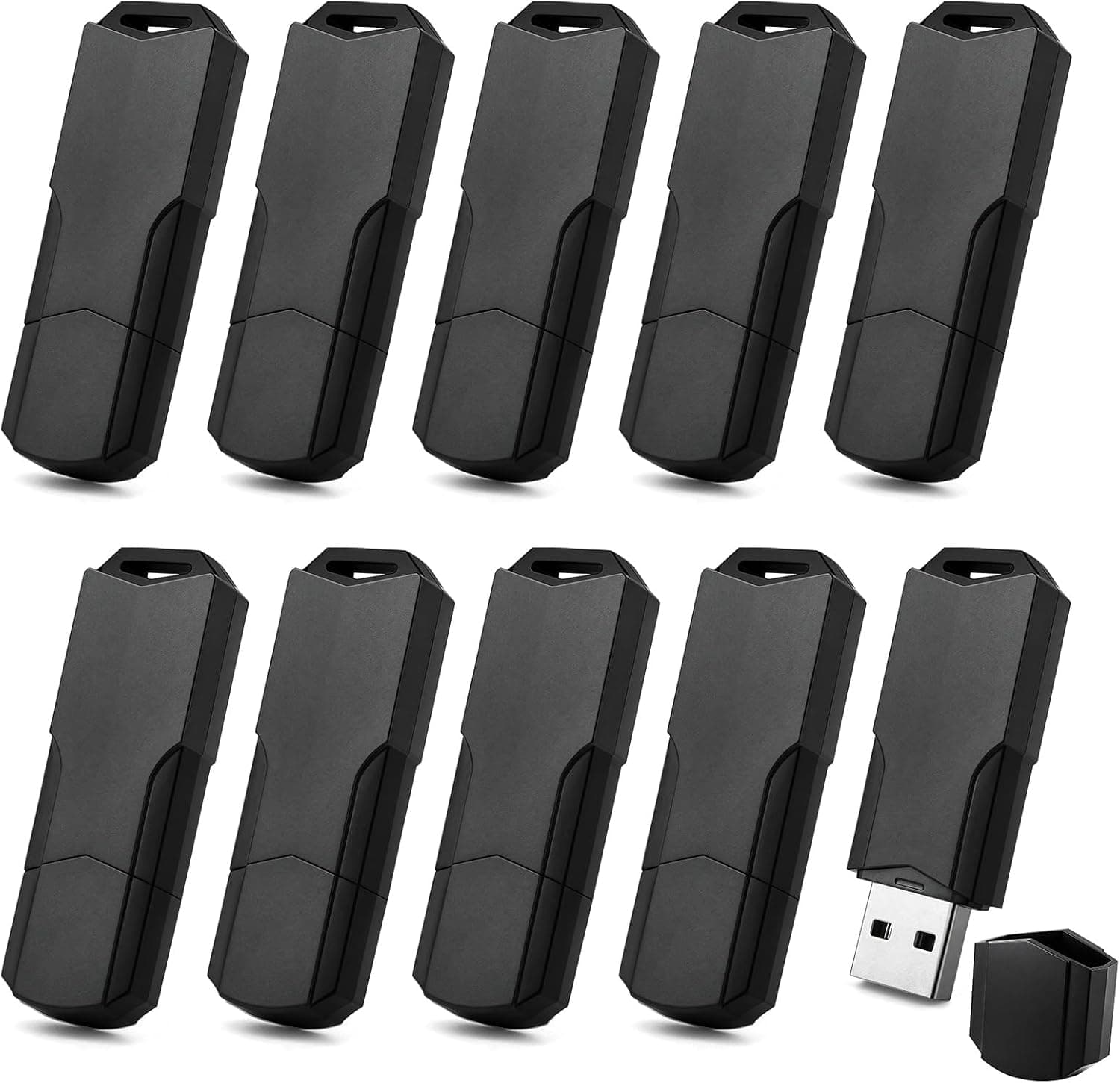
The body is capless: a 360-degree aluminium clip rotates around to cover the connector, so there is no cap to lose. An LED indicator shows activity, and the drive is plug-and-play with no driver installation.
Construction is ABS plastic with an aluminium clip, and the manufacturer warranty is one year.
As of the 8 July 2026 capture, the Amazon.co.Check the retailer's page for the latest user reviews.
That reads well, but seven reviews is far too small a sample to tell you anything about defect rates or long-term endurance. Judge this drive on fit for purpose, not on its star rating.
Quick Verdict by Use Case
| Use case | Verdict | Why |
|---|---|---|
| Motherboard BIOS/UEFI update media | Excellent | Many boards demand FAT32, and small drives are recognised most reliably |
| memtest or a lightweight Linux boot disk | Good | Images in the tens-to-hundreds of MB range fit |
| Handing over documents, PDFs, a few photos | Good | The OTG adapter plugs straight into a phone |
| Playback on car audio and older gear | Good | Devices that choke on large drives usually accept this one |
| Carrying photos and video | No | ~950MB usable is not enough |
| Creating Windows install media | No | Microsoft requires an 8GB or larger drive |
| Day-to-day backups | No | Short on capacity, speed and redundancy |
The pattern is clear: the value here is not speed or capacity but the smallness itself. Legacy hardware and firmware updaters often accept a 1GB stick where a 128GB high-speed drive fails outright.
Outside those cases, the small capacity is pure downside and your money goes further elsewhere.
Compatibility Guide
Connection is USB 2.0 with USB 1.1 backward compatibility.
The normal use is plugging it directly into a USB-A port; it works in blue USB 3.x ports too, but the speed stays within USB 2.0 limits.
Treat the rated 15-20 MB/s read and 7-9 MB/s write as an order of magnitude slower than current USB 3.x drives.
Fitting the bundled Type-C/OTG adapter lets you connect to USB-C phones, tablets and MacBooks. On Android the handset must support USB host (OTG) mode, and you may need a file manager app to move files.
USB-C iPads and iPhone 15 or later can browse the drive through the Files app, though behaviour varies by device and OS version — check your own hardware before buying. Lightning-era iPhones and iPads cannot connect at all; those need an MFi-certified Lightning drive instead.
Supported operating systems are listed as Windows 2000/XP/ME/Vista/7/8/8.1/10/11, Linux, and macOS 10.3 or later.
The listing suggests NTFS for older systems, but for a 1GB drive FAT32 (or FAT16) is the safer choice in practice. macOS cannot write to NTFS out of the box, BIOS updaters and car head units frequently read FAT32 only, and FAT32's 4GB per-file ceiling is irrelevant on a drive this size.
Physically, the OTG adapter adds length. A thick phone case can stop the adapter seating fully, and on laptops with closely spaced ports the rotating clip may overlap its neighbour.
The drive also draws power from the host, so leaving it connected to a phone for long stretches costs battery.
Product Details
| Item | Value |
|---|---|
| Capacity | 1GB (approx. 950MB usable) |
| Interface | USB 2.0 (USB 1.1 compatible) |
| Read speed | 15-20 MB/s |
| Write speed | 7-9 MB/s |
| Design | Capless rotating aluminium clip |
| Body material | ABS plastic with aluminium clip |
| LED indicator | Yes |
| Included | Type-C/OTG adapter |
| Warranty | 1 year |
Check the retailer's page for the latest price.co.jp.
The eBay entry captured on 8 July 2026 returned only "See listing" with no figure attached. Flash drive prices move constantly as stock and sellers rotate, so always check the product page for the current price before ordering.
Divide that figure by capacity and you get roughly ¥2,960 per gigabyte, against multi-gigabyte USB 3.x drives selling in the same bracket.
This is not a drive you buy on value per gigabyte. The reasons to choose it are narrow and specific: you need small capacity and FAT32, you want a capless body that survives a keyring, and you want the Type-C/OTG adapter in the box.
A 2024-ish launch is inferred from availability rather than any published date, so treat that as a guess.
How It Compares
At this price you could instead buy a USB 3.2 Gen 1 drive in the 16GB to 128GB range, with an order-of-magnitude advantage in both speed and capacity.
If you simply want "a USB stick", buy that. This drive only enters the conversation when you are deliberately hunting for small capacity to satisfy legacy hardware or a firmware updater.
Capless rotating designs are common across brands, so that is not a differentiator. The bundled adapter is — but it cuts both ways, because an adapter is one more small thing to lose.
Dual-connector drives with Type-A on one end and Type-C on the other remove that risk entirely. If phone use is your main scenario, an integrated dual-connector drive is the more practical everyday choice.
Who It's For
Builders and repair techs who flash firmware. BIOS/UEFI update utilities commonly demand a small FAT32 drive and reject large ones.
Keeping one stick permanently assigned to that job is exactly what this capacity suits.
People who build lightweight boot media. memtest, partition tools and small Linux images fit comfortably inside 950MB.
Modern mainstream desktop Linux ISOs run to several gigabytes, however, so check the image size first.
Anyone feeding files to older equipment. Car audio units, digital pianos, older TVs and printers frequently refuse large drives.
Small capacity plus FAT32 is the most widely accepted combination there.
One-off document handoffs. With the OTG adapter you can export a PDF straight from a phone for a print shop or a client.
It is a bad fit for photo libraries, video, project files, backups, or anyone who cares about transfer speed.
Before You Buy
Cost per gigabyte is the headline problem. At the ¥2,960 captured on 26 August 2026, this is not a cheap spare stick.
If your reason for buying is anything other than "I specifically need a small drive", buy capacity instead.
The listing metadata does not line up. Brand naming varies between pages, and the ASIN shown in the Amazon disclosure does not match the ASIN of the page the price came from; seller and fulfilment are registered overseas.
Mismatched listing data is common on marketplaces but it is also how people end up with the wrong item. Before ordering, confirm the product image, the title, and that the Type-C/OTG adapter is listed as included.
Some media simply cannot be made. Windows 10/11 installation media needs an 8GB or larger drive, and current mainstream desktop Linux ISOs will not fit either.
Check your target image size before committing.
The speed is noticeable. At 7-9 MB/s write, filling 950MB takes around two minutes, and far longer with many small files.
Never pull the drive while the LED is blinking — always eject it properly, since interrupting a write can destroy the file system, not just the file.
Do not rely on it as your only backup. Flash media is not a long-term archival format.
Keep important data on your PC or in the cloud as well and treat this as transport only. There is no hardware encryption either, so use your OS encryption tools if the files are sensitive.
Mind the adapter. The Type-C/OTG adapter is tiny and easy to misplace once detached.
Decide where it lives — ideally attached to the drive in a pouch. The warranty runs one year, so test for defects soon after delivery.
FAQ
Q. How much actually fits in 1GB? A.
About 950MB. At roughly 3-6MB per phone photo that is something like 150-300 images, or several hundred to a few thousand PDFs and office documents.
A single video can consume the whole drive.
Q. Does it work with an iPhone or iPad? A.
USB-C iPads and iPhone 15 or later can use it through the bundled adapter and the Files app, though behaviour varies by device and OS version. Lightning-era devices cannot connect and need an MFi-certified drive.
Q. Which file system should I use? A.
FAT32 when in doubt. It reads and writes on Windows, macOS and Linux, and suits BIOS updaters and car audio units that accept nothing else.
NTFS is awkward because macOS cannot write to it by default.
Q. How long do transfers take? A.
From the rated 7-9 MB/s write speed, filling 950MB takes roughly two minutes, and longer with lots of small files.
Q. Can I use it in a USB 3.0 port?
A. Yes, but it stays at USB 2.0 speeds. A faster port does not make the drive faster.
Product Disclosure (Amazon)
- Manufacturer: darkFlash
- Seller: Amazon US
- Fulfilled by: Amazon US
- ASIN: B0GSYXL8X4
- Note: This article covers a manufacturer-made product based on Amazon listing details.