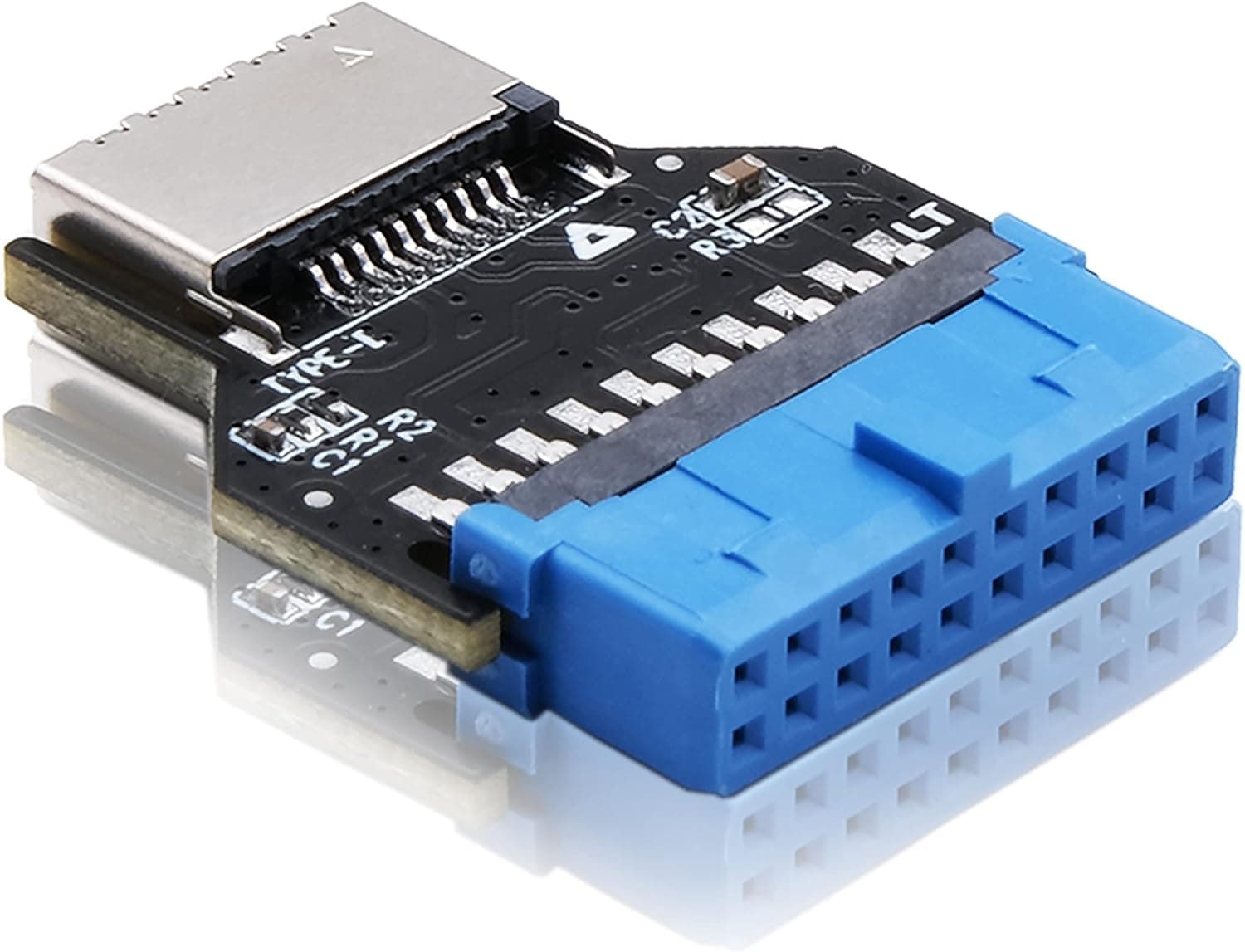
This article takes a close look at the 10Gtek PCIE 3.0 延長ケーブル 4X to 4X オス-メス 90° to 90° エクステンダーライザーケーブル 干渉防止EMI シールド 15cm.
The short version: this is a part for rerouting x4-class expansion cards inside a cramped chassis. It is not a x16 GPU riser, and confusing the two is the single most common way people waste money on it.
Overview
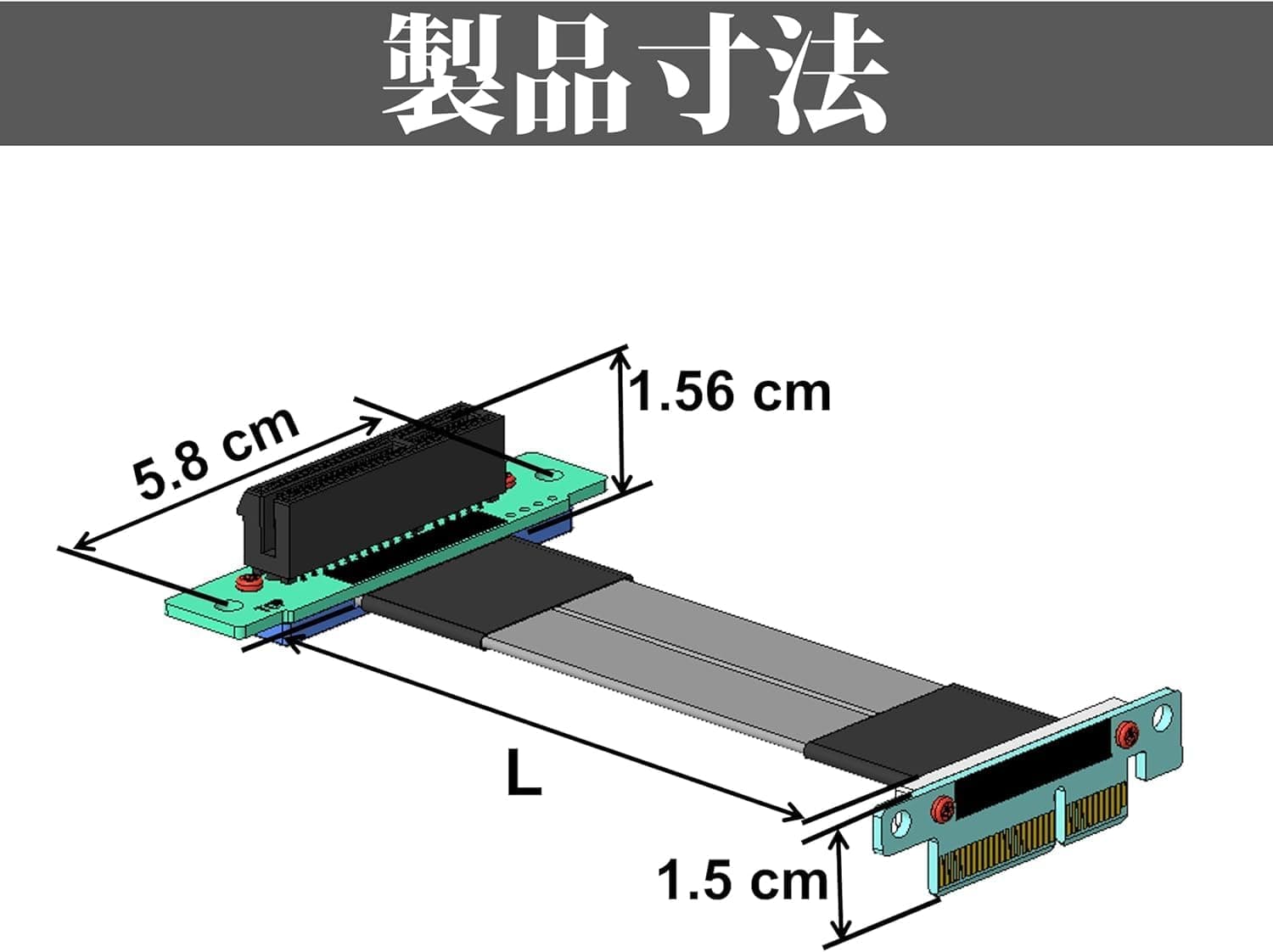
The 10Gtek PCIe 3.0 extension cable is a 15cm riser with a PCI Express 3.0 x4 interface, male-to-female connectors, and a 90-degree bend at both ends.
The male end plugs into the motherboard slot; the female end accepts the card. Between them runs an EMI-shielded cable.
The gold fingers use an immersion gold process with 3U thickness, which matters for contact reliability across repeated insertions.
It fits builds where vertical clearance is scarce - Mini-ITX cases, 1U/2U chassis - and where you need to lay an x4-class card (an NVMe adapter, a 10GbE NIC, a capture card, a SAS HBA) somewhere other than directly above its slot. Amazon.co.jp reviews stood at 29 ratings and 4.2 out of 5 stars (roughly 84% positive) as of the June 2026 capture.
That sample is small, so treat it as a weak signal rather than proof.
Compatibility Guide
Start with physical fit. The motherboard-side male connector is x4-sized, so it drops into x4, x8, or x16 slots.
But as the spec states, bandwidth in an x16 slot is still capped at x4. A card that ran at x8 will be limited to x4 the moment it goes through this cable.
PCIe 3.0 x4 gives roughly just under 4GB/s one-way, which is enough for a 10GbE NIC or a PCIe 3.0-era NVMe drive, but a PCIe 4.0 SSD will be throttled.
Now the part most buyers miss: the female end. It is also x4-sized, so a card with an x8 or x16 edge connector will not physically go in - unlike a motherboard slot, it is not open-ended.
If your goal is mounting a graphics card sideways, this cable cannot do it. You need a dedicated x16-to-x16 GPU riser for that.
| Check | Spec | What it means in practice |
|---|---|---|
| Interface | PCI Express 3.0 x4 | Assume 3.0-class speed even on a 4.0/5.0 board |
| Motherboard side | Male, x4, 90-degree | Fits x4/x8/x16 slots; bandwidth still x4 |
| Card side | Female, x4, 90-degree | Cards with x8/x16 edge connectors will not fit |
| Length | 15cm | Enough to shift a card a few centimetres, not across the case |
| Shielding | EMI shielding | Helps in dense card layouts near wireless modules |
| Hot-swap | Not supported | Power down and unplug before connecting |
The 90-degree bend has a fixed orientation. With both ends angled, the card lies parallel to the motherboard - but which way it folds depends on how the connector is oriented.
Check the product photos and trace the path from your slot before ordering. With only 15cm of cable, "it bends the wrong way and does not reach" is a real failure mode.
Product Info
As captured on 27 August 2026 the Amazon listing showed ¥2,099; an earlier capture on 8 June 2026 showed ¥2,299. So expect the street price to float in the low ¥2,000 range, and check the product page for the current figure before buying.
The box contains only the cable - no drivers or utilities, because this simply extends PCIe wiring and is invisible to the OS. Warranty terms follow whatever the listing states.
The two spec highlights are the EMI shielding and the 3U immersion gold plating. Cheap risers often skip shielding, or use plating thin enough that repeated reseating causes intermittent contact.
Getting both stated at around ¥2,000 is the value proposition here. What you do not get is PCIe 4.0 support or a choice of lengths.
It is a narrow product: cheap when it fits your use case, useless when it does not.
Best Use Cases
- Mini-ITX and SFF builders clearing height for an x4 card: the 90-degree ends lay the card flat against the motherboard, avoiding side panel and top fan interference.
- Users running 10GbE NICs or PCIe 3.0-generation NVMe adapters: these do not saturate PCIe 3.0 x4, so routing through the riser costs essentially no real-world performance.
- Rackmount or DIY NAS builds that need the bracket opening to sit somewhere other than the slot position.
- Dense multi-card layouts, where EMI shielding reduces interference risk next to wireless or tuner cards.
Before You Buy
The x4 female connector is the trap. "Supports x4/x8/x16" describes the motherboard slot, not what you can plug into the cable.
Buy this for a graphics card and it simply will not seat. Verify your card's edge connector length first.
Bandwidth is always capped at x4. Route a PCIe 4.0 NVMe SSD or an x8 HBA through it and performance drops visibly.
If benchmark numbers land at half of expectations, this is usually why. For speed-critical cards, plan a layout that does not need a riser at all.
No hot-swap. Inserting or removing under power can kill the card or the board.
Shut down, switch off the PSU, and unplug. When handling, grip the connector PCB rather than the cable - pulling on the thin wire core causes breaks and intermittent contact.
There is no slack. 15cm is for moving a card to an adjacent position.
Measure the distance you actually need, and avoid forcing a tight bend radius, which degrades signal quality.
Listing metadata can be wrong. In the data for this product, one price source was labelled "Amazon US" while the link pointed to Amazon.co.jp with a yen price.
Mismatches like this - and wrong manufacturer names, model numbers, or ASINs - do happen on product pages. Before ordering, confirm the images and title match on three points: 90-degree ends, x4-to-x4, and 15cm.
FAQ
Q. Can I use it to mount a graphics card vertically? A.
No. The card-side connector is x4, so an x16 graphics card will not fit.
Use a dedicated x16-to-x16 riser instead.
Q. Does it work on PCIe 4.0/5.0 motherboards?
A. It will plug in, but the product is specified as PCIe 3.0. Assume 3.0 x4 performance.
Q. Will it run at x16 in an x16 slot?
A. No. The spec explicitly caps bandwidth at x4 regardless of slot.
Q. Do I need drivers or BIOS changes? A.
No. The card appears to the OS as if directly installed.
If it is not detected, check the seating first, then slot lane bifurcation settings.
Q. What if I need something longer than 15cm? A.
No other lengths are listed for this product, so look at another series or vendor. Longer runs also make signal integrity harder to maintain.