This article covers 電源アダプターモジュール ZJ-012 ブレークアウトボード ATX 電源配線ボード 24ピン 20ピン コンピュータ電源用.
Overview
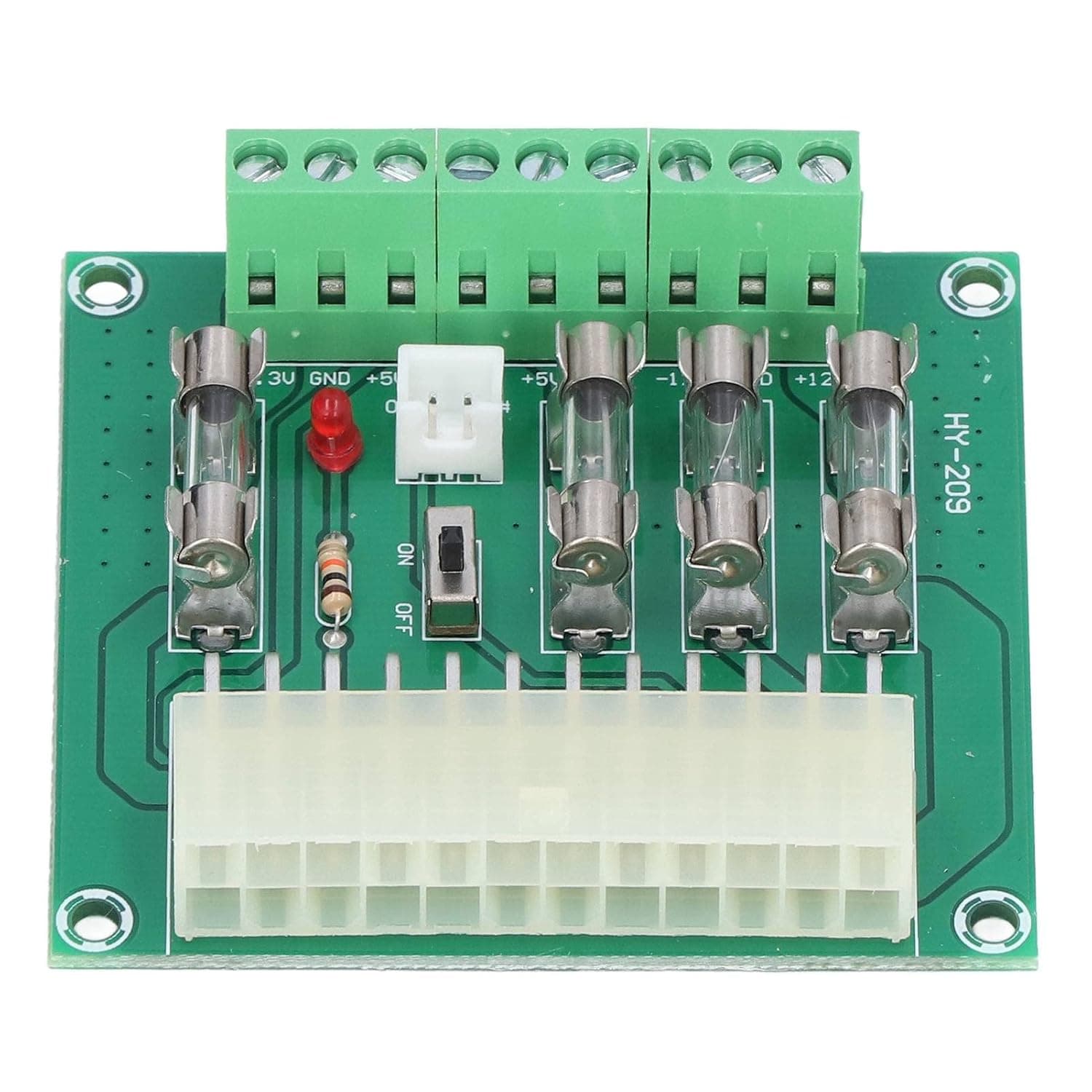
The ZJ-012 ATX Breakout Board is a compact distribution module that lets you tap into the voltage rails of any standard ATX power supply without soldering or hacking cables. Designed for hobbyists and technicians, it accepts a 24-pin or 20-pin ATX connector and breaks out +3.3V, +5V, +12V, -12V, and +5VSB onto clearly labeled terminals. A built-in toggle switch or an optional remote switch provides a clean way to turn the PSU on and off. Whether you're powering a bench test setup, a Class-D amplifier board, or a lab experiment, this board makes repurposing an old PSU quick and safe.
Compatibility Guide
The board uses a standard ATX 24-pin (or 20-pin) input header. Any desktop ATX power supply with a compatible main connector will work, including most units from Corsair, Seasonic, EVGA, and others. Non-standard or proprietary connectors (e.g., Dell/Alienware OEM PSUs) are not supported. The output voltages are directly passed through from the PSU — there is no voltage regulation or conversion. The +5VSB rail is active whenever the PSU is plugged into AC power, so handle that line with care.
Product Info
This is a no-frills hobbyist accessory, not a mainstream PC component. The build quality is typical for the price range (around ¥8,000 on Japan), with a single-sided PCB and screw terminal blocks for wiring. It is sold as a bare board with no enclosure, so you should mount it on an insulating surface. There is no active protection circuitry — you rely entirely on the PSU's own overcurrent/short-circuit protections.
Best Use Cases
Bench testing PC hardware — Perfect for running a PSU outside a case to power a test bench with motherboard, GPU, and drives. The toggle switch makes hot-swap scenarios easier. Not recommended for daily use inside a closed case due to exposed terminals. Audio amplifier power supply — Ideal for powering small Class-D amp boards that need multiple voltages (e.g., ±12V for op-amps + 5V for Bluetooth receiver). Avoid drawing more than 10A continuously through the board traces. Electronics lab power source — Reuse an old ATX PSU as a multi-rail lab supply. The clear labeling and easy screw terminals are great for breadboard prototypes. Not for beginners without basic electrical safety awareness. Who should NOT buy — Anyone looking to replace a standard PSU cable or extend power to PC peripherals. This board does not provide the same connectors (SATA, Molex, PCIe) that regular builds require. ## Alternatives
A cheaper alternative is the classic "paperclip test" (shorting PS_ON to ground) combined with a breakout cable set. That approach costs almost nothing but requires careful wiring and offers no labeled terminals. Another option is a dedicated PSU tester, which shows voltages but cannot deliver power to external devices. The ZJ-012 strikes a balance between simplicity and functionality for hands-on projects.
Things to Consider
Safety is paramount — the board has no fuse or reverse-polarity protection. Always double-check your wiring before applying power. High-current loads (above 10A per rail) can overheat the PCB traces; use external fuses if you plan to draw heavy current. The screw terminals accept up to 14 AWG wire, which is sufficient for most hobbyist loads. Also note that this board does not include a power switch; you need to supply your own toggle or remote switch. ## FAQ Q: Can I use this board inside a computer case? A: Yes, but it's not designed for that purpose. The exposed terminals could short against the case metal, so you'd need to insulate or mount it properly. It's better suited for open-air use. Q: What gauge wire can I connect to the screw terminals? A: The terminals accept wire from 22 AWG up to 14 AWG. For the +12V rail drawing several amps, 18 AWG or thicker is recommended. Q: Does it work with SFX or TFX power supplies? A: As long as the PSU has a standard 24-pin or 20-pin main connector, it will work. The physical size of the PSU does not matter.