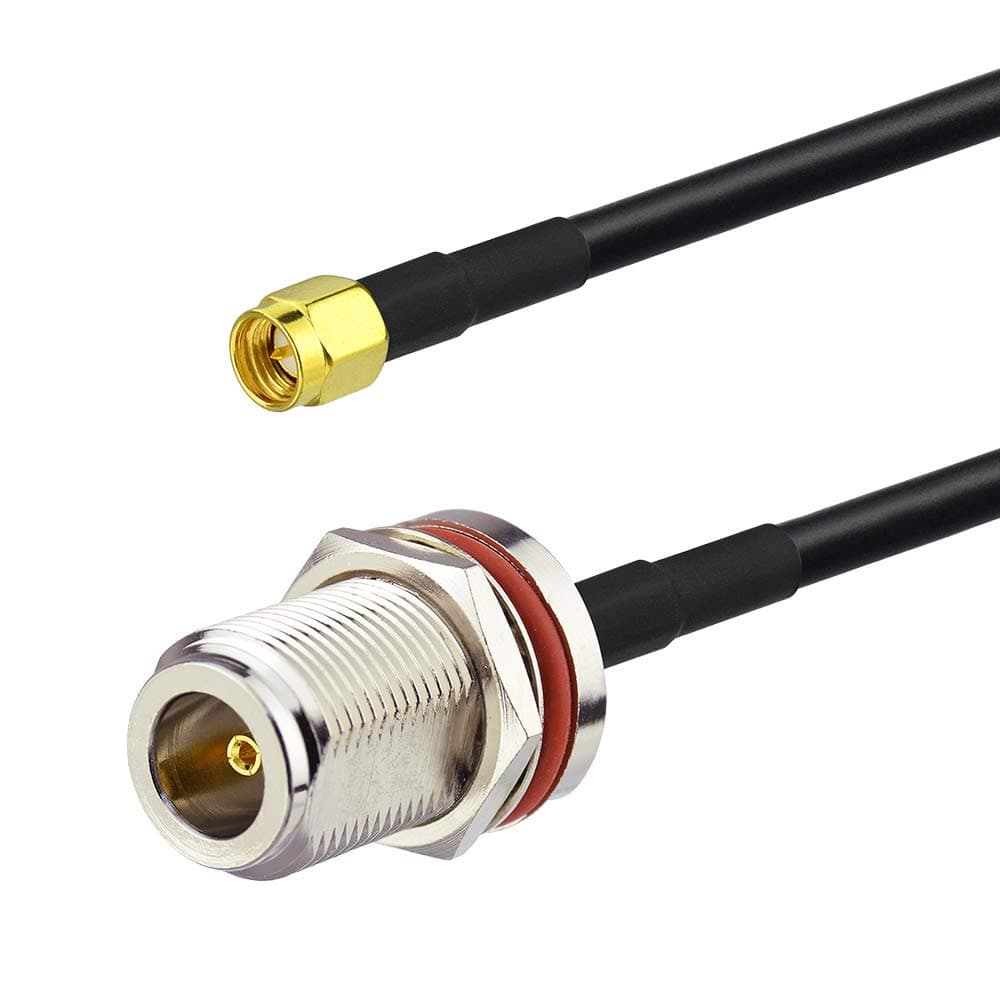
The BINGFU SMA male to N female adapter cable exists to solve the single most common snag in any RF setup: the port on your device and the port on your antenna don't match. This article digs into which devices it actually fits, where people go wrong, and who should skip it entirely.
Overview
This product — BINGFU SMA オス - N メスバルクヘッドマウント RG58 同軸アダプターケーブル 1フィート 30cm 4G LTE ワイヤレスルーター ゲートウェイセルラー RTL SDR USB ADS-B レシーバーに対応 — is a short jumper that puts an SMA male plug on the device end and an N female bulkhead jack on the antenna end. It is 30cm long, built on RG58 coaxial cable, and maintains 50Ω impedance end to end.
The verdict up front: this is for people who want to move from a device's SMA port to an N-type external antenna over a short distance. It is not for people whose device uses RP-SMA (reverse polarity), and it is not for people who need the antenna a meter or more away.
Those two questions decide almost everything.
The bulkhead mount on the N female side is what separates this from a plain jumper. You can drill a panel, secure the jack, and bring an antenna connection cleanly through a chassis or enclosure.
Compatibility Guide
The manufacturer's compatibility note is blunt: it connects SMA male devices to N female antennas, and it is not compatible with RP-SMA connectors. That one sentence covers most of what you need to know.
| Item | Value | What it means in practice |
|---|---|---|
| Connector type | SMA male - N female | Device side must be SMA; antenna side must be N male |
| Cable length | 30cm | A bridge, not an extension |
| Cable type | RG58 coaxial | General grade; fine short, poor over distance |
| Impedance | 50Ω | RF standard; not the 75Ω TV world |
| Mount type | Bulkhead | N female can be panel-mounted |
Check polarity first. An SMA male has a thin center pin; an RP-SMA male has the same threads but a socket instead of a pin.
They look nearly identical in photos, which is exactly why returns happen. Hold your device up to the light and look for the pin.
Most consumer Wi-Fi routers and Wi-Fi cards use RP-SMA, so be especially careful for Wi-Fi projects.
Frequency behavior matters too. RG58 is a general-purpose 50Ω coax.
Across LTE bands from roughly 700MHz to 2.1GHz, loss over just 30cm is negligible.
Above 2.4GHz, RG58's per-meter loss becomes something you have to account for — but at this length it still sits comfortably within practical limits.
The trouble only starts on long runs.
Plan the bulkhead install physically. An N female bulkhead needs a round hole in the panel and a nut tightened from the inside, which means you need both the correct hole diameter and clearance for a spanner.
Confirm the exact hole size from the product listing's dimensions. On a metal panel, the chassis becomes part of the ground plane, so paint removal at the contact point can change behavior.
Don't mix impedances. 50Ω is the standard for ham radio, LTE, Wi-Fi, and SDR; TV antenna hardware is 75Ω.
Some combinations will physically mate anyway. For receive-only work the penalty is small, but anything that transmits will see increased reflection and strain the radio.
Product Info
BINGFU produces a broad catalog of coaxial cables and antenna adapters — the small parts that patch over standards gaps. This unit's specs: SMA male to N female connectors, 30cm length, RG58 coax, 50Ω impedance, bulkhead-mount N female.
The package contains one cable, and warranty follows the manufacturer's standard terms (check the package for details).
As captured on August 31, 2026, the listed price on Amazon.co.jp was ¥3,197. That is not the cheapest way to bridge two connectors, but it buys a finished assembly with a bulkhead jack rather than a bare adapter.
Prices on small RF parts move with stock and promotions, so treat this figure as a snapshot and confirm the current price on the product page.
Check the retailer's page for the latest user reviews. Fifty-three reviews is a thin sample, but for a category where a product either works or doesn't, 4.4 suggests the basic build is sound.
Note that negative reviews on adapter cables often trace back to buyers ordering the wrong polarity rather than to defects, which makes your own connector check more important than the star rating.
Alternatives and How They Compare
There are three ways to solve this problem:
- An assembled jumper (this product) — two connection points total, flexible routing, and a bulkhead option.
- A bare adapter barrel — cheapest and lowest loss, but it hangs a heavy N-type antenna directly off your device's port, straining it mechanically.
- Low-loss cable (LMR200 / LMR400) with connectors — the right answer for runs of several meters. Bulkier and pricier, but the loss gap widens with every meter.
This product wins in the first slot: short distance plus the ability to anchor the jack to a panel. If you only need to mate an SDR dongle to a discone on your desk, a bare adapter is cheaper.
If you're running from a rooftop antenna into a room, buy low-loss cable instead.
Installation Tips
Tighten by hand until it stops, then add only the slightest bit more. SMA is small, and over-torquing with a wrench damages the center pin or the PTFE dielectric.
Too loose is equally bad: intermittent contact shows up as an elusive "it drops out sometimes" symptom rather than a clean failure.
On the bulkhead side, mount the jack first, then leave a small service loop in the cable before connecting to the device so strain never lands on the connector root. In vehicles or drones, that one habit prevents most cable failures.
If any part of the install faces outdoors, remember the connectors are not weatherproof. Wrap with self-amalgamating tape covered by electrical tape, or house the junction in a sealed enclosure.
Best Use Cases
- Moving a 4G LTE router or cellular gateway to an external antenna — swap from the stock stub to a higher-gain N-type antenna near a window or outside. It's a realistic, no-construction way to improve reception, provided the router's port is genuine SMA and not RP-SMA.
- RTL-SDR and ADS-B reception — most SDR dongles use SMA, and at 1090MHz the antenna dominates results. This jumper is a convenient length for switching to an N-type discone or a purpose-built ADS-B antenna.
- Ham radio, FPV, and vehicle installs — the bulkhead lets you bring an N female jack to the outside of an enclosure while keeping the electronics sealed.
- IP cameras and wireless access points with SMA male ports benefit the same way.
Things to Consider
The RP-SMA mix-up is the biggest trap. Most consumer Wi-Fi gear uses RP-SMA and will not mate with this cable.
Verify the center pin before ordering; buying this for a generic "router antenna upgrade" without checking usually ends in a return.
Don't underestimate how short 30cm is. Usable reach is a bit over 20cm once bend radius is accounted for.
If your antenna sits a meter away, buy a single cable of the right length instead — fewer junctions, less loss, fewer failure points. Chaining extensions adds both.
RG58 is general-purpose, not low-loss. At 30cm the difference is minor, but choosing RG58 for a long 2.4GHz+ run is a mistake.
If you expect to extend later, design around LMR200 or LMR400 from the start.
Check ratings if you transmit. Receive-only use (SDR, ADS-B) is unproblematic, but for ham transmission you should confirm power handling and maximum frequency on the product page.
The supplied data doesn't state those figures, so we won't guess at them here.
Listing metadata can disagree with the actual item. Marketplace product fields — manufacturer, model number, compatibility text — are often auto-populated and sometimes carry another product's data.
Before ordering, confirm from the listing photos that the connectors match (center pin on the SMA end, the larger N jack on the other) and that the title matches the images.Check the retailer's page for the latest price.
Who should skip it: anyone doing a permanent outdoor installation, anyone whose antenna sits more than a meter from the device, and anyone whose gear uses RP-SMA. In those three cases, a different part is the faster path.
FAQ
Q: Can I use this to change my WiFi router's antenna? A: Only if the router port is SMA male with a visible center pin.
Most consumer routers use RP-SMA. Inspect the port before buying.
Q: Does it work with an RTL-SDR v3 (RTL2832U)? A: Most RTL-SDR dongles use SMA, so the SMA male end goes to the dongle and an N male antenna attaches to the N female end.
Many ADS-B antennas use N-type, making this a natural pairing.
Q: Is 30cm too short? A: It depends on the job.
It's ample for desk-level bridging or bringing a jack through a panel, but it is not a distance solution. Need a meter or more?
Buy that length as a single cable.
Q: Can I use it outdoors?
A: Not as-is. Weatherproof the connectors with self-amalgamating tape or place them inside a sealed box.
Q: How much signal does 30cm of RG58 cost me? A: Around 1GHz and below, loss over 30cm is negligible in practice.
Loss rises with frequency above 2.4GHz, but at this length it stays within a workable range.
Only long runs justify low-loss cable.
Q: Are the reviews trustworthy? That's a small sample, but it indicates the part works when the standards match.
Bear in mind that poor ratings on adapters frequently stem from ordering the wrong connector type.