Overview
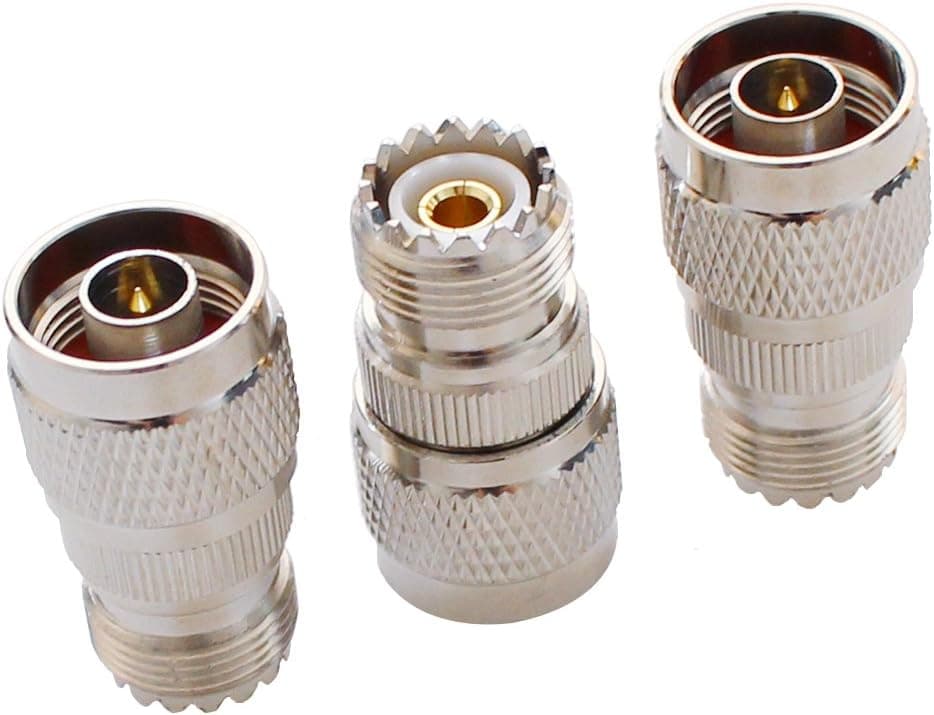
If you work with amateur radio, CCTV, or broadcast gear, mismatched connector standards are a fact of life. The exgoofit Nオス - UHFメスパック 3個 (N Male to UHF Female, SO-239 jack) RF coaxial adapter converts an N-type male plug into a UHF female SO-239 jack, at a uniform 50Ω impedance so it drops straight into standard RF systems.
The short version: this product is for people who want to reconnect existing gear rather than replace it. A radio with an SO-239 socket paired with a feedline terminating in an N-type male plug is a combination that shows up constantly when you repurpose commercial antennas or LMR-series cable.
On Amazon.co.jp the listing carries 163 reviews averaging 4.8 out of 5 — a 96% favourable score, which is solid for a small passive part.
The three-pack lets you keep one at the shack, one in the go-bag, and one spare.
Compatibility Guide
The rated specifications are as follows. Anything outside this table is outside the product's intended use.
| Item | Value |
|---|---|
| Connector type | N Male → UHF Female (SO-239) |
| Impedance | 50Ω |
| Package contents | 3 adapters |
Get the gender right. The N side is a male plug with a protruding pin; the UHF side is a female SO-239 jack that receives a PL-259.
So it bridges an N-female jack on one side and a PL-259 male plug on the other. If both of your ends are N male, or both are PL-259, this adapter will not help.
Check the actual hardware with your fingers before ordering.
Treat it as 50Ω-only. It suits LMR, RG-58, RG-213 and similar 50Ω coax.
Inserting it into a 75Ω video or TV path (RG-6 and friends) produces reflections from the impedance mismatch. How much that hurts depends on frequency and cable length, but there's rarely a good reason to accept it.
Torque determines performance. Both N and UHF use threaded coupling, and a loose joint means higher contact resistance and worse SWR.
Hand-tighten firmly, but don't crank on it with tools. Note that the PL-259/SO-239 family is not a constant-impedance design, so routing through UHF hardware introduces some discontinuity above a few hundred MHz.
That's a non-issue on HF and VHF; for precise UHF-and-above work, staying all-N is cleaner.
Physical clearance. Each adapter adds a few centimetres to the connection.
If the back of your radio sits close to a rack wall, stiff LMR-400-class cable may not have room for its bend radius, putting stress on the connector shell. A short jumper solves this.
Product Info
Brand is exgoofit; the package contains three adapters. The price captured on 4 September 2026 on Amazon.co.jp was ¥3,380.
Coax adapter pricing moves with sales and stock, so always confirm the current figure on the product page. Three units at ¥3,380 works out to roughly ¥1,127 each — about the same as buying comparable singles.
The value here is bulk convenience and spares, not a volume discount.
Reviews stand at 163 with a 4.8/5 average (96%).
Few coax adapters accumulate that much feedback, so the odds of a dead-on-arrival unit are low. Warranty follows the marketplace seller's policy.
Positioning is entry-to-mid range. Manufacturer-grade N-to-UHF adapters from names like Amphenol can cost several thousand yen apiece, so this is clearly cheaper.
The flip side is that plating thickness, dielectric quality, and mating-cycle durability are unlikely to match. It suits a set-and-forget installation better than a bench that gets re-patched daily.
Best Use Cases
Amateur radio operators. If your radio has an SO-239 and your feedline ends in an N male, this closes the gap without rebuilding anything.
Three units cover a fixed station, portable operation, and the toolbox. For routine HF-to-VHF use, this price tier is enough.
CCTV and commercial installers. Nothing stalls a job like the wrong connector.
Screwing on an adapter beats fabricating a custom jumper on site. Just keep it off 75Ω video runs.
RF experimenters and test-bench users. Prototype cabling never matches your instruments.
Keeping a few 50Ω adapters on hand keeps work moving — while remembering the UHF-path caveat below.
Who should skip it: anyone installing permanently outdoors, anyone needing tight performance above UHF, and anyone working in 75Ω video/TV systems. In those three cases another solution is cheaper in the long run.
Before You Buy
It is not weatherproof. Left bare at an outdoor antenna feedpoint, water enters the coupling and internal corrosion slowly degrades SWR.
Outdoors, wrap with self-amalgamating tape and cover with vinyl tape for UV protection, or fit a weatherproof boot. Vinyl tape alone peels within months and traps water, making things worse.
Accept the limits of UHF connectors. PL-259/SO-239 is an old standard that does not maintain constant impedance.
That's irrelevant on HF and VHF, but above roughly 430MHz — and especially at 1.2GHz — loss and mismatch stop being negligible.
Inserting a UHF conversion into an otherwise all-N system is a compromise to preserve existing equipment, not an optimisation.
Sold only as a three-pack. Even if you need one, you buy three.
Coax adapters are easy to lose and their contacts do wear, so spares rarely go to waste.
Not built for repeated mating cycles. Budget adapters typically have less contact spring resilience and thinner plating than premium parts.
For daily plugging and unplugging, treat them as consumables or buy up-market.
About the listing data. This item is listed with Amazon US seller information attached, and registered details such as manufacturer name and ASIN (B07DB7HK7C) can occasionally display inconsistently with the actual part.
Coax adapters look nearly identical to one another, so verify from the product images and title that you are getting a pin-bearing N male on one end and an SO-239 jack on the other. Reverse-gender "N female to UHF male" parts appear in the same search results, and that mix-up only becomes obvious after delivery.
Alternatives Compared
There are three approaches. First, an adapter like this one: cheapest, reuses existing gear, hard to get wrong, but adds a junction.
Second, buying or building a cable with the connectors you actually want: fewer junctions and better high-frequency behaviour, at the cost of money, effort, and the risk of a bad solder or crimp. Third, replacing the connector on the equipment itself — thorough, but rarely practical.
For routine HF and VHF work, option one is simply enough. The higher your operating frequency, the more option two pays off.
As a rough rule of thumb: if you operate mainly above 430MHz with a feedline longer than 10m, it's worth building a cable that avoids the adapter entirely.
FAQ
Q: Can I use it on 75Ω TV antenna cable? A: Not recommended.
This is a 50Ω part; inserting it into a 75Ω path causes reflections. Use a 75Ω-rated adapter for television work.
Q: Which direction does it convert? I might confuse it with N female to UHF male. A: The N side is male (protruding pin) and the UHF side is female (SO-239 jack).
It joins an N female jack to a PL-259 male plug. Reverse-gender parts are widely sold, so check the images first.
Q: Can I use it outdoors? A: No weatherproof rating is stated.
Protect the joint with self-amalgamating tape or a boot; bare outdoor installation invites internal corrosion.
Q: I only need one. A: It ships only as a three-pack.
Look for single-unit listings from other brands if that matters — though spares are rarely wasted.
Q: How much insertion loss should I expect? A: No loss figure is published for this product.
Generally, a properly tightened coax adapter contributes very little loss at HF and VHF, effectively negligible in practice. The impact grows with frequency, so measure if your system is sensitive.
Q: Is ¥3,380 fair? A: At the 4 September 2026 capture that's about ¥1,127 per unit — below manufacturer-grade parts, above no-name bargains.
Prices change; check the listing.
Product Disclosure (Amazon)
- Manufacturer: exgoofit
- Seller: Amazon US
- Fulfilled by: Amazon US
- ASIN: B07DB7HK7C
- Note: This article covers a manufacturer-made product based on Amazon listing details.