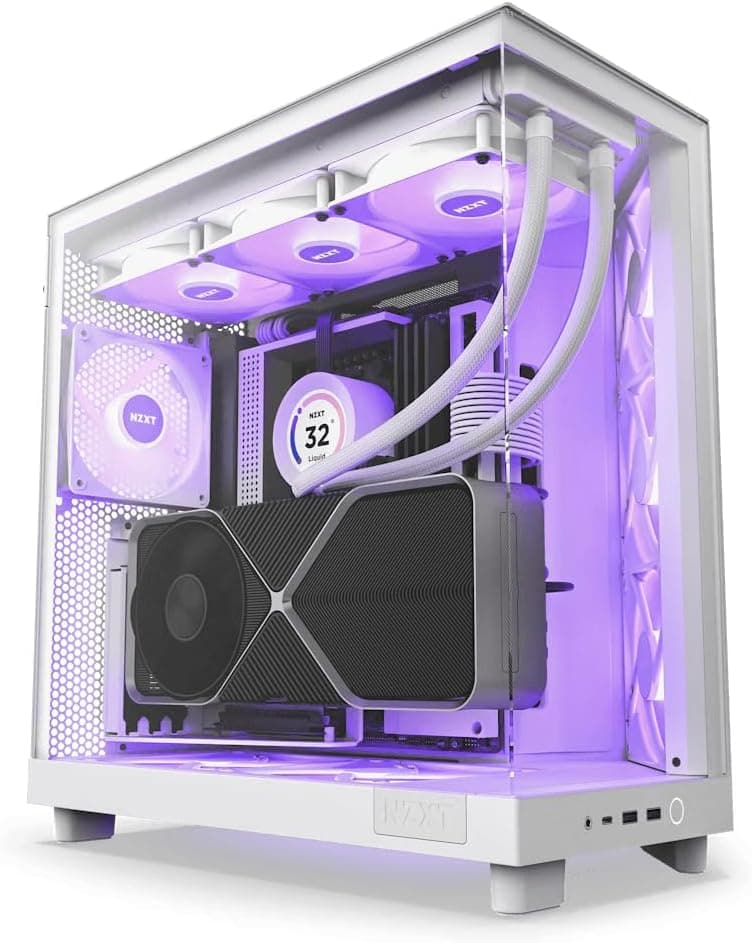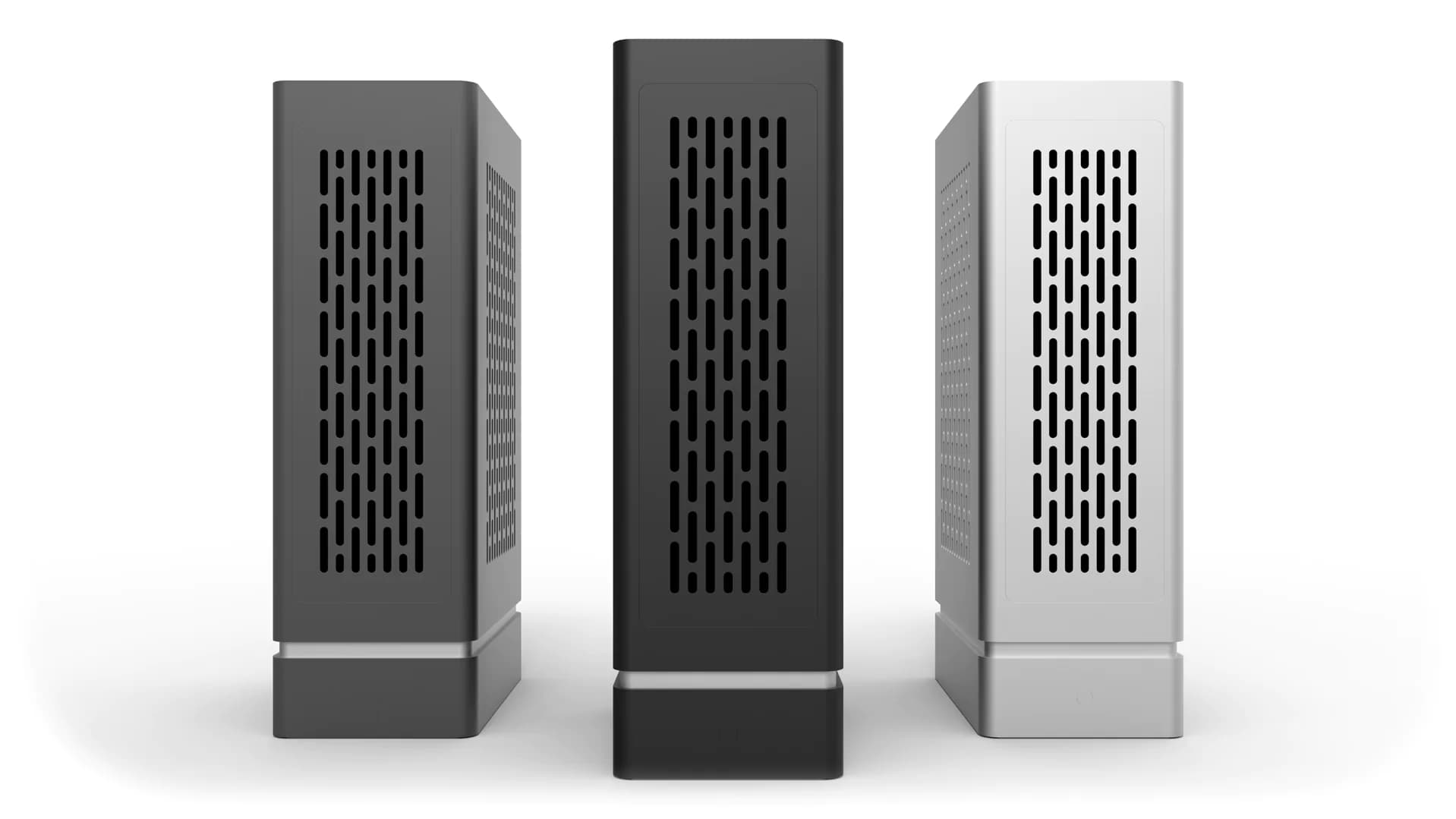
A 322mm GPU inside 9.7 litres
The THOR ZONE MJOLNIR is a mini-ITX case that fits a graphics card up to 322mm long inside 9.7 litres.
That pairing is the whole point of the case; everything else is shaped around it.
322mm accommodates a full triple-fan flagship card. The case puts that into a footprint smaller than a sheet of A4 paper.
Dimensions and clearances
| Item | Value |
|---|---|
| Volume | 9.7L |
| Exterior | 131 (W) × 354 (D) × 209 (H) mm |
| Max GPU length | 322mm |
| Max GPU thickness | 46mm |
| CPU cooler height | 51mm (air) |
| AIO | 120mm / 240mm |
| PSU | SFX / SFX-L |
| Max RAM height | 55mm |
| Storage | 2× 2.5-inch plus M.2 |
| Case fans | Two 120×25mm or 120×15mm |
| Material | 6061 aluminium, 5mm walls |
| Weight | 3.6kg (performance panels) / 3.4kg (tempered glass) |
Fitting a 240mm AIO restricts you to an SFX supply; SFX-L is deep enough to foul the radiator.
Why 5mm machined walls matter
The shell is machined from solid 6061 aluminium with 5mm walls. Comparable cases in this size class use 0.8-1.0mm steel, so this is an unusual choice.
The cost is weight. At 3.4-3.6kg empty it is heavy for 9.7 litres, and a built system will exceed 5kg.
This is not a case you carry one-handed.
The benefit is rigidity. Thin-walled small cases transmit fan vibration into the panels and develop their own resonance; a 5mm block does not.
The thickness is what makes "small and quiet" possible here.
Airflow
It uses a sandwich layout, motherboard on one side and GPU on the other. The advantage is that GPU and CPU exhaust stay separate, so neither feeds the other.
Watch the 46mm GPU thickness limit. Thick triple-fan cards can exceed 46mm even when they clear the 322mm length, so checking length alone is not enough.
The manufacturer also notes that standard PCIe power connectors with cables add roughly 22mm of height. If your card has connectors standing proud of the top edge, that 22mm matters.
Right-angle adapters or cards with rear-facing connectors give you room back.
Who it suits
- Anyone wanting a flagship GPU in something that sits on a desk
- People who value machined rigidity and finish
- Builds that get assembled once and left alone
Who it does not suit
- Anyone who wants portability. A finished build passes 5kg
- Anyone needing 3.5-inch drives. There is no provision for them
- Anyone wanting a large air cooler. 51mm limits you to low-profile top-flow designs
- Anyone avoiding fiddly assembly. Sandwich layouts involve riser routing and more steps than a standard ATX case
Against the mainstream options
The 9-10L class sits below Cooler Master's NR200 family and near Fractal's Terra at 10.4L.
Terra pursues its identity through a wood front and steel body; MJOLNIR goes the other way, machining aluminium.
322mm of GPU length is long for this class. Most cases around 10 litres stop at 280-300mm, and clearing that is this product's reason to exist.
Things to settle before you build
In a case this size, fitment is decided by a few millimetres. The following does not appear in a spec table but matters once you start assembling.
Riser cable generation
A sandwich layout connects the GPU through a riser. If your card is PCIe 4.0 or newer, the riser must be rated for that generation. An underspecified riser can halve the link width, or fail to enumerate the card at all.
Check what generation the bundled cable supports before you order.
If the link is unstable, dropping the PCIe generation by one step in UEFI often settles it. For gaming, going from 4.0 to 3.0 costs very little in practice, and is a more useful compromise than a machine that will not post.
PSU depth, and cable stiffness
SFX is 100mm deep by specification; SFX-L is 130mm. That difference is why a 240mm radiator build rules out SFX-L.
The trap is cable thickness and bend radius. Even when depth fits, a stiff 24-pin or PCIe cable can refuse to bend at the connector and stop the panel closing.
With a supply that ships rigid cables, replacing them with short custom leads becomes effectively mandatory — budget for that from the start rather than discovering it late.
How to read the 46mm GPU limit
Slot-count figures (2-slot, 2.5-slot) are applied inconsistently between vendors.
One slot is 20.32mm, so 46mm is roughly 2.25 slots.
Cards marketed as "2.5 slot" often measure near 50mm and will not fit.
Work from the manufacturer's stated thickness in millimetres. Backplate protrusions and exposed heatpipes are sometimes excluded from published figures, so leave a few millimetres of margin.
What 51mm of cooler height really means
51mm restricts you to low-profile top-flow coolers. Choice is limited in that band and performance does not approach a tower cooler.
Pair it with a high-TDP CPU and the cooler becomes the limit before the silicon does.
In practice, planning around a power limit (PL1/PL2, or PPT) in UEFI gives better results than chasing stock behaviour. Capping power usually costs single-digit percentages of real performance while cutting temperature and noise substantially.
A case this size is not a box for running parts unrestricted; it is a box that works because you restrict them.
Where two 2.5-inch drives go
Two 2.5-inch bays exist, but mounting positions that sit in the airflow path will block it.
If M.2 covers your needs, leaving the 2.5-inch bays empty is better thermally.
If you need the capacity, consider moving it to external or network storage instead.
The 55mm RAM limit
Tall-heatspreader memory runs 40-50mm. 55mm looks generous, but in layouts where an AIO radiator or its fans sit above the DIMMs, the fan interferes before the stated limit does.
Choosing low-profile memory keeps your options open when you revise the build later.
Living with a machined shell
Aluminium absorbs heat, and it also conducts it well. The exterior runs warmer under load than a thin steel case would.
That is not a fault, but think about where it sits — proximity to other equipment, or standing directly on a wooden surface.
The threads are aluminium too. Overtightening strips them. If you expect repeated disassembly, keep torque modest and consider thread inserts if you damage one.
Thinking about power and heat
9.7 litres holds only enough air to be exchanged in a few seconds.
Intake temperature therefore translates almost directly into component temperature: raise ambient by 5°C and expect roughly the same rise inside.
If you plan to run heavy loads through summer, decide your combined CPU and GPU power budget before selecting parts. A configuration that puts too much heat into too little volume cannot be fixed by adding fans.
Availability
At the time of writing no price is published on the official site. The page shows a "Restocking Late August" notice, so this is not a product held in continuous stock.
No Japanese distributor could be confirmed. Buying means ordering direct, with international shipping plus import duty and consumption tax on top.
Small manufacturers restock on irregular schedules, so if you need it by a certain date, follow the restock announcements.
Units do appear on the second-hand market, but machined cases show shipping dents clearly — inspect condition carefully.
Product images are from the official THOR ZONE website.