How Much Can Fit Inside an Approximately 18.3L Cube?
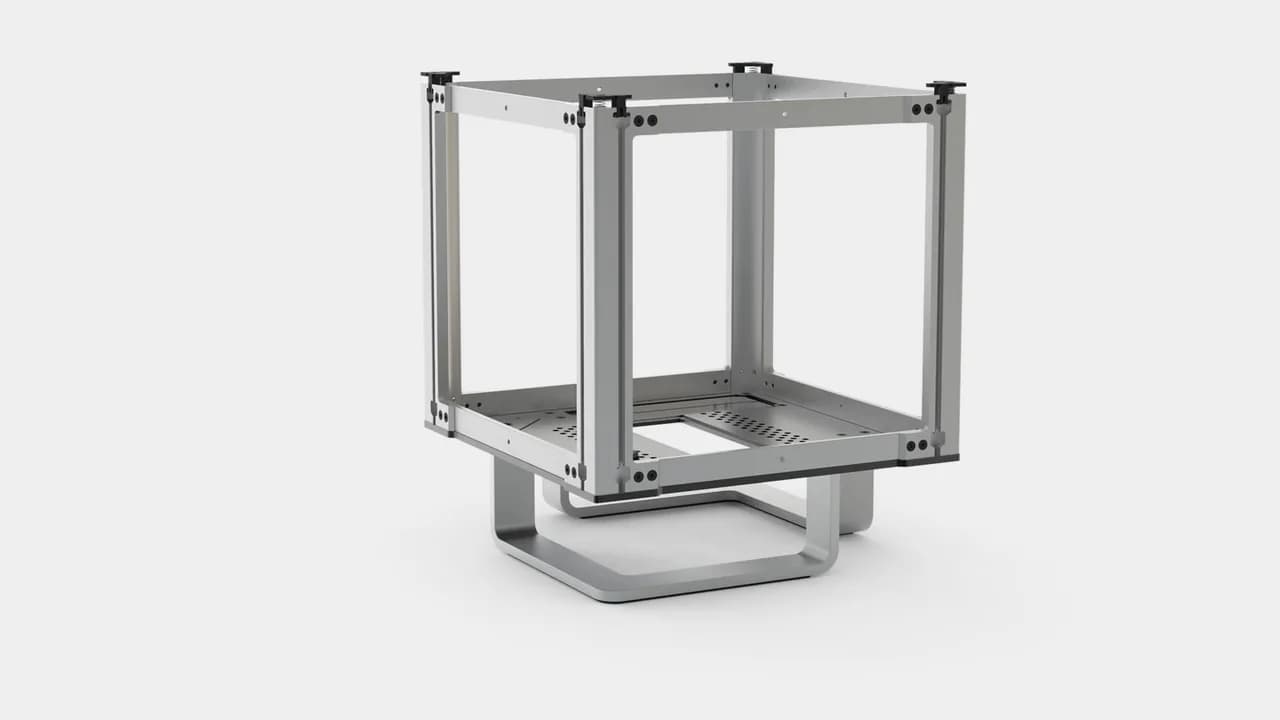
The Streacom DB4 is not interesting merely because it is compact. Its external dimensions are 260 × 260 × 270mm, which work out to approximately 18.3L when calculated from the exterior measurements.
Within that envelope, Streacom lists support for a Mini-ITX motherboard, a dual-slot full-height PCI card, as many as 5 × 3.5-inch drives, or as many as 12 × 2.5-inch drives.
The approximately 18.3L figure is a calculation from the exterior dimensions, not an official statement of usable internal capacity.
It also includes the physical envelope occupied by the panels and frame, so it must not be read as the amount of space actually available to components. Even with that qualification, the range of hardware listed for a cube of this size is the central surprise of the DB4.
Streacom describes it as a fanless ITX cube case. Instead of shrinking the enclosure and relying on rapidly moving fans, the DB4 makes the enclosure itself part of the cooling system.
That approach gives the case a purpose beyond component density alone.
A GPU Has to Fit in More Than One Direction
The supported PCI card is dual-slot and may be up to 200mm long. The specification gives the card envelope as 200 × 116 × 50mm in length, height, and width.
It says the height measurement is inclusive of the auxiliary power connector. Elsewhere in the supplied product text, the maximum is described as 200mm in length and 110mm in height, so the official page contains differing height figures.
Thickness is represented both by the dual-slot description and by the 50mm dimension. In practical PC building, slot-thickness terminology can vary between products, so the label alone should not replace checking the card's physical measurement against 50mm.
Power cables also have a bend radius. A card may satisfy the stated envelope while still requiring a separate check that its cable can be routed without an excessive bend.
The official text does not state a required cable clearance or a specific supported cable geometry.
GPU cooling is optional and requires a separately sold cooling kit. Its stated cooling capability is 65W TDP.
Physical card compatibility and thermal suitability therefore need to be treated as separate questions. For a fanless build in general, it can be sensible to design around a power limit from the beginning instead of selecting components first and reducing their power only afterward.
The supplied text does not name supported GPU models or provide guaranteed temperatures under particular operating conditions.
Whether a PCIe riser is included, which standard it follows, and which PCIe generation it supports are not officially stated. In systems that use risers, generation matching can generally affect setup and troubleshooting, but the source provides no basis for assigning a particular riser generation to the DB4.
CPU Cooling Without a Conventional Height Figure
The officially stated CPU-cooler height is not provided. The DB4 is not presented as a case built around the height allowance for a conventional tower cooler.
Its described cooling system carries heat from the CPU through heat pipes to a side panel.
Standard CPU cooling is listed at 65W TDP and can be upgraded to 105W with the LH6 expansion kit. Streacom says the redesigned CPU mount is adjustable and universally compatible with any socket.
A copper shim sits between the processor's IHS and the heat pipes, creating an all-copper thermal route to the heat sink and improving heat transfer.
The motherboard and side panels are parallel, allowing the heat pipes to run perpendicular to them and away from surrounding components. Together with the flexible universal bracket, this arrangement is said to make virtually all ITX motherboards compatible.
The supplied source does not include a board-by-board or memory-by-memory compatibility list.
Builders often check memory height first in a small enclosure, but in compact systems generally, a fan or another nearby component can become the first point of interference. The DB4 has no case fan in its stated concept, yet its heat pipes, brackets, components, and cables still occupy physical space.
The official material does not provide a maximum memory height or a full set of internal clearance measurements.
The Exterior Is Also the Heat Sink
The identical sides have two jobs. They form the monolithic exterior, and they act as convection surfaces or heat sinks for component cooling.
This dual use is described as the basis of the fanless operation. The symmetrical design and placement of all ports on the bottom help preserve the appearance from every viewing angle.
An official case-fan count, individual intake and exhaust dimensions, and a forced-air path are not stated. The cooling principle explicitly described by Streacom is heat conduction into the side panels followed by natural convection from those surfaces.
As a general thermal consideration, the temperature of air entering a small enclosure can translate more directly into component temperature because there is limited room for conditions inside the case to differ from the immediate environment. Drives and cable bundles can also obstruct the movement of air.
Installing many 2.5-inch drives may, in general, close off paths that would otherwise remain open.
The source does not provide DB4-specific temperature changes or a quantified preferred arrangement, so these points are considerations rather than claims about measured behavior.
Storage Density Reaches 12 Drives
Storage support is one of the clearest examples of what the enclosure can hold. The DB4 supports up to 5 × 3.5-inch drives or up to 12 × 2.5-inch drives.
Mixed configurations are also possible. The official example combines 2 × 3.5-inch drives with 2 × 2.5-inch drives.
The case uses a universal bracket system. Drives, heat-sink mounts, and the ZF240 can be positioned at different points along the frame, allowing the layout to change with the selected hardware.
All side panels are removable, as is the motherboard tray, leaving an open frame with access around it during assembly.
A separately available ODD kit adds support for a 12.7mm slot-loading optical drive.
The official text does not state the number of storage cables required, preferred connector locations, or cable bend-radius guidance. In a build with many drives, cable routing and power distribution generally need to be considered alongside the nominal drive count.
ZF240 or Nano Power
The stated power-supply options are a ZF240 Flex PSU or the Nano arrangement, which combines an AC adapter with an internal DC PCB. The introductory description likewise says the case can be powered by Nano or ZeroFlex PSU solutions.
Compatibility with ordinary ATX, SFX, or SFX-L power supplies is not officially stated. The supplied source also does not establish which power unit is included, list every available power capacity, or prescribe a complete cable set.
Power selection therefore has to account for more than whether the CPU and GPU physically fit. The stated CPU and optional GPU cooling limits are also part of the build's power framework.
13mm Side Panels and a Substantial Inner Frame
The extruded aluminium side panels are 13mm thick. Aluminium 6063 is used for the outer panels, frame, and feet.
The brackets are steel, while the top is acrylic. The exterior receives a sandblasted and anodized surface treatment.
Streacom says the inner frame is made entirely from aluminium and contains no individual part thinner than 4mm. Although hidden after the exterior is installed, it is described as a precision CNC-machined frame.
The product weight is 7.5kg, while the gross packed weight is 9.25kg.
Aluminium threads can generally be damaged by poor tool alignment or unsuitable tightening practice. The official text does not specify an allowable screw torque for the DB4.
Because the removable panels and movable brackets encourage hands-on configuration, careful alignment when reinstalling screws remains a relevant general assembly practice rather than a product-specific torque instruction.
Who Should Not Choose It?
The DB4 is not suited to someone who requires a GPU beyond the stated 200mm length, 50mm width, or available height envelope. It is also not a natural choice for a system intended to exceed the specified 65W CPU cooling capability, or the 105W capability stated with the expansion kit.
Anyone who expects to reuse an ATX, SFX, or SFX-L unit without further investigation should note that those power-supply formats are not listed as compatible in the supplied text.
It is also a poor conceptual match for someone who wants forced airflow to compensate automatically for hardware selection and placement. With the DB4, CPU and GPU heat output, heat-pipe routing, side-panel dissipation, drive placement, and cable routing form a single thermal problem.
What this compact format gives up is the freedom to ignore those relationships.
A user who wants to install an unrestricted full-size graphics card, select components without a power budget, or fill every mounting position without considering convection should look elsewhere. The DB4's capacity is remarkable, but it is not the same thing as unlimited compatibility.
Availability and the Boundaries of the Published Information
The official page provides a buying route and lists the company's own shop along with regional where-to-buy sections for the Americas, Asia, Europe, and Oceania. Specific current stock, individual retailer names, and shipping coverage cannot be established from the supplied source alone.
The DB4 is offered in silver, black, and titanium. Its I/O is positioned on the bottom and consists of 2 × USB Type-A 3.0 ports using a 19PIN motherboard connector.
Ultimately, the striking point is not simply that the DB4 is compact. It is that an exterior envelope calculated at approximately 18.3L can be associated with a 200mm dual-slot GPU, extensive drive support, and a chassis that serves as its own heat sink.
That density does not create effortless freedom. It rewards a builder willing to treat dimensions, cable paths, power limits, natural convection, and component placement as parts of the same design.