Overview
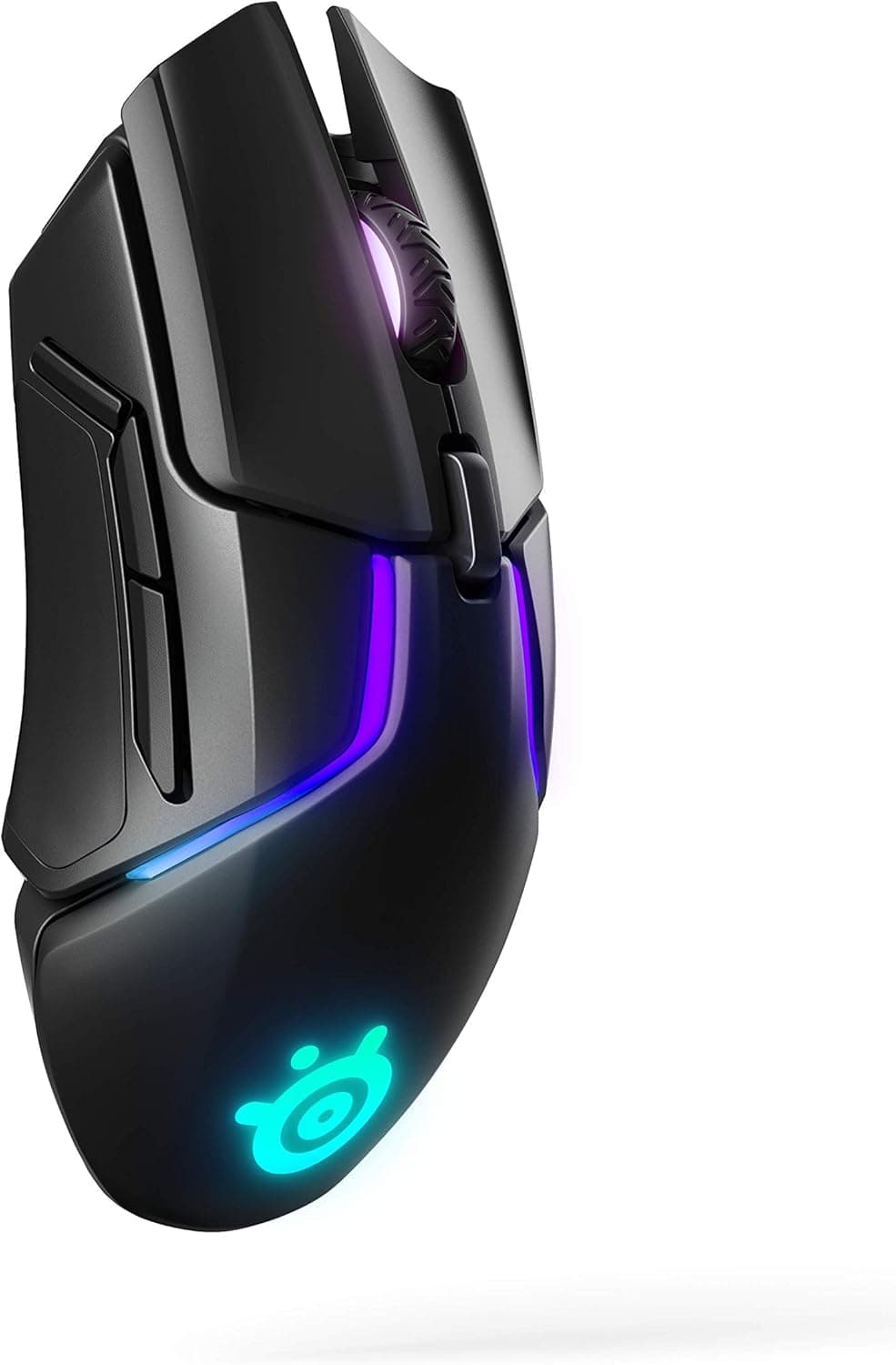
The SteelSeries Rival 650 Quantum Wireless Gaming Mouse, released in 2018, is a wireless mouse that bet on features and weight tuning rather than on being light. Its core pitch is the TrueMove3+ dual optical sensor with up to 12,000 CPI, lift-off distance adjustable from 0.5mm to 2mm, and a 15-minute rapid charge that returns 10 hours of use.
That design philosophy runs directly against the 2026 ultralight trend.
Here is the short answer: this is not a mouse to judge against today's lightweight competitors on the same terms. If you play at low sensitivity, support the mouse with your whole palm, and want to set the center of gravity yourself, it still fits.
If you fingertip-grip and flick, the weight works against you every second. On Amazon.co.jp it holds 4.4 out of 5 stars across 2,219 reviews (88 on a 100-point scale, captured 17 Jun 2026).
| What you want | The answer here |
|---|---|
| A genuinely light mouse | No (~130g body plus weights) |
| Tunable center of gravity | Yes (256 weight configurations) |
| Wired-like feel, no cable | Yes (2.4GHz, wired mode available) |
| Less charging hassle | Yes (24h+ and 15 min for 10 hours) |
| Latest polling rates | No (different generation) |
The decision comes down to two things: weight and generation. Accept both and the sensor and battery side still hold up.
Where Lift-Off Tuning Actually Matters
The "+" in TrueMove3+ refers to a second sensor dedicated to reading how high the mouse has been lifted, separate from the tracking sensor. That is what allows lift-off distance to be set anywhere from 0.5mm to 2mm.
For low-sensitivity FPS players who repeatedly lift and reposition, whether the view drifts at the moment of lift directly affects how repeatable your aim is, so being able to push toward 0.5mm remains a practical advantage.
That said, 0.5mm is not automatically correct.
On thick desk mats or long-pile cloth pads, setting it too low can cause tracking dropouts during normal movement. Start near 1mm and tighten in steps until you find the point where lifting no longer flicks the cursor.
This is a pad-compatibility problem more than a mouse setting.
Compatibility Guide
Windows, Mac and Linux are supported, and a single free USB port is all that is required — the supplied compatibility notes list no chipset requirements. But "it works" and "you can configure it" are separate questions.
CPI stages, lift-off distance and the 8-zone RGB are configured through SteelSeries Engine, and which operating systems that software supports changes over time. Building your profile on a Windows machine first and then moving to another OS is the reliable route.
The wireless link is a dedicated 2.4GHz receiver.
There is no mention of Bluetooth support, so devices that cannot keep a dongle plugged in, or machines without USB-A, become awkward. If you plan to use a USB-C adapter, test the mouse plugged in directly first — adapter quality can make the link unstable.
2.4GHz is also known to pick up interference near USB 3.0 devices; if the connection stutters, move the receiver to a different port or position it closer to the mouse.
Wired mode matters more than it sounds. You can keep playing while charging, so an empty battery never ends a match.
For competitive use, that fallback is the difference between confidence and anxiety.
Product Info
The headline specs: TrueMove3+ dual optical sensor at up to 12,000 CPI, 0.5–2mm adjustable lift-off distance, 24+ hours of battery life, 15-minute rapid charge for 10 hours of use, 256 weight configurations, switches rated for 60 million clicks, and 8 RGB zones.
Note that 256 is 2 to the power of 8 — it describes fitting or omitting eight individual weights, not stepless adjustment. You are moving the balance point front, back, left and right by choosing where the weights sit.
Treat the prices as snapshots. Two figures were captured: ¥18,603 on Rakuten (as of 7 Aug 2026) and $34.99 on eBay US (as of 12 Jul 2026).
The gap is several-fold, which is unsurprising for a 2018 product now circulating mainly as grey-import and remaining stock — new, used and incomplete units all land in the same search results. If you go with an overseas listing, check the condition description, confirm the receiver and charging cable are included, and total up shipping and import taxes before deciding.
Both figures move with sales and exchange rates. Warranty is stated as one year, manufacturer standard.
How It Compares
Lined up against the current lightweight wireless mice covered elsewhere on this site, the difference in character is obvious. The Logitech G PRO X Superlight 2c is 53g, the Pulsar CrazyLight is 38g, and the ATTACK SHARK RS6 ULTRA is 63g.
The Rival 650 is roughly 130g before you add any weights — more than triple the 38g class and over double the 53g class. That is not "a bit heavier"; it is a different category.
On polling rate, the RS6 ULTRA and Razer Viper 8K Hz advertise 8,000Hz, while this mouse should be read as a 2018 design.
Weight is not purely a drawback, though. In low-sensitivity play driven by the wrist and arm, an extremely light mouse can overshoot at the moment you stop, and a fair number of players find some inertia easier to control.
Within the heavy multi-button wireless niche, the Logicool G G502 X LIGHTSPEED sits closest, and which one suits you depends on grip style and sensitivity rather than on spec sheets.
Best Use Cases
- Low-sensitivity FPS players — Lift-off distance tightened toward 0.5mm pays off when you constantly lift and reset the mouse. This is where the dual sensor earns its keep.
- Players who want to tune balance — 256 weight configurations let you shift the center of gravity in ways most mice simply cannot.
- Large hands using a palm grip — Spreading ~130g across the whole palm keeps fatigue manageable.
- Marathon sessions — 24+ hours of runtime plus a 15-minute charge worth 10 hours makes charging almost an afterthought.
- Anyone who wants a wired fallback — Charge and play at the same time; nothing stops mid-match.
Before You Buy
Weight comes first. Around 130g before weights is heavy by the standards of a market where 38–63g is normal.
If you fingertip-grip, you can rule this out on that basis alone. Grey-import units often carry different return terms than domestic stock, so do not buy on the assumption that you will adapt — handle a similarly heavy mouse first if you can.
Then consider battery age. This is a 2018 product, and used or long-shelf units may have degraded cells.
The 24-hour figure is a new-condition rating, and running all 8 RGB zones continuously will shorten real-world runtime. The charging connector is also of its era, so if you expect to share USB-C cables, check the port in the product photos before ordering.
Check warranty and support. Even with a stated one-year manufacturer warranty, grey imports frequently fall outside domestic distributor coverage.
Software updates also slow down for older products, so accept that future OS updates may change how the configuration software behaves.
Finally, question the listing itself. The two captured prices differ several-fold, and retail product pages sometimes carry model numbers or manufacturer fields left over from a different product.
Before ordering, confirm with the product image, title and model number that you are looking at the SteelSeries Rival 650 Quantum Wireless, and verify whether the receiver and charging cable are included.
FAQ
Q. What happens if the battery dies mid-game? A.
Switch to the wired connection and keep playing while it charges. In practice you never have to stop.
Q. Is 12,000 CPI enough? A.
Easily. Most competitive FPS players sit between 400 and 1,600 CPI, so the ceiling is never the limit.
Lift-off behavior and sensor consistency matter far more than the headline number.
Q. Can the battery be replaced? A.
The supplied specifications say nothing about replaceability. Built-in cells degrade with age, so assume less than the rated runtime on used or long-stored units.
Q. Can I configure it fully on Mac or Linux? A.
It operates on any machine with a USB port, but CPI stages, lift-off distance and RGB require the configuration software, whose OS support varies by period. Set up profiles on Windows first.
Q. Is it usable left-handed? A.
It follows the Rival line's right-handed ergonomic shape and is not ambidextrous. Check the side-button placement in the product images before buying for left-hand use.
Q. Is it worth switching from a lightweight mouse? A.
Not if you chose light on purpose. But if you have felt that ultralight mice overshoot when you stop, or that the balance never sits right in your hand, the 256-step weight tuning is hard to replicate elsewhere.