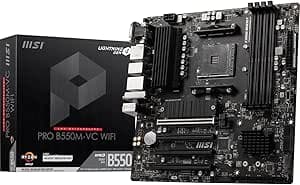
This article covers MSI アーセナル ゲーミング AMD Ryzen 2NDおよび第3世代 AM4 M.2 USB 3 DDR4 DVI HDMI Crossfire ATX マザーボード (B450 Tomahawk MAX II).
Overview
The MSI B450 Tomahawk MAX II is the final and most refined iteration of the iconic B450 Tomahawk series. Based on the AMD B450 chipset, it features an extended PWM heatsink and Core Boost digital power design, enabling stable operation with Ryzen 3000 and 5000 series processors. With a single M.2 Gen3 x4 slot, USB 3.2 Gen2, and a solid VRM layout, this ATX motherboard strikes an excellent balance between price and performance for mid-range gaming builds. Its market position is clearly in the value-oriented mid-range tier—ideal for builders who want reliable performance without paying a premium for PCIe 4.0 or the newest chipset.
Compatibility Guide
Socket AM4 ensures broad CPU support: first through third-gen Ryzen, plus Ryzen 5000 with a BIOS update (version 7C02v3C or later). Memory is DDR4, with support up to 4133 MHz (OC) across four DIMM slots. The ATX form factor fits standard cases. Expansion includes one PCIe 3.0 x16 slot, one PCIe 2.0 x16 (x4 electrical), and three PCIe 2.0 x1 slots. Storage options are one M.2 Gen3 x4 slot and four SATA 6Gbps ports. Power delivery requires a 24-pin ATX and an 8-pin EPS connector. For a typical Ryzen 5 or Ryzen 7 (≤ 105W TDP) build, a 650W PSU is recommended.
Product Info
Released in early 2020, the MSI B450 Tomahawk MAX II originally retailed around ¥13,000–¥15,000. Today, it may command higher prices due to limited stock. Warranty length is three years from MSI. The B450 chipset draws about 6W, while the VRM is rated for processors up to around 105W TDP. Memory capacity is 64 GB max (depending on CPU support). The board features an extended heatsink over the VRM area and Core Boost technology for improved power precision, placing it firmly in the mid-range market. It lacks PCIe 4.0, so it's not for those chasing the latest storage speeds, but for practical gaming and general use, it remains a reliable choice.
Best Use Cases
Budget-Conscious Gamer: Pair with a Ryzen 5 5600X and a mid-range GPU (e.g., RTX 3060 Ti) for solid 1080p/1440p gaming without breaking the bank. The B450's mature BIOS provides stable performance, and you can allocate more budget to the graphics card. Not ideal* if you plan to use a Gen4 NVMe SSD or need PCIe 4.0 for future-proofing.
Home Server / HTPC: With its robust VRM and modest power needs, the Tomahawk MAX II works well for an always-on server or media center using a low-TDP Ryzen 3 or 5. The single M.2 slot is sufficient for boot, and the four SATA ports cover basic storage. Not ideal* if you need many SATA drives (consider a board with 6+ ports).
Platform Upgrade from Older Ryzen: If you're moving from a Ryzen 1000 or 2000 series to a used 3000 or 5000 series CPU, this board offers a cost-effective pathway without buying a new B550/X570 board. Just ensure you have access to an older CPU for the BIOS update first. Not ideal* if you're building from scratch and can get a B550 board at similar price.
Things to Consider
The B450 Tomahawk MAX II lacks PCIe 4.0 support, meaning you won't get full performance from modern Gen4 SSDs (though gaming load times are still good). Additionally, it has only one M.2 slot; adding a second NVMe drive is not possible without an adapter (using the PCIe x4 slot). BIOS Flashback is absent, so updating the BIOS to support Ryzen 5000 requires a compatible CPU already installed. Currently, the retail price of this board is often higher than its original MSRP—in many regions, you can find a B550 board (like the MSI B550-A PRO) for a similar price, offering PCIe 4.0 and often dual M.2 slots. Weigh the value carefully: if you already own the board or find it at a discount, it's still a great performer; if paying full premium, consider alternatives. Also note that the VRM, while good, is not designed for heavy overclocking of Ryzen 9 processors (65W is ideal, 105W is okay with adequate case airflow).
FAQ
Q: Can I use a Ryzen 7 5800X on this motherboard?
A: Yes, after a BIOS update to version 7C02v3C or later. However, the 5800X has a 105W TDP and may push the VRM near its limit under sustained all-core load. Ensure your case has good airflow over the VRM heatsink. A 5800X with PBO enabled might trigger thermal throttling on the VRM; consider limiting PPT to 105W or using a stronger board.
Q: Does it support memory overclocking well?
A: Yes, the board supports DDR4 up to 4133 MHz (OC) and has good memory trace layout for Ryzen's Infinity Fabric. With a Ryzen 5000 CPU, you can typically run 3600–3800 MHz CL16-18 kits stably. Higher speeds (4000 MHz+) may require manual tuning and are often limited by the CPU's memory controller.
Q: Is the B450 Tomahawk MAX II worth buying in 2026?
A: Only if you can find it at a sub-¥5,000 price used or ¥8,000 new. In most regions, the B550 boards offer better value with PCIe 4.0, dual M.2, and often better audio. The main r