Overview
The ANT.TERR.
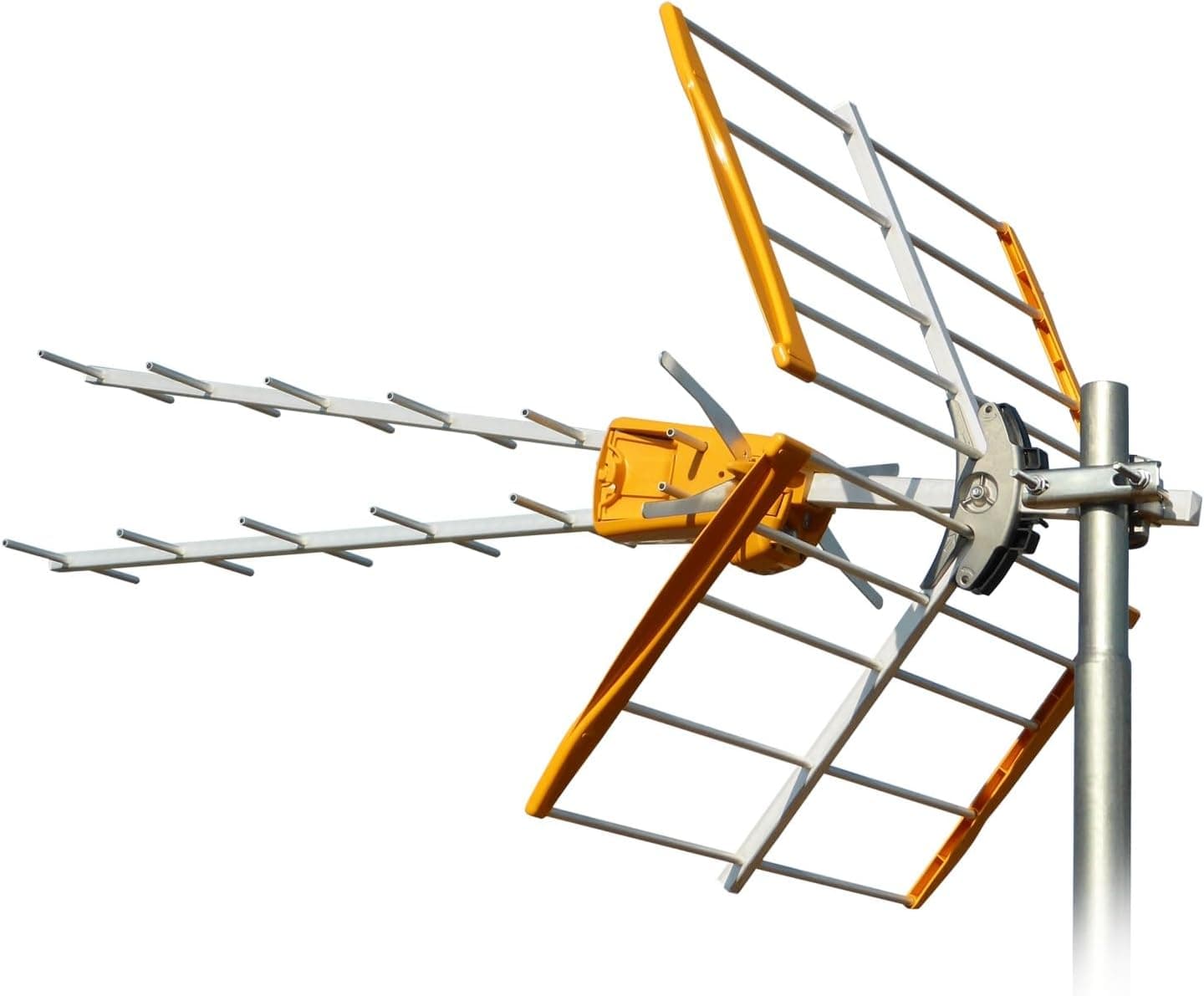
V Zenit UHF (C21-48) G13dBi INDIV. is a high-gain UHF antenna from Televes, a Spanish broadcast equipment maker.
The short version: this is for people in weak-signal areas who only need UHF terrestrial TV. If your current reception is already clean, it is overkill.
Headline figures are 13 dBi of gain, coverage of UHF channels 21–48, and a built-in LTE700 (2nd Digital Dividend) high-band rejection filter.
The stated maximum range is 316,800 ft (about 60 miles / 96 km), and the V-shaped dual-director layout packs that directivity into a 600 mm (23.62 in) body, short for its gain class.
On Amazon.co.jp the listing carried 308 reviews averaging 4.7 out of 5 (94% positive) as captured on 4 September 2026 — a solid sample size for an antenna.
As covered below, though, the channel numbering follows the European allocation, which matters if you plan to use it in Japan.
Reading the Key Specs
| Item | Value | What it means in practice |
|---|---|---|
| Brand | Televes | European broadcast/reception equipment maker |
| Gain | 13 dBi | Roughly 10.85 dBd — above a typical domestic Yagi |
| Frequency range | UHF 21-48 ch | European UHF allocation, roughly 470–694 MHz |
| Max range | 316800 ft (approx 60 miles) | A line-of-sight ideal figure; obstacles cut it sharply |
| Dimensions | 600 mm | Short for a high-gain model; balcony-friendly |
| Channels | 70 | Manufacturer's stated channel count |
| Filter | LTE700 rejection | Suppresses 700 MHz cellular spill-in |
The most misread number here is the 60-mile range. An antenna has no intrinsic "range" spec; figures like this assume clear line of sight.
Real coverage depends on transmitter power, terrain, buildings, trees, and losses in your cable and amplifier chain. Do not read it as a guarantee at 60 miles.
The 13 dBi gain figure is referenced to an isotropic radiator. Japanese catalogues usually quote dBd, which is about 2.15 dB lower for the same antenna.
When comparing products, always compare dBi to dBi or dBd to dBd.
Compatibility Guide
The antenna uses a standard F-type coaxial connection, so ordinary TV coax runs work fine. Packages typically include the antenna only — budget separately for a mast or wall bracket, coax, and self-amalgamating tape for weatherproofing.
At 600 mm it mounts easily on common 25–32 mm masts, which is part of its appeal.
The real thing to check is the channel plan. "C21-48" refers to European UHF channel numbering, corresponding roughly to 470–694 MHz.
Japan's ISDB-T broadcasts also sit in UHF above 470 MHz, so the bands overlap physically, but the channel numbering and modulation standard (DVB-T versus ISDB-T) are different. Band overlap and manufacturer-supported operation in Japan are two separate questions — confirm with the seller before ordering for domestic use.
The lack of VHF support is less of a problem in Japan than it sounds. Since the 2011 analogue switch-off, all Japanese terrestrial digital TV is transmitted in UHF, so no VHF antenna is needed for television.
VHF only matters if you also want FM or community radio on the same mast, in which case a separate antenna is the clean answer. For the signal chain, keep the order antenna → amplifier → splitter → rooms; amplifying after the splitter wastes most of the benefit.
Product Info
On Amazon.co.jp the price was ¥23,371 (tax included) as captured on 5 September 2026.
Prices move with stock and promotions, so check the listing for the current figure. An eBay search is also available for the same model, but per-listing prices vary and must be read directly from the listings.
Reviews stood at 308 with a 4.7/5 average (94% positive) as of 4 September 2026 — an unusually large sample for this product class.
The ANT.TERR.
V Zenit UHF (C21-48) G13dBi INDIV. sits in Televes' professional-leaning lineup, not alongside the ¥3,000–8,000 consumer Yagis on retail shelves.
Treat ¥23,371 as the entry point to professional gear rather than the top of the domestic range.
Warranty terms depend on the seller. This is a marketplace listing rather than a manufacturer storefront, so confirm who handles a defective unit — the shop or the importer — before you buy.
How It Compares
Against the domestic 20-element Yagis sold for a few thousand yen, this loses on price and availability but wins on integration: many cheap Yagis have no LTE rejection filter, so you end up bolting one on, adding insertion loss and another weatherproofing point. Here the filter is built in.
The other axis is length. Conventional Yagis reaching similar gain often run 1.5–2 m of boom.
At 600 mm, this model stays realistic for balcony mounts, low-wind-load roof installs, and buildings with appearance rules. Conversely, if you have space and no wind constraints, a longer Yagi at the same budget can deliver gain more cheaply.
Best Use Cases
- Fringe-area viewers short on signal — high gain and tight directivity attack weak fields directly, though an amplifier and cable review usually belong in the same project.
- Anyone seeing blocking artefacts near cell sites — the built-in LTE700 filter removes the need for a bolt-on filter, and it helps in cities too.
- Installs constrained by space or wind load — 600 mm makes balcony and small-mast mounting practical.
- Installers and semi-pros — Televes build quality suits long service life and standardising across sites.
Before You Buy
This is a European-market antenna sold with European labelling. "C21-48" maps to the European UHF channel plan, not one-to-one onto Japanese physical channels.
The bands overlap, but whether it covers every domestic channel and how it performs with ISDB-T should be confirmed with the seller. Assuming "it says UHF, so it will work" is the single most common mistake with imported antennas.
Also be aware that Amazon listing metadata does not always match the physical product. In this listing the seller and shipper are a marketplace vendor rather than the manufacturer, and it is not clear which standard figures like "70 channels" are measured against.
Verify the product from the title and photos on the page, and treat the spec table as indicative. The ¥23,371 price is a 5 September 2026 snapshot and will likely differ when you look.
Where it is a poor fit: if reception is already clean, a higher-gain antenna will not improve picture quality. Digital TV looks identical above the required signal level, so surplus gain buys nothing.
In strong-signal areas it can even overload the tuner input, forcing you to add an attenuator.
Installation is the other hidden cost. Sharp directivity means a few degrees of misalignment measurably drops the level, and aiming by eye without a signal meter leaves performance on the table.
Roof work carries real risk, so budget for a professional install — often comparable to or more than the antenna itself.
FAQ
Q. Will it receive Japanese terrestrial digital TV as-is? A.
The frequency band overlaps Japan's UHF band, but the channel labelling and target standard are European. Confirm domestic compatibility with the seller before buying.
Q. Does the lack of VHF cost me any channels? A.
Not for television in Japan — all terrestrial digital broadcasting has been UHF since 2011. VHF only matters for FM and similar services.
Q. Will it work at 60 miles (96 km)? A.
That figure assumes clear line of sight. Terrain and buildings dominate in practice, so check for obstructions toward the transmitter rather than trusting distance alone.
Q. Should I add an amplifier? A.
Amplify close to the antenna and before any splitter. In strong-signal areas an amplifier can cause overload, so measure your level first.
Q. Are mounts and cable included? A.
Usually the antenna only. Budget for a mast, bracket, coax, and weatherproofing, and confirm contents on the listing since they vary by seller.
Product Disclosure (Amazon)
- Manufacturer: Televes
- Seller: ★第二期ユーエスエヌ★
- Fulfilled by: ★第二期ユーエスエヌ★
- ASIN: B07YCQTXDR
- Note: This article covers a manufacturer-made product based on Amazon listing details.