Overview
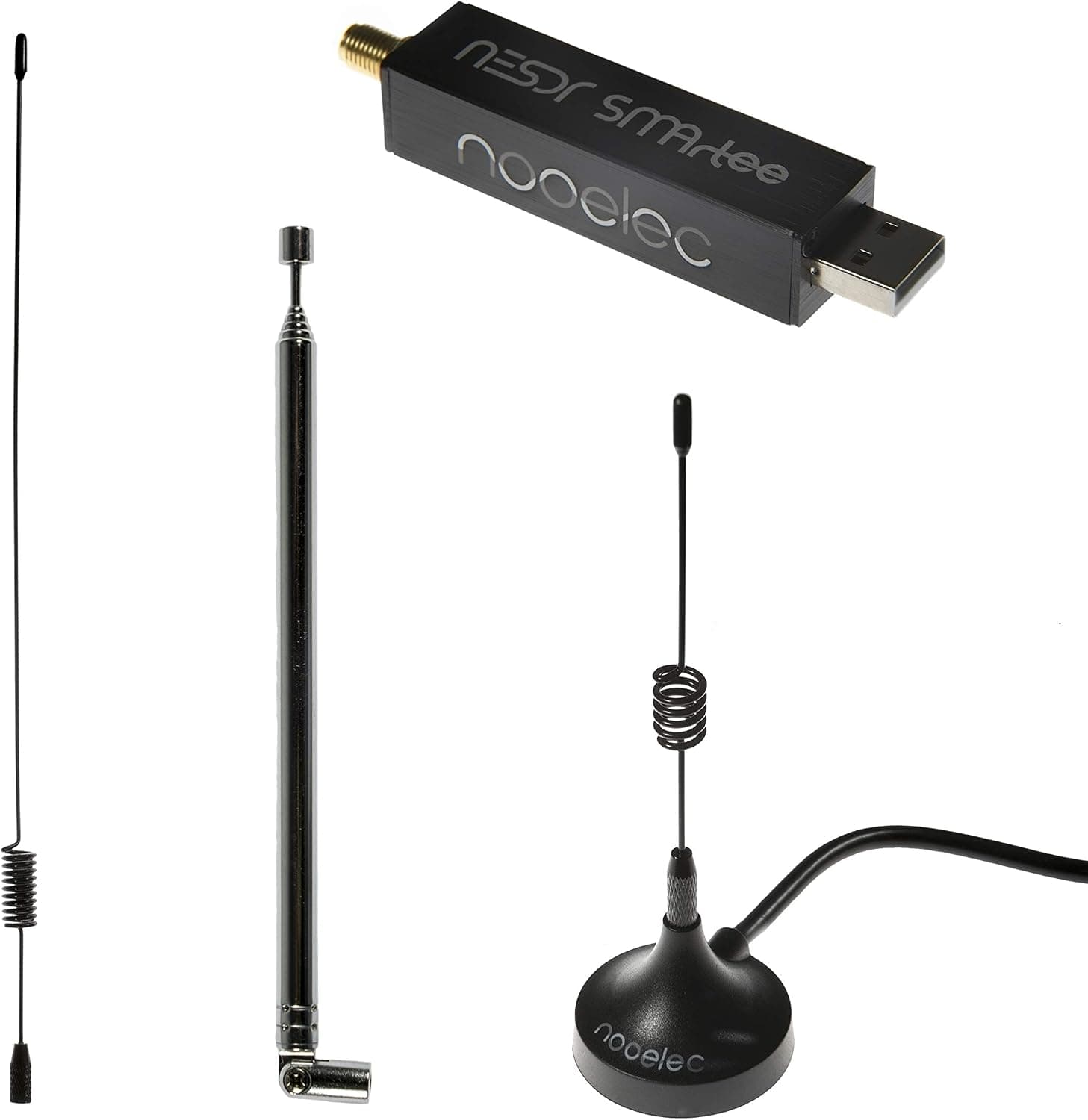
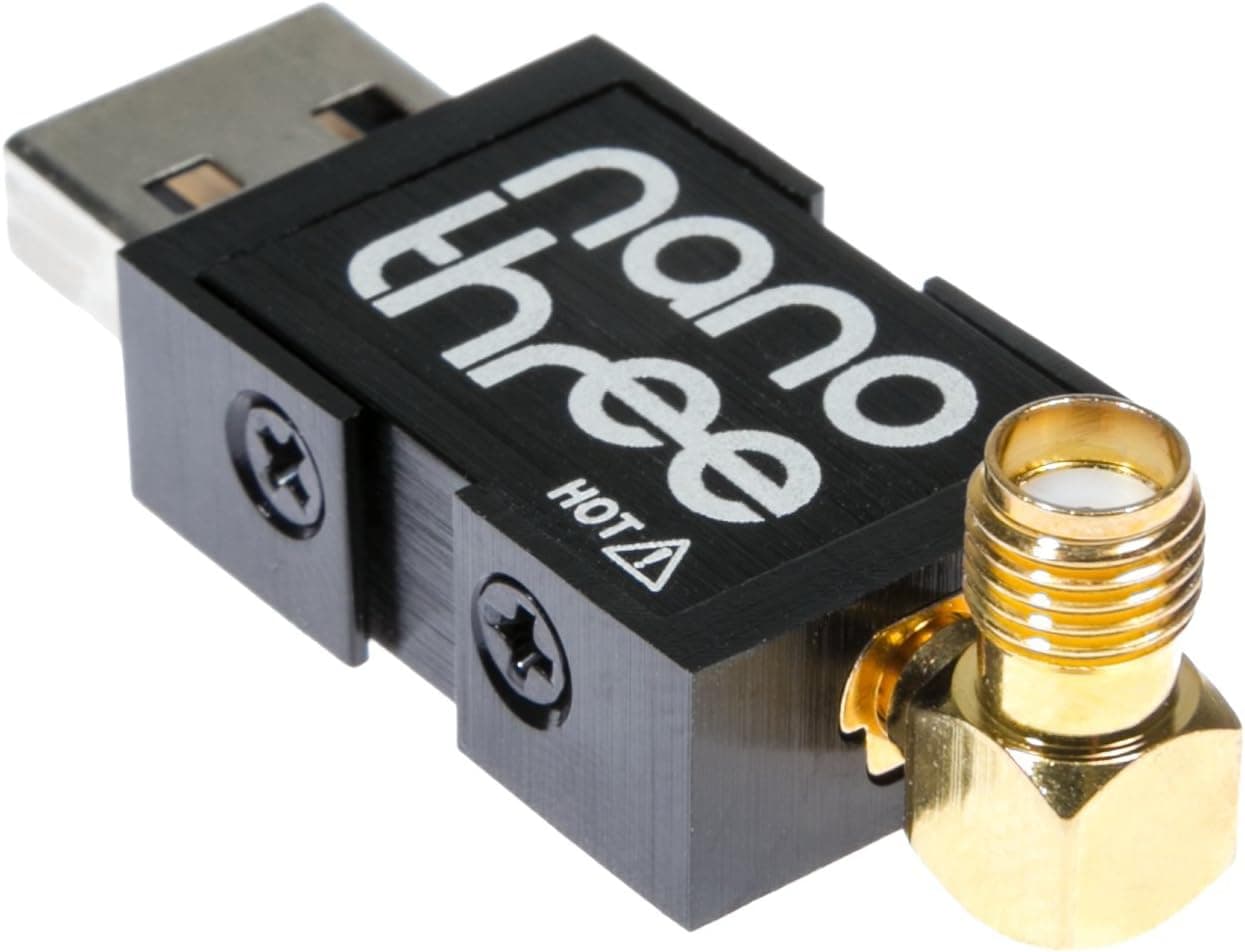
The Nooelec NESDR Nano 3 — Premium Compact RTL-SDR with Aluminum Enclosure is an ultra-compact USB software-defined radio (SDR) receiver built on the RTL2832U and R820T2 chipsets. It suits anyone who wants to listen to and log VHF/UHF signals such as ADS-B aircraft positions, FM broadcasts and airband, with the dongle left plugged into a laptop or Raspberry Pi.
It covers 25MHz to 1700MHz. Its 0.5PPM TCXO (temperature-compensated crystal oscillator) keeps the frequency drift common in cheap RTL-SDR dongles under control.
The aluminum enclosure measures 17×8×20mm and weighs 15g, so it is about as easy to carry as a USB flash drive. The metal shell shields against outside noise (EMI) and also gets rid of heat.
Fitting the included custom heatsink to both sides improves cooling further. However, it is receive-only and cannot tune shortwave below 25MHz or the 2.4GHz band.
Once you know what it can and cannot do, it rarely disappoints.
What Can You Receive Between 25MHz and 1700MHz?
It is hard to picture what '25-1700MHz' actually gets you, so here are typical uses with approximate frequencies.
| Use | Approx. frequency | On the Nano 3 |
|---|---|---|
| FM broadcast | 76-108MHz (region dependent) | In range. Good first test |
| Airband (AM) | Around 118-137MHz | In range. Easier near airports |
| Weather satellites (e.g. Meteor-M series) | 137MHz band | In range. Needs a dedicated antenna |
| Marine AIS | 161.975 / 162.025MHz | In range |
| Amateur radio (receive only) | 144MHz, 430MHz, 1200MHz bands | In range. No transmit |
| ADS-B | 1090MHz | In range. Signature use |
| Shortwave / AM broadcast | Below 25MHz | Out of range. Needs an upconverter |
| Wi-Fi / Bluetooth | 2.4GHz | Out of range |
In concrete terms, 0.5PPM means an error of at most about ±545Hz at 1090MHz and ±50Hz at 100MHz.
Wideband signals like ADS-B decode fine even with some drift. The TCXO matters most for narrowband FM and amateur digital modes, where a few hundred hertz of error can stop reception.
Because it barely drifts as it warms up, you rarely need to retune between power-on and an hour later.
One warning: the US NOAA analog (APT) weather satellites, long the classic beginner target on 137MHz, were retired one after another in 2025. Following an old tutorial and waiting for a NOAA pass will get you nothing.
If you want to try weather satellites, check which satellites are operating at the time before you start.
Compatibility Guide
The Nano 3 connects over USB 2.0 and runs on USB bus power, so no external supply is needed.
It also works in USB 3.x ports.
Supported platforms are Windows, macOS, Linux, Android and Raspberry Pi OS. It works with major SDR software including CubicSDR, HDSDR, SDR Touch, Stratux, Planeplotter, GQRX and SDR#.
Almost any platform with librtlsdr support can use it, and it also pairs with signal-processing tools such as MATLAB and GNU Radio.
The listed antenna connectors are SMA (female) and MCX (female), switched using the included adapter. That means antennas with either male SMA or male MCX plugs will fit.
Most aftermarket SDR antennas and coax use SMA, so check what your antenna has first. Whether the Nano 3 can power an antenna or LNA (low-noise amplifier) over the coax, known as a bias tee, is not stated in our spec data.
If you plan to use an active antenna or LNA that needs power, check the product page or arrange a separate power source.
In practice, most problems come from physical placement and noise.
- Plugging straight into the PC is not always best: A computer is full of noise sources, and a dongle plugged directly into it can lose sensitivity. A short USB extension cable often fixes this.
- Strain on the USB port: The body is tiny, so a stiff coax cable acts like a lever on the port. An extension cable also protects the port from damage.
- Android: You need a phone or tablet that supports USB OTG, plus an adapter cable. Support depends on the app and device, so check user reports first.
- macOS: There is less software than on Windows. Pick programs that have a Mac version, such as GQRX or CubicSDR.
Setup (Windows, Linux, Raspberry Pi)
On Windows, SDR software often cannot see the dongle right after you plug it in. The RTL2832U was originally a digital TV chip, and Windows may load a TV tuner driver for it.
The usual fix is to use the Zadig driver tool to assign the WinUSB driver to the device, which normally shows up as 'Bulk-In, Interface (Interface 0)'. Then open SDR# or HDSDR and check that you can hear an FM station first.
On Linux and Raspberry Pi, install the rtl-sdr package and run rtl_test to confirm the device is detected. If the kernel's DVB-T driver (dvb_usb_rtl28xxu) grabs the device first, blacklist it and reboot.
For ADS-B, the common setup is a dump1090-based decoder feeding an aggregator such as FlightRadar24 or ADSBexchange.
One trap applies to every OS: two programs cannot use one dongle at the same time. If one program holds the device, the other fails with a 'device busy' error.
Use one dongle per application, or serve the device from a single process with something like rtl_tcp.
Product Info
| Item | Value |
|---|---|
| Chipset | RTL2832U + R820T2 |
| Frequency range | 25MHz - 1700MHz |
| TCXO stability | 0.5PPM |
| Dimensions / weight | 17 x 8 x 20 mm / 15g |
| Antenna connector | SMA (female) + MCX (female) via adapter |
| Interface | USB 2.0 |
| Enclosure | Aluminum |
| Warranty | 2 years |
As of September 7, 2026, the price on Amazon.co.jp was ¥9,495.
Sales and exchange rates change it, so check the listing for the current price before you buy.Check the retailer's page for the latest user reviews.
The included accessories are a custom heatsink and an SMA-to-MCX adapter. No antenna is listed among these accessories. Check the listing to see whether an antenna is bundled, and if not, buy one suited to your use.
It sits at the entry-to-midrange level of RTL-SDR receivers. Compared with cheaper dongles built on the same chips, it has three advantages: the 0.5PPM TCXO, the shielded aluminum shell and its small size.
Its tuning range is not very different from other R820T2-based RTL-SDRs. Think of the extra cost as paying for precision and portability, and the buying decision becomes easier.
How It Compares With Other SDRs
- Larger RTL-SDR dongles: They cover roughly the same range. Bigger housings handle heat more easily, but the Nano 3's size wins when you leave it plugged into a laptop or Raspberry Pi.
- Dedicated ADS-B dongles (with a built-in 1090MHz filter and LNA): If you only track aircraft, a dedicated unit will pick up more distant planes. The reason to choose the Nano 3 is that you also want to listen to other bands.
- SDRs with a built-in HF upconverter, or wideband SDRs: For shortwave or 2.4GHz analysis you need a different class of hardware. The HackRF One, for example, covers 1MHz-6GHz, but it costs much more, and you need a radio license to use its transmit function.
Best Use Cases
- Aviation fans starting an ADS-B feeder: It is a natural fit for receiving 1090MHz ADS-B and feeding FlightRadar24 or ADSBexchange. Its small size makes it easy to leave on a Raspberry Pi by a window. It has no dedicated ADS-B filter or LNA, so add an external LNA or a 1090MHz antenna if you want to reach distant aircraft.
- SDR beginners: One dongle lets you try FM broadcast, airband and amateur radio reception. The TCXO cuts down on time spent fixing frequency offsets, so there is one less thing to trip over.
- Always-on Raspberry Pi projects: Its small size and low power draw suit a Pi running without a screen. Pairing it with dump1090 or Stratux is a classic setup. Use a USB hub if you run out of ports, and a power adapter with plenty of headroom if the power supply is unstable.
- Portable and field use: At 15g, with a tough aluminum shell, it suits field work and laptop use on the move. Outdoors, put it in a waterproof case or similar.
Before You Buy
This is not a storage product. On our site it is filed alongside items like external SSD enclosures, but the Nano 3 is a radio receiver.
The 'enclosure' in its name is the metal shell around the radio board, not a drive case. If you are shopping for an SSD or HDD enclosure, this is not it.
It is receive-only and cannot tune out-of-range signals. It cannot transmit and is no substitute for an amateur radio transceiver.
Shortwave and medium wave below 25MHz (AM and shortwave broadcasts) are out of range, as is the 2.4GHz band (Wi-Fi and Bluetooth).
An upconverter adds shortwave reception, but for 2.4GHz work you need a different product.
Strong signals can hurt reception. The RTL2832U has an 8-bit ADC, and about 2.4MHz of bandwidth is the generally stable limit.
Near FM transmitters or cell towers, strong signals can drown out the weak signal you want. If that happens, add something like an FM band-stop filter.
Do not expect the sensitivity of an expensive wideband SDR.
It runs hot. RTL-SDRs tend to heat up during long sessions.
The aluminum shell is designed to move heat outward, so feeling warmth on the case is normal. For 24/7 use, fit the included heatsink and keep it in a well-ventilated spot.
The antenna matters most. Your antenna and where you put it decide results more than the dongle does.
For ADS-B, mount an antenna tuned for 1090MHz as high as possible with a clear view of the sky. Coax loses a lot of signal at 1090MHz, so long cable runs hurt.
Legal note for Japan: Receiving is generally allowed in Japan, but the Radio Act forbids passing on or using the content of radio communications meant for a specific party. Do not post what you overhear on social media.
Check the listing: The NESDR line includes similarly named older models such as the 'Nano 2+'. When buying, check the photos and title to confirm the listing really is the Nano 3.
In our collected data, pricing labeled as 'global' actually pointed to the Japanese Amazon page, so listing information can be inconsistent. Do not take the page at face value; confirm the model name.
FAQ
Q. Can I watch digital TV with it? A.
It is not meant to be a TV tuner. The RTL2832U was designed for the DVB-T standard used overseas and is not generally used to watch Japan's terrestrial digital TV (ISDB-T).
Q. Does it work on Windows 11? A.
Windows is listed as supported. In most cases you first need to switch it to the WinUSB driver with Zadig, or SDR software may not see it.
Q. Do I need PPM correction? A.
With a 0.5PPM TCXO, most uses need no correction or only a tiny one.
For narrowband digital modes, it is worth checking the offset once against a known frequency.
Q. Can a Raspberry Pi receive ADS-B 24/7 with it? A.
Yes. Its small size and low power draw suit continuous use.
Because it gets warm, fit the heatsink, keep the area ventilated and give the Pi a power supply with headroom.
Q. Is an antenna included? A.
The accessory information this article is based on lists only a heatsink and an SMA-to-MCX adapter. Check the listing to see whether an antenna is bundled.
Product Disclosure (Amazon)
- Manufacturer: NooElec
- Seller: Nooelec Japan
- Fulfilled by: Amazon
- ASIN: B073JZ8CC2
- Note: This article covers a manufacturer-made product based on Amazon listing details.