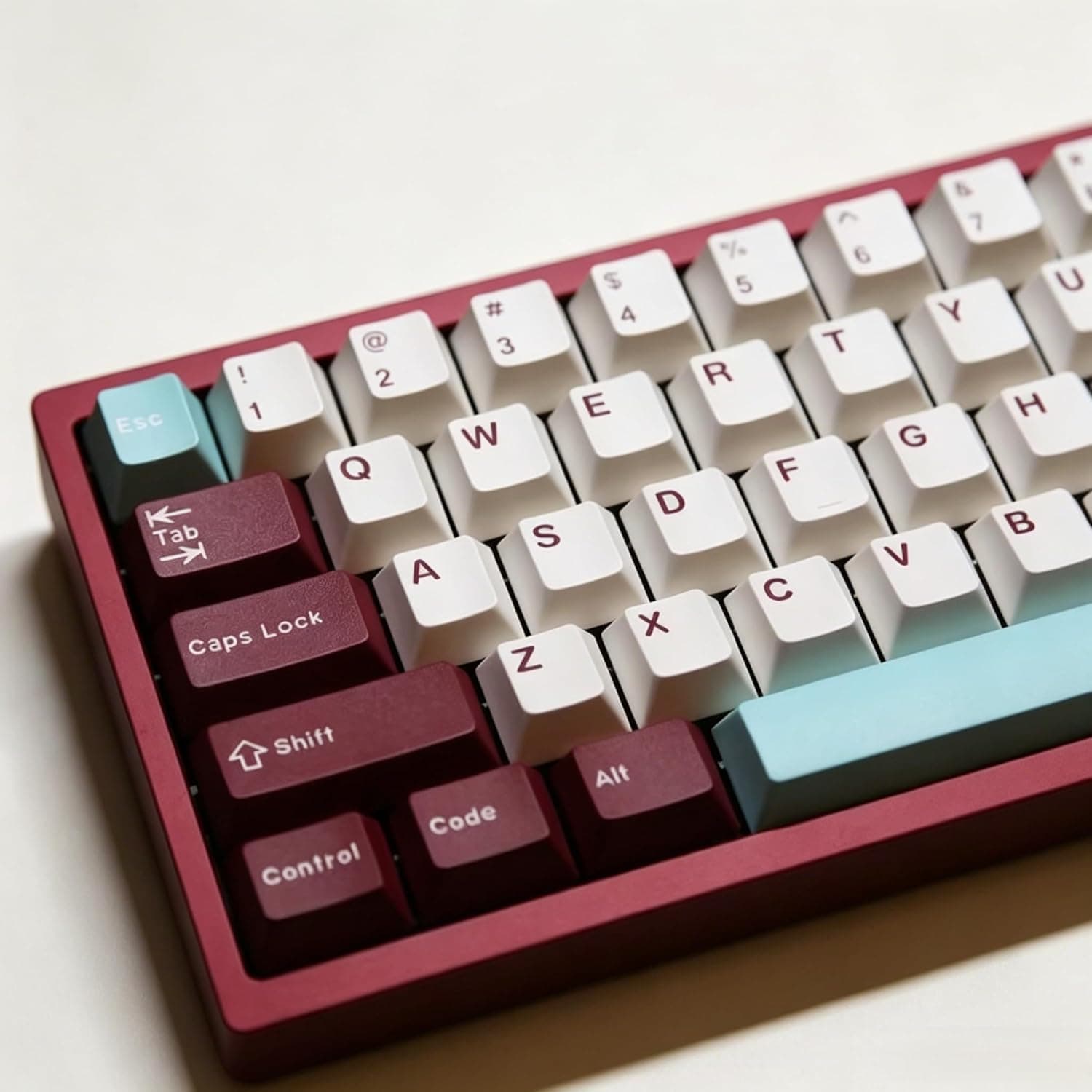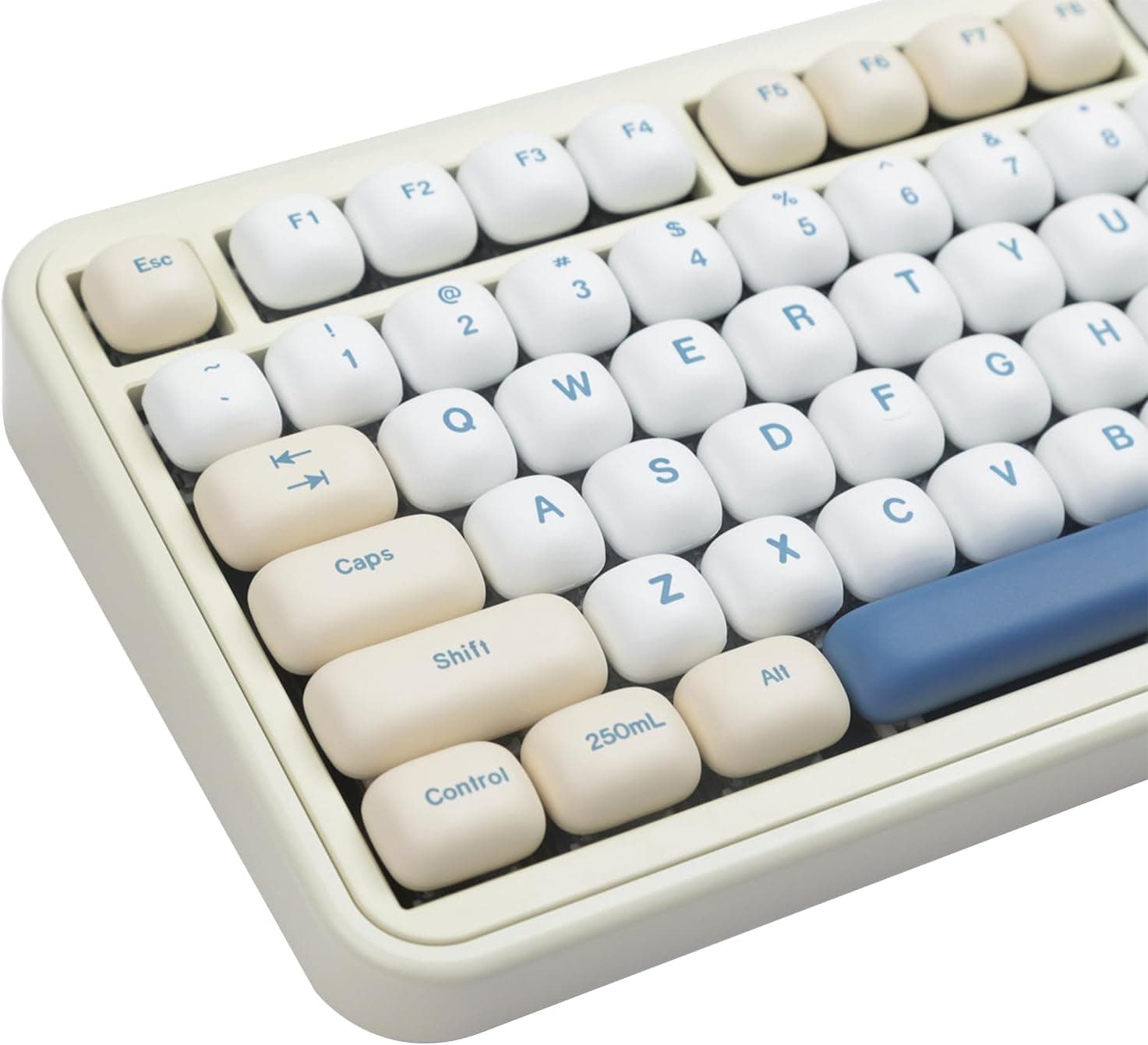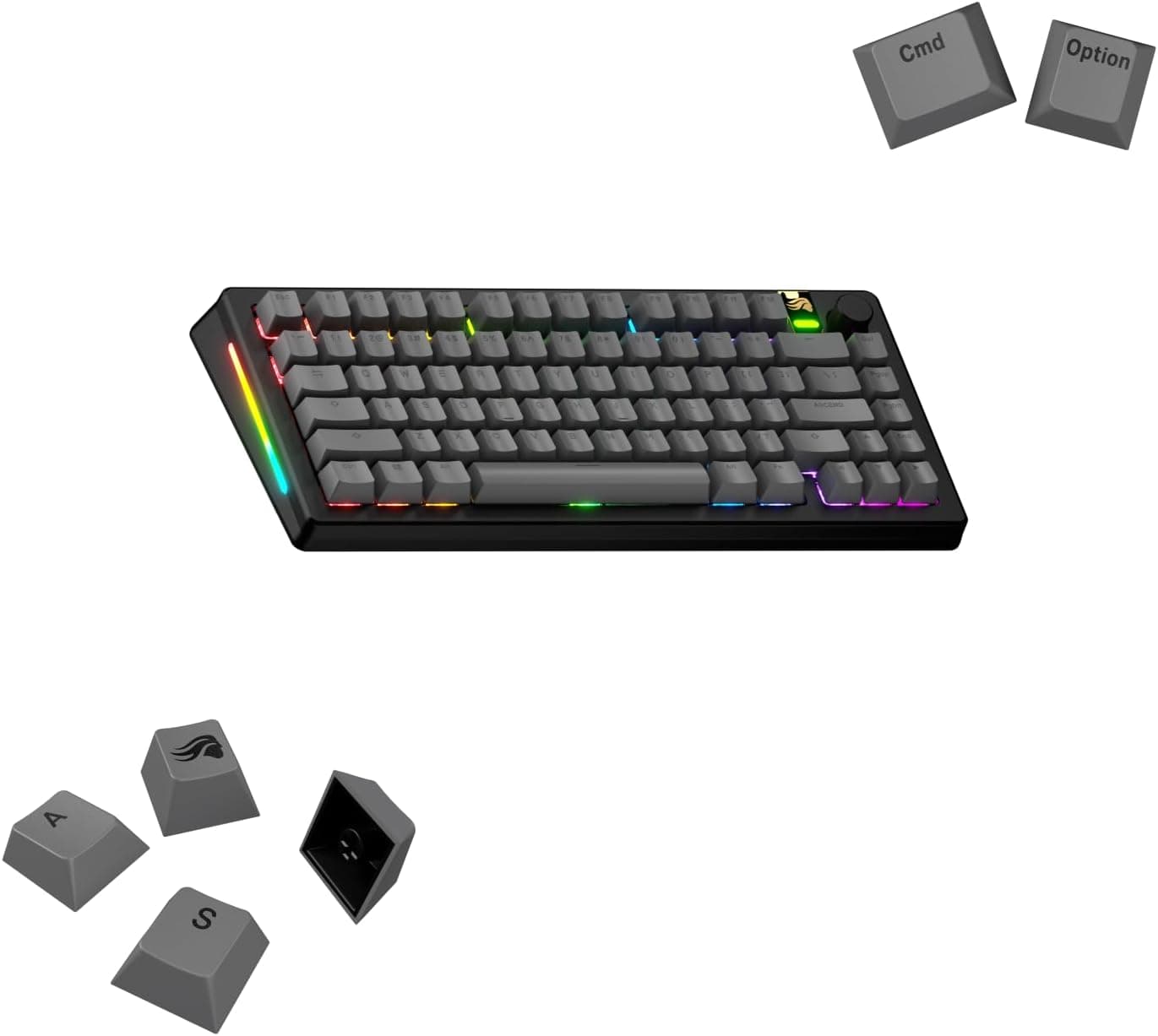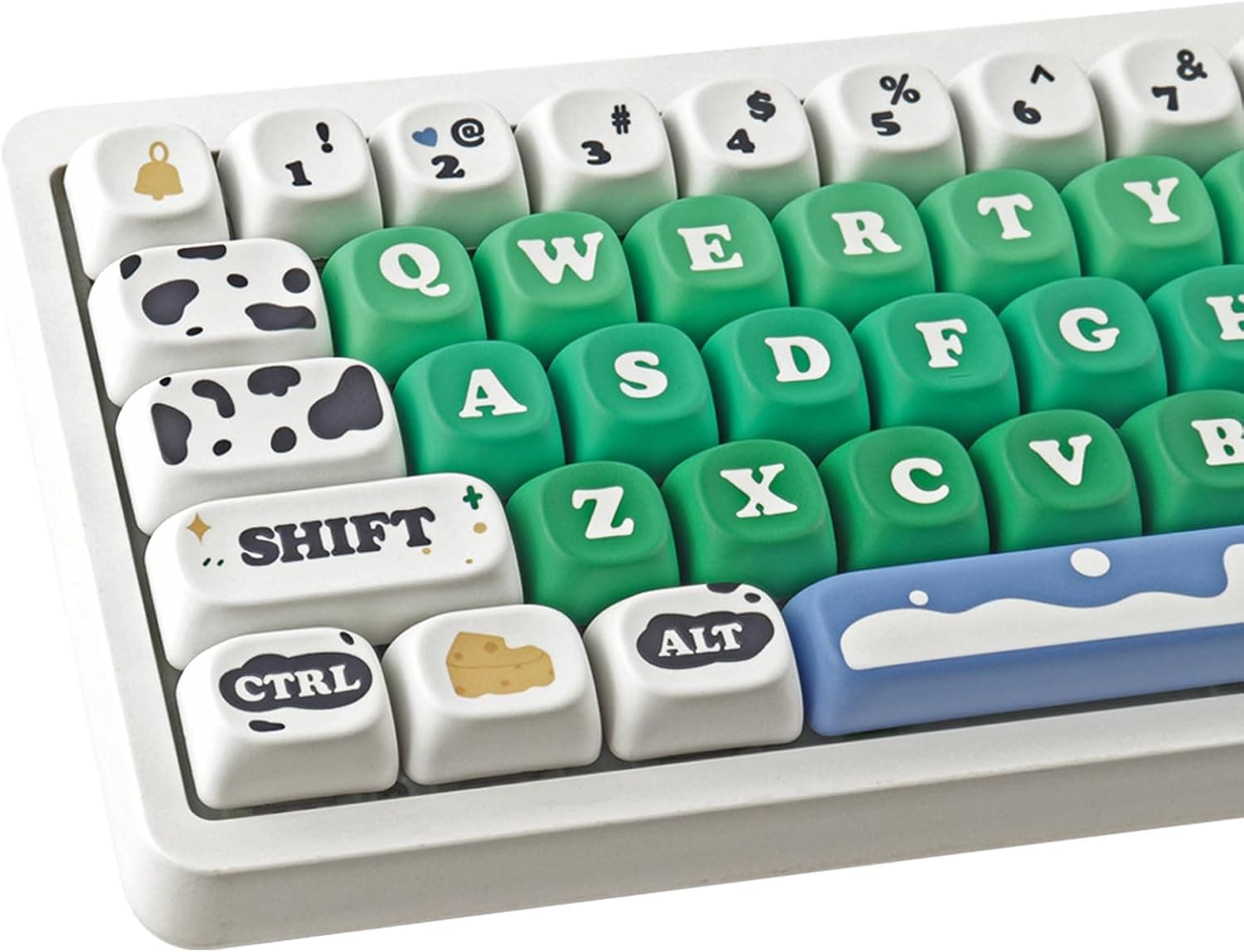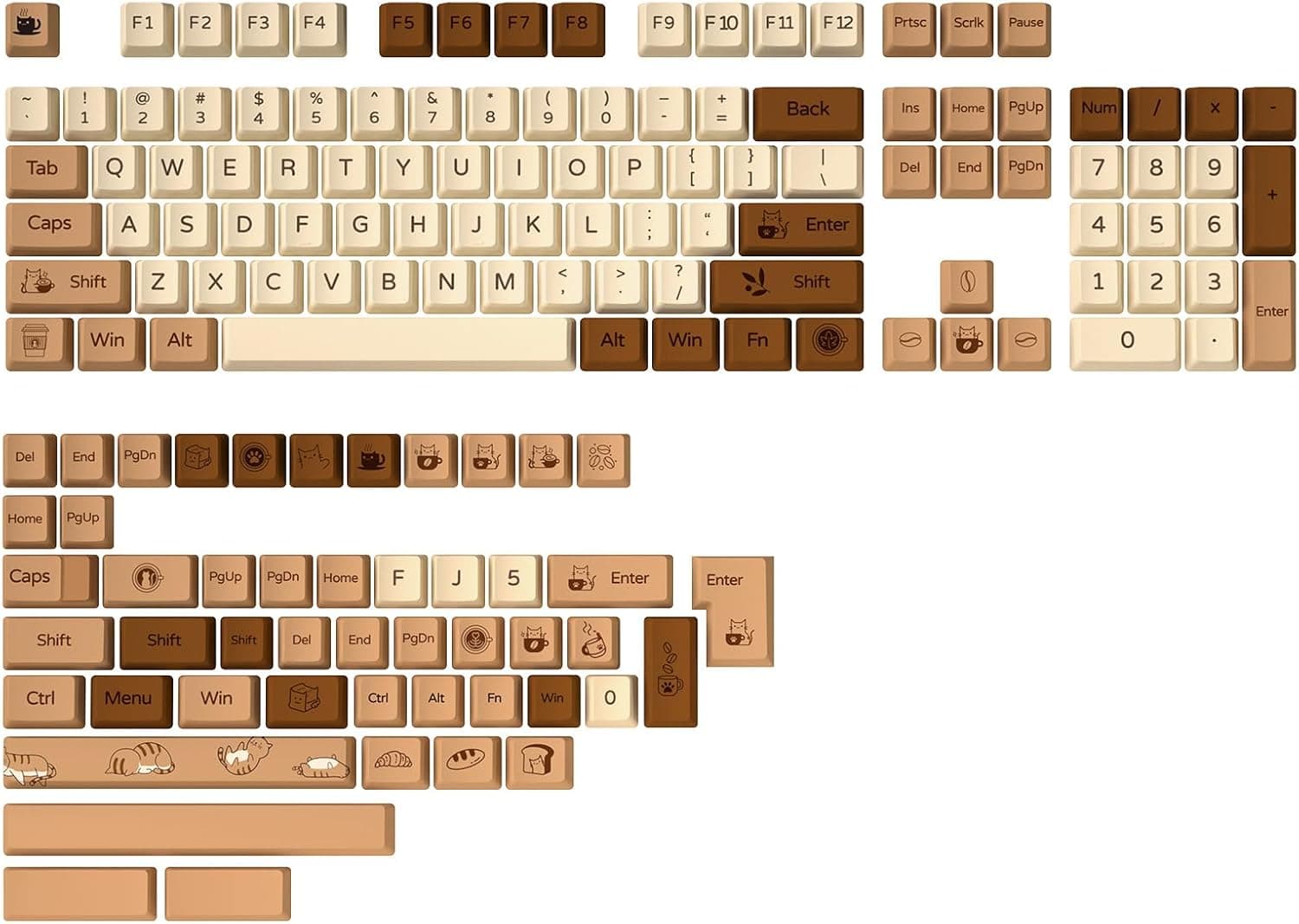
This article covers the YUNZII コーヒーキャット PBT 昇華型キーキャップ 152キーカスタムキーキャップ キープーラー付き Cherry Gateron MXスイッチ対応(チェリープロファイル)— a 152-key custom keycap set — with a focus on the compatibility checks people skip and regret.
Overview
The YUNZII Coffee Cat PBT dye-sublimation keycap set includes 152 keys in the Cherry profile, molded in PBT with dye-sublimated legends, and fits Cherry MX, Gateron MX, and other MX-style cross-stem switches. On Amazon.co.Check the retailer's page for the latest user reviews.
The short verdict: this set is optimized for two people — someone replacing a full set of keycaps for the first time, and someone who simply wants the cat-and-coffee look on their desk. If you want your RGB backlight to shine through the legends, or you type on an ISO or Japanese (JIS) layout board, check carefully before ordering.
A 152-key count exists to cover many layouts; it does not guarantee every key on your board is covered.
Dye-sub PBT is a genuine strength at this price. Legends are dyed into the plastic rather than printed on top, so they cannot wear off, and PBT's harder surface resists the greasy shine that ABS develops.
If you type all day, that difference shows up over years, not months.
Compatibility Guide
The requirement is a mechanical keyboard with Cherry MX-style cross stems: Cherry MX, Gateron MX, Kailh MX, and MX clones all work. Topre, Alps, low-profile-specific stems, scissor-switch, and membrane boards physically cannot accept these caps.
Judge by the stem shape, not by whether the board is "mechanical" — pull one cap and look at the switch top.
Supported layouts listed include 61/87/104/108/84/64/98/96 keys and full-size, plus 2.25u and 2.75u split spacebars and a 7u spacebar.
The most common failure point is spacebar and right-side modifier widths. Many 65% and 75% boards use a 1.75u right Shift or a row of 1u modifiers, and widths vary by manufacturer.
If your board deviates from standard ANSI (6.25u space, 2.25u left Shift, 2.75u right Shift), compare your layout diagram against the set key by key.
A JIS caveat: Japanese layouts add 半角/全角, 変換, 無変換, and かな keys, use a short right Shift, and an inverted-L Enter. Sets like this are built around ANSI, so a JIS board will typically end up with a mismatched Enter and leftover or missing bottom-row keys.
For JIS, buy a set that explicitly states Japanese-layout support.
Cherry is a sculpted profile — each row has its own height and angle — so caps must go back on the same row they came from. Mixing R1–R4 makes the typing surface uneven.
Lay the old caps out row by row before you start. Cherry also sits slightly lower than OEM, so moving from a stock OEM set shortens finger travel a touch.
On backlighting, be clear-eyed: dye-sub PBT is opaque. Legends do not light up.
RGB only leaks around the edges, and on some boards it is barely visible.
Pre-install checklist
| Check | Where to look | Symptom if wrong |
|---|---|---|
| Stem shape | Pull a cap; is the stem a cross? | Caps won't seat at all |
| Spacebar width | 6.25u / 7u / split | Only the spacebar won't fit |
| Right Shift & bottom row | 1.75u vs 2.75u; how many 1u | A few keys left over or missing |
| Layout | ANSI vs JIS | Enter and IME keys don't match |
| Backlight | Do you want lit legends? | Disappointment |
The first three cannot be settled from the product page. You have to look at the keyboard in front of you — the spacebar in particular is usually discovered only after everything else is installed.
Product Info
Key specs: 152 keys, Cherry profile, PBT, dye-sublimation printing, MX-compatible switches, package dimensions 381 x 51 x 51 mm, and an included keycap puller.
Price on Amazon.co.jp was ¥9,505 as captured on 2026-08-28.
Keycap pricing moves with stock and sales, so confirm the current figure on the product page before buying. An eBay search link also exists, but listings are individually priced with no fixed amount, and private sellers carry more risk of transit damage or missing keys than an Amazon order.
Not a huge sample, but 4.7 indicates no widespread defect such as legends flaking or caps that refuse to seat.
Note that low keycap ratings usually stem from layout mismatch rather than build quality — read which keyboard a reviewer used, not just the star count.
Product Disclosure (Amazon)
- Manufacturer: YUNZII
- Seller: Amazon US
- Fulfilled by: Amazon US
- ASIN: B0BNN5MS6N
- Note: This article covers a manufacturer-made product based on Amazon listing details.
How It Compares
Against other PBT dye-sub character sets, three axes actually decide the purchase:
- Profile: Cherry (low, sculpted), OEM (slightly taller, sculpted), XDA/DSA (flat, uniform height), MDA/MOA (rounded, mid-height). Coming from stock OEM, Cherry feels familiar; coming from a flat XDA set, the sculpting changes the feel noticeably.
- Key count and layout coverage: 152 is generous, but generous is not the same as matching your board. Sets that explicitly claim ISO or JIS support are safer for those users.
- Shine-through: If you want lit legends, you need a translucent set. Dye-sub PBT and shine-through are fundamentally incompatible.
The honest positioning: you buy this set for the design and the key count. Finer legend detail and color accuracy exist further up the price ladder — but PBT plus dye-sub at this price is real durability, not marketing.
Best Use Cases
- Heavy typists bothered by shine: PBT plus dye-sub is a clear upgrade over the ABS caps bundled with most keyboards.
- Desk-aesthetic changes: The cat-and-coffee palette transforms a plain black board without leaning on RGB.
- Owners of several keyboards: Coverage from 61 to 108 keys means one set may serve two boards — check each spacebar width first.
Things to Check Before Buying
Not for RGB fans. Opaque dye-sub PBT means unlit legends and only edge glow.
Treat this as a set for a backlight-off, calm-looking desk. If RGB matters, buy a shine-through set instead.
Layout mismatch is the number-one regret. "152 keys, surely it fits" leads to a spacebar that won't seat or one missing bottom-row modifier.
Compact 65%/75% boards and JIS boards are the usual victims. Before ordering: pull a cap to confirm the stem, then verify spacebar and right Shift widths.
Wrong removal technique breaks stems. Grip opposite corners with the puller and lift straight up.
Angling it can snap the cross stem. Stabilized keys — spacebar, Enter, Shift, Backspace — must be lifted evenly from both ends, or the stabilizer wire pops out and reseating it costs you time.
Keep the rows organized. Because Cherry is sculpted, caps must return to their original rows.
Photograph the board first; it saves guessing during reinstall.
Verify the listing yourself. Amazon listing metadata — manufacturer, model, compatibility notes — can lag behind the item actually shipped, especially when color and key-count variations share one ASIN.
Everything here reflects the listing as captured; before ordering, confirm the product images, the title, and your selected variation match what you intend to receive.
Sound barely changes. PBT tends to sound slightly deeper and drier, but switches, lubing, and case foam matter far more.
Don't expect keycaps alone to quiet a loud board.
FAQ
Q: Do these work with RGB backlighting? Dye-sub PBT is opaque; light only leaks around the cap edges.
Choose a shine-through set if lit legends matter.
Q: How do I confirm they fit my keyboard? A: Three steps: (1) pull a cap and confirm a cross-shaped MX stem; (2) check whether your spacebar is 6.25u, 7u, or split; (3) match your right Shift and bottom-row modifier widths against your layout diagram.
Q: Will these work on a Japanese (JIS) keyboard? A: Usually not cleanly.
Sets like this assume ANSI, so the inverted-L Enter, short right Shift, and IME keys typically won't line up. Buy a set that states JIS support, and check the listing's layout image first.
Q: How long does the swap take? A: Roughly 30–60 minutes for a first full-size install.
Nothing is difficult, but pull stabilized keys slowly and evenly from both ends.
Q: PBT vs ABS — what's the difference? A: PBT is harder and resists the greasy shine ABS develops, and dye-sub legends can't wear off.
ABS offers brighter colors and, in double-shot form, shine-through.
Q: What's the rating? co.jp (captured 2026-08-28).
Read which keyboards reviewers used — most low scores come from layout mismatch, not quality.