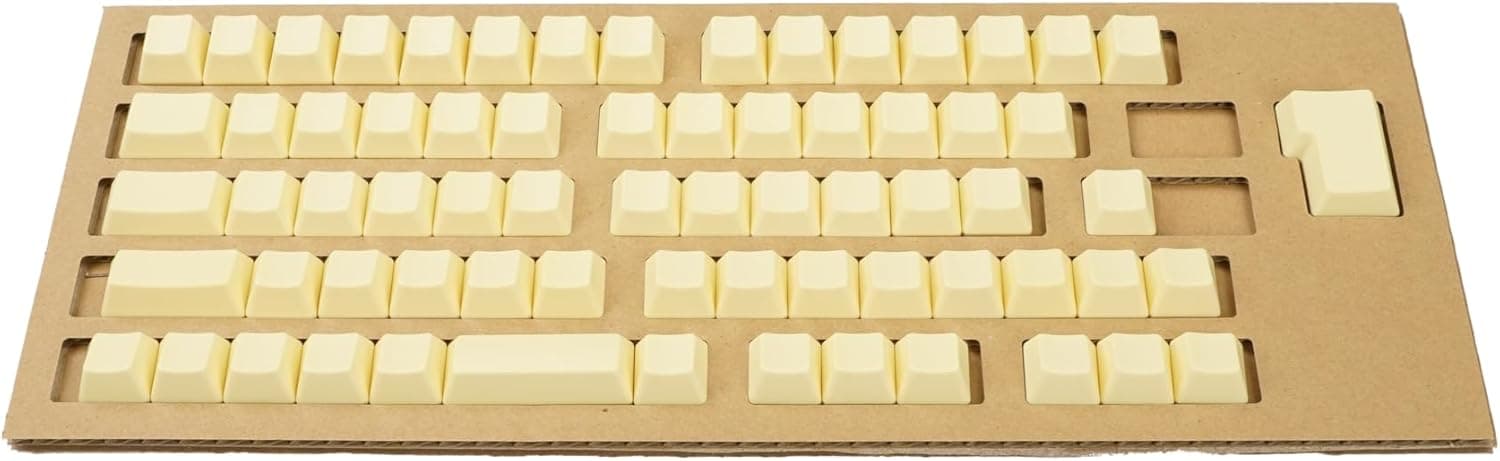
This article covers the PFU HHKB Professional Series Keycap Set, Japanese Layout, Blank, Dandelion (PD-KB420KTLYN) — what it fits, how the swap goes, and who should skip it.
Overview
PD-KB420KTLYN is PFU's official replacement keycap set for Japanese-layout models of the HHKB Professional series. To be blunt up front: this is not a performance part, it is an appearance part.
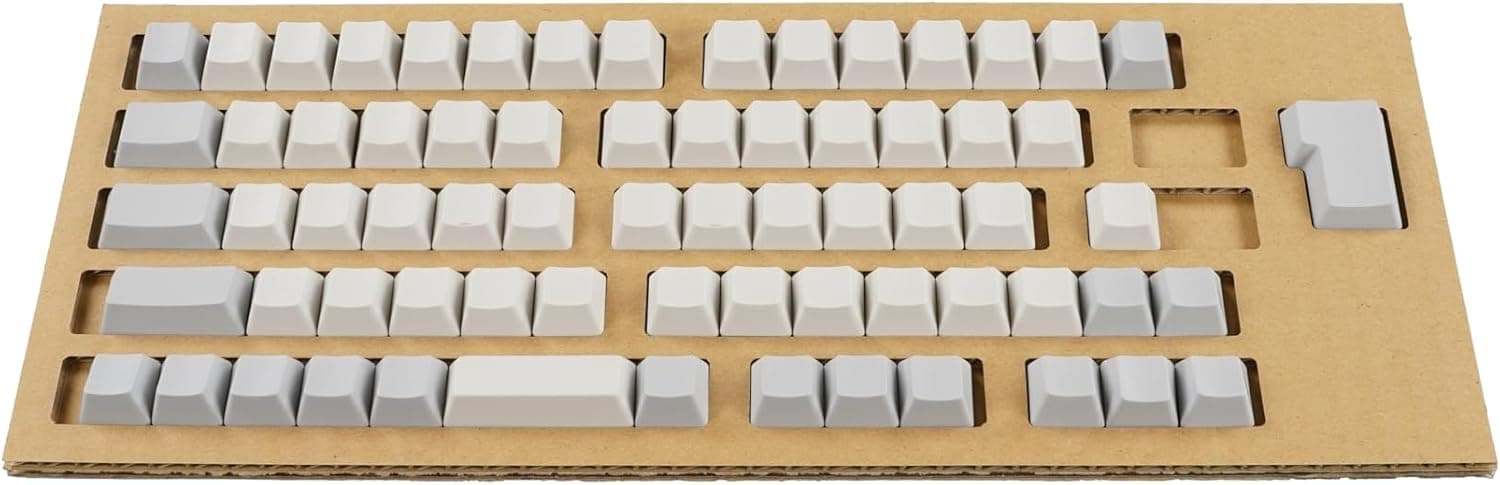
It only makes sense if you already own a compatible HHKB and want to change how it looks. The dandelion-yellow color is warm and bright, like spring sunshine, and the caps are completely blank — no legends at all — which pushes the board firmly toward a minimal aesthetic.
The package contains all 69 keycaps, a keycap puller, and an instruction manual. Because the puller is included, you do not need to buy any extra tools even if this is your first keycap swap.
The flip side is that the set is sold only as a complete package: individual keys are not available separately.
This is the third release in PFU's "Color Keycap Project," so you can mix it with the project's white or ink-black center-legend sets to build a two-tone layout of your own. On Amazon.co.jp it holds 4.4 out of 5 stars across 44 reviews — roughly an 88% positive score as of the June 2026 capture — which is a steady result for what is essentially a taste-driven accessory.
Compatibility Guide
This set is designed exclusively for Japanese-layout HHKB Professional models.
| Fits | Model |
|---|---|
| Yes | HHKB Professional JP |
| Yes | HHKB Professional JP Type-S |
| Yes | HHKB Professional BT |
| Yes | HHKB Professional HYBRID |
| Yes | HHKB Professional HYBRID Type-S |
| No | HHKB Studio series |
The most common mistake is buying the wrong layout. HHKB's US and JP models differ in key count and key widths, and the 69-key composition here assumes the Japanese layout.
On a US board you would end up with leftover caps and gaps around the spacebar. If your board is US layout, you need the English-layout part number (the PD-KB400 family) instead.
Checking whether your keyboard's model number falls in the "420" (JP) or "400" (US) family before ordering is the reliable test.
The HHKB Studio series is explicitly not supported. Studio uses a different switch and housing design from the Professional line, so "it's an HHKB, it must fit" does not hold.
Even within the Professional line, if you are using an older generation board, confirm the compatibility list on the product page before ordering.
The swap itself is simple: pull each cap straight up with the included tool, then press the new cap on from directly above. The failure mode is angling the puller, which can scratch the cap's sides or stress the slider.
PFU notes that replacement is done at the user's own risk, so keep the manual's key-layout diagram in view and lay out the removed caps in order. This matters most on the Japanese layout, where several narrow keys of similar width sit next to each other and are easy to mix up.
Product Info
Key specs: 69 keys, Japanese layout, blank (no legends), dandelion-yellow color, with a keycap puller and manual included. Released around late 2024, the set was listed on Amazon.co.jp at ¥9,240 (tax included) as captured in August 2026.
Prices move with stock and season, so check the product page for the current figure. It is also sold through PFU's own store (PFU Direct).
On ratings, Amazon.co.jp shows 4.4 out of 5 from 44 reviews as of the June 2026 capture.
With a sample that small, treat it as "no widespread complaints" rather than a hard quality metric.
Warranty terms vary by retailer, but keycaps are generally handled as consumables, so in practice expect coverage for arrival defects only. Chips from drops or shine from long use are unlikely to qualify.
As for positioning, this sits in the mid-to-high tier of official HHKB customization parts. Third-party caps cost less, but the PFU set guarantees correct fitment, faithful color, and a cap thickness and feel consistent with the originals.
Whether roughly ¥9,000 reads as "expensive for keycaps" or "reasonable for changing the whole look of a board that costs several times more" is the real purchase decision.
Comparison With Other Options
Within the Color Keycap Project, choices split along two axes: color and legends. Dandelion yellow and wisteria purple sit alongside white and ink-black, each available blank or with center legends.
Center-legend caps put the character in the middle of the key — distinctive, and more practical day to day. Blank caps are the purist option.
Third-party PBT sets in Cherry or MDA profiles start much cheaper, but HHKB's Japanese layout uses key widths that generic MX sets do not fully cover, so you typically end up with unfilled positions. HHKB is precisely the board where "just buy cheap caps" tends not to work, which is why the official set is often the shortest path.
One note on the color itself: in person the yellow is louder than photos suggest, and a fully yellow board stands out on a desk. If that is too much, a practical approach is using the blank dandelion caps for modifiers only and pairing them with white or ink-black center-legend caps for the alphas.
That mix-and-match use is exactly what the multi-color project is built for.
Things to Check Before Buying
Start with what "blank" really costs you. Blank caps look clean, but they only work if your touch typing is genuinely complete.
Letters are the easy part; on a Japanese layout, people stall on symbol keys (@ : ; [ ] \) and on the henkan / muhenkan / kana cluster. Cover your hands and test yourself before ordering.
If you hesitate, pick the center-legend version in the same color instead.
Second, you cannot buy single keys. There is no replacement path for one lost or broken cap, so factor that in if your desk sees drinks or frequent travel.
Third, the swap carries real risk of cosmetic damage. Caps on a board that has never been opened can be stubbornly tight, and pulling sideways in frustration is the single biggest cause of scratches.
Pull vertically and slowly.
Also, keep expectations in scale. This changes keycaps, not switches.
The electrostatic capacitive mechanism underneath is untouched, so typing feel changes only marginally — mostly the surface texture and the freshness of new caps. If you want a different typing experience, look at a Type-S model or silencing rings instead; this product does not serve that goal.
Finally, a word about listing data. On marketplace pages, manufacturer, model number, and compatibility fields are sometimes wrong or mismatched.
This product line is especially easy to confuse because JP (420) and US (400), blank and center-legend variants all share nearly identical names. Before ordering, confirm from both the images and the title that you are looking at the Japanese-layout, blank, dandelion version.
Best Use Cases
This is ideal for people who use a Japanese-layout HHKB Professional daily and want to personalize its appearance without giving up official fitment. Because the caps are blank, it suits intermediate and advanced typists who never look down — programmers, writers, and long-time HHKB owners whose fingers already know home row.
It also fits creative users who want to combine colors from the Color Keycap Project as a desk accent, and it answers a practical need: telling apart two identical HHKBs at home and at the office by color. The cheerful yellow brightens a home-office setup, and as a gift for a fellow HHKB owner, an official part is a safe pick.
It is not for people who look at their keys while typing, who are unsure of Japanese-layout symbol positions, who own an HHKB Studio or a US-layout board, or who are hoping to improve typing feel.
FAQ
Q. Will it fit a US-layout HHKB?
A. No. This is a Japanese-layout-only 69-key set. Choose the English-layout part number for US boards.
Q. Does it work with HHKB Studio? A.
No. Studio is explicitly unsupported.
Supported models are Professional JP, JP Type-S, BT, HYBRID, and HYBRID Type-S.
Q. Do I need to buy a puller separately?
A. No. A keycap puller and manual are included. Just pull straight up, slowly.
Q. Can I order a single replacement key?
A. No. Individual keys are not sold; it is a full-set purchase only.
Q. Does typing feel change? A.
Not meaningfully — the switches are unchanged. Expect a change in looks and surface feel.
For typing feel, consider Type-S or silencing rings.
Q. Is an all-yellow board too loud? A.
In person the dandelion shade is stronger than photos suggest. Mixing it with white or ink-black sets and using yellow only on modifiers is an easier look to live with.
Product Disclosure (Amazon)
- Manufacturer: HHKB
- Seller: PFUダイレクト
- Fulfilled by: PFUダイレクト
- ASIN: B0DV5CYPBW
- Note: This article covers a manufacturer-made product based on Amazon listing details.