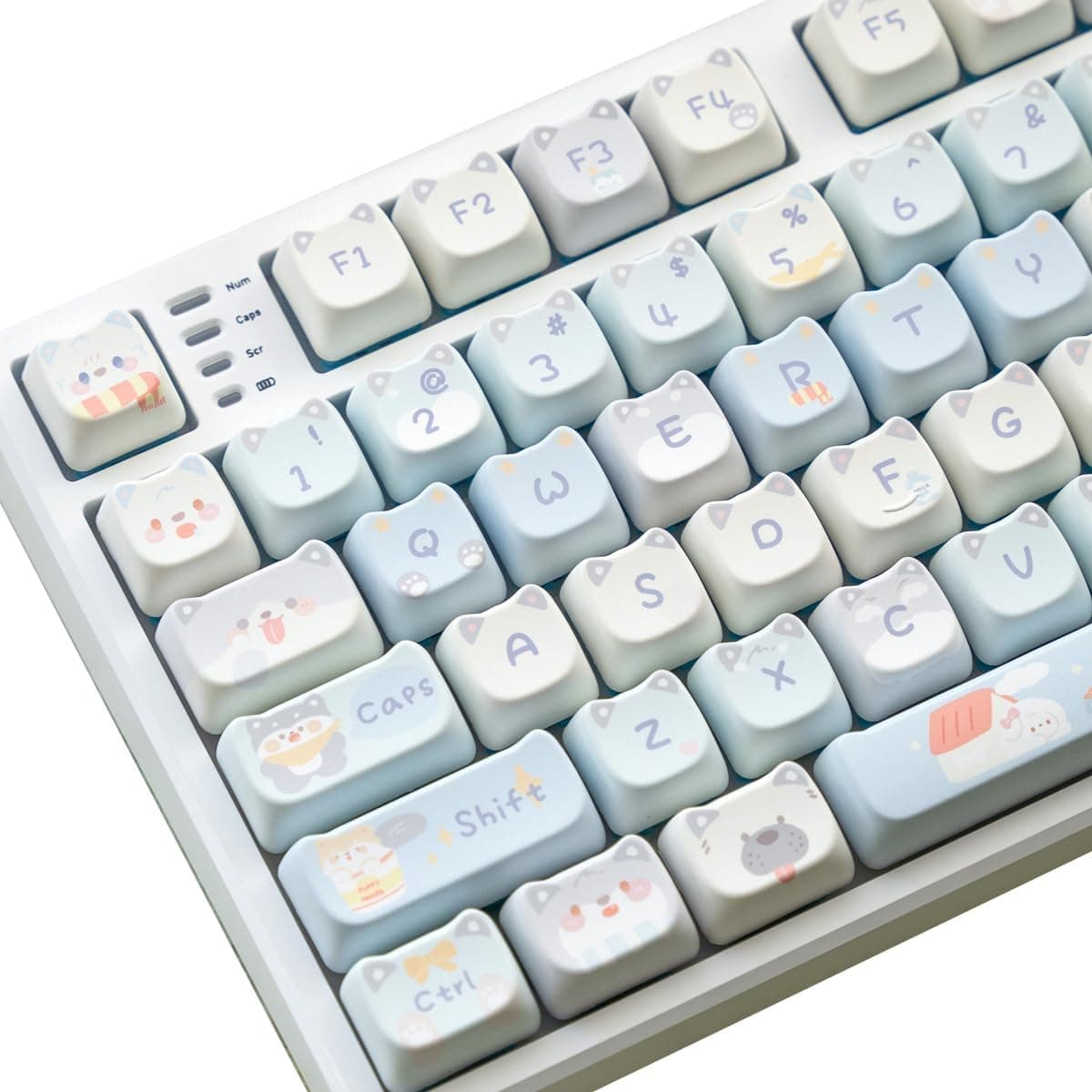
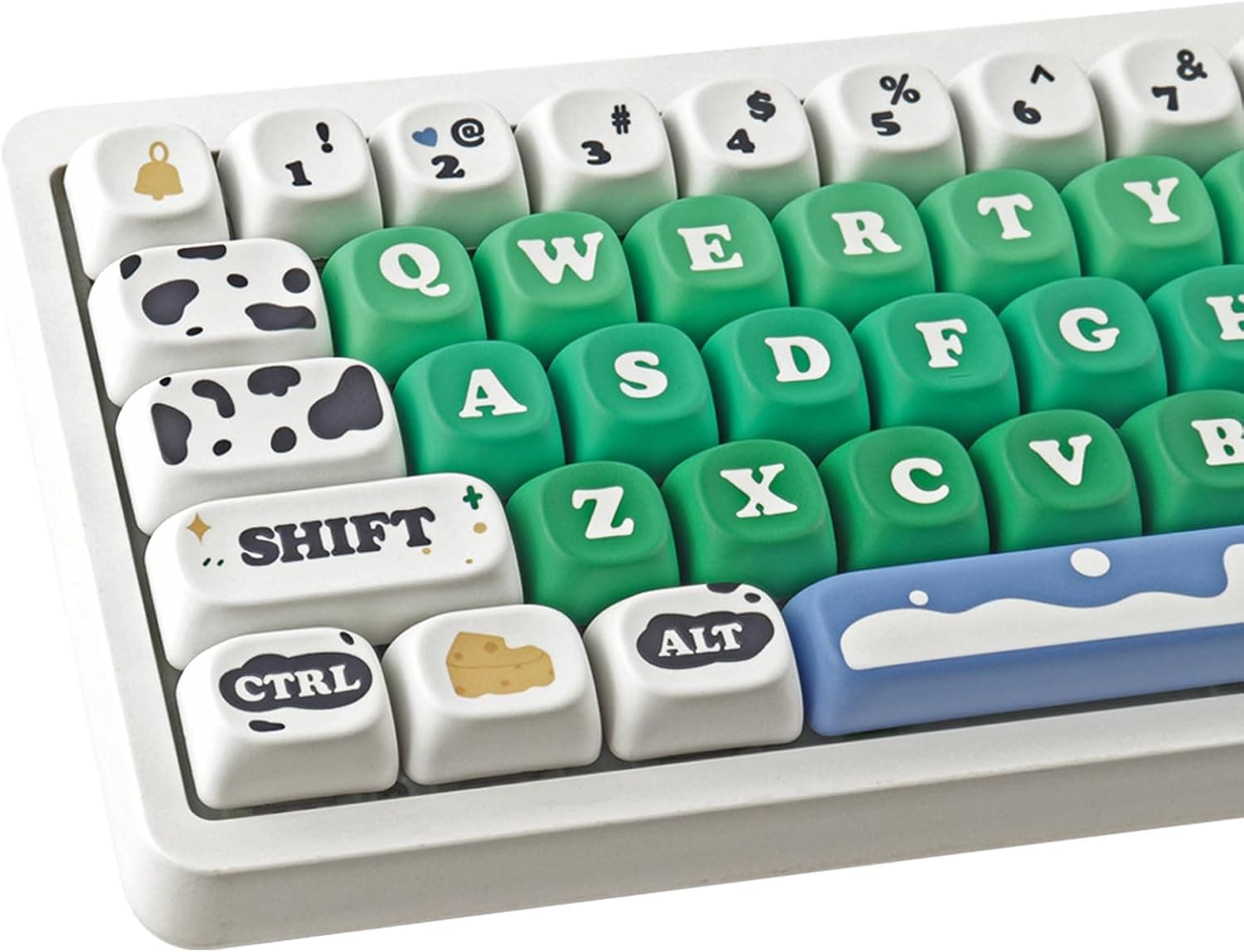
The SA GIFT 170-Key PBT Double-Shot Keycap Set - Beige is a thick PBT, double-shot keycap set built for mechanical keyboards that use Cherry MX-style cross stems. This article covers which keyboards it actually fits, what changes after you install it, and the pitfalls people discover only after buying.
Overview
This is an SA-profile PBT keycap set in a muted beige base with blue and pink accents. At 170 keys, it covers US ANSI layouts from 61-key up to full 104-key boards in a single set.
It is keycaps only — no keyboard, no switches, and no key puller are included.
The short version: this set suits people who already own a US-layout mechanical keyboard and want to change both the look and the typing feel for a modest sum. Double-shot molding forms the legends from a second shot of plastic rather than printing them, so the legends cannot wear off.
Thick PBT has a matte surface that resists the shine and oil marks that thin ABS develops over time.
It does not suit people who need backlit legends, people on JIS or ISO layouts, or people who want to keep their keyboard low on the desk. Each reason is spelled out below.
What Makes SA Profile Different
SA describes the keycap shape. Its defining traits are height and a spherically dished top surface.
Compared with the OEM profile most keyboards ship with, or the Cherry profile common in custom builds, your fingertips sit noticeably higher. The set is sculpted, meaning each row has a different height and angle, so moving between rows feels different too.
The spherical dish guides fingertips toward the center of each cap, which many typists find reassuring. The trade-off is that keys feel further apart, and fast typists often see extra typos for the first few days.
That usually passes, but it is worth knowing this is not a set that feels perfect the moment you install it.
SA also carries a retro look that pairs well with this set's beige-led colorway.
Compatibility Guide
The set fits Cherry MX-compatible cross stems. Cherry, Gateron, Kailh, Outemu, TTC and similar MX-clone switches all work.
Optical and capacitive switches with cross-shaped stems will physically accept the caps, but switches with proprietary stem heights or housings are not guaranteed.
The layout is US ANSI only. Official compatibility covers 61-key to 104-key US boards, which means JIS, ISO, HHKB and split ergonomic layouts are outside its scope.
On a JIS board you would be short on symbol and conversion keys, and there are no kana legends. "170 keys must be enough" does not hold here.
Three physical issues are easy to overlook. First, switches with a raised housing wall around the stem (Kailh Box-style designs) can interfere with certain thick keycap interiors.
Second, high-profile cases whose top bezel sits close to the caps can make contact with tall SA caps. Third, spacebar length (6.25u, 7u, or split 3u arrangements) and modifier widths (2.75u, 1.75u, 1.25u) must match what the set contains, or those specific keys simply will not fit.
This is the single most common keycap-swap failure at any price.
The one check worth doing before you order: photograph your keyboard from above and compare your bottom row key by key against the set's layout image.
Product Info
| Spec | Value |
|---|---|
| Key count | 170 keys |
| Profile | SA (spherical, sculpted) |
| Material | PBT (thick) |
| Legends | Double-shot |
| Layout | US ANSI |
| Switch fit | Cherry MX-compatible cross stem |
Pricing on Amazon.co.jp was ¥3,704 as captured on 13 June 2026, and ¥3,899 as captured on 27 August 2026.
Both are capture-time figures and move with sales and stock. At roughly ¥3,700–¥3,900 for 170 caps, that is about ¥22–23 per key — clearly cheap for a thick double-shot PBT set.
Overseas marketplace listings exist, but prices vary per seller, so check the current figure at purchase time.
Check the retailer's page for the latest user reviews.
No official release date is published. Warranty information is limited, so your practical recourse for a defective set is the seller's return policy.
Contents are the 170 keycaps only.
Choosing a Profile
Profile changes the experience more than material does.
| Profile | Height | Shape | Suits |
|---|---|---|---|
| SA | Tall | Spherical dish, sculpted rows | Looks first, deeper travel feel, palm-rest users |
| Cherry / OEM | Low to medium | Cylindrical dish, sculpted rows | Keeping the current typing feel |
| XDA / MOA | Medium, uniform | Flatter, same height all rows | Rearranging layouts, ortholinear boards |
Choosing this set means choosing the top row of that table. If your goal is "same feel, new look," a Cherry or OEM set matches the goal better.
If your goal is "change everything while I'm at it," SA delivers an unusually large change per yen spent.
Typing Feel and Sound
Thick PBT tends toward a lower, harder sound than thin ABS. SA's large internal volume adds resonance, producing a deeper tone.
On a metal-plate board that can still read as bright; on gasket-mounted or foam-filled boards it goes more muted. Sound preference varies, so avoid assuming "PBT plus SA equals good sound" in advance.
Posture matters too. The extra height angles your wrists more, which makes a palm rest close to mandatory — especially for long typing sessions.
Installation
The swap is simple but unforgiving of careless handling. Photograph your current layout first as a reference, then pull each existing cap straight up with a key puller.
None is included, so buy one separately; a wire puller scratches cap sidewalls far less than a ring puller.
With the caps off, this is the easiest moment to blow out dust with compressed air or a brush. Press new caps on vertically until you feel them seat.
Angled force is how stems get broken. For large keys, align the stabilizer wire first, then press the center and both ends in turn.
Finish by pressing every key and checking for dead or stuck keys. Budget 10 to 20 minutes.
Best Use Cases
1. Owners of US-layout mechanical keyboards who want a new look. The beige-led palette stays quiet enough for an office or home desk.
If your board is a 61- to 104-key US layout, the only spend is this set plus a puller.
2. Newcomers to keyboard customization. Trying a distinctive profile at this price is low risk — if you dislike it, your old caps go back on and the set stays reusable.
3. People with more than one keyboard. 170 keys leaves room to split the set across boards, such as a 65 percent and a full-size.
Verify the size breakdown first, since duplicate sizes are not guaranteed.
4. Anyone burned by worn legends. Double-shot legends are molded plastic, so they cannot fade or rub away.
Before You Buy
Legends do not light up. Despite being double-shot, the plastics are opaque, so LED light escapes only around the caps.
If you game in the dark using backlit legends, or care about RGB presentation, this is a mismatch of purpose, not a minor compromise.
It will not fit a JIS keyboard. Most keyboards sold in Japan use JIS.
This set is US ANSI only, with no kana legends and no JIS-specific key widths. The quickest check is the Enter key: a wide rectangle means US, a reverse-L means JIS or ISO.
No key puller is included. Buy one alongside the set.
Prying caps off with a screwdriver or fingernails damages both the caps and the plate.
Extra height has side effects. High-bezel cases may contact the caps, and the changed wrist angle makes a palm rest necessary.
If you want a low desk setup, look elsewhere.
That sample is too small to reveal unit-to-unit variation, and thick PBT sets can show slight molding flash or color variance. Buying from a seller with a workable return policy is the sensible hedge.
Listing metadata is not always reliable. In this product's own data, the displayed storefront label did not match the actual region and currency of the listing.
Do not take the manufacturer name, model number, or region shown on the page at face value — confirm the product from the images, title, and key-size chart before ordering. This problem is common across the keycap category generally.
FAQ
Q. Can I use these on a backlit keyboard? A.
They fit, but the legends stay dark. Light escapes from under the caps only.
For lit legends, choose a set explicitly labeled shine-through.
Q. Will they work on a Japanese (JIS) keyboard? A.
No. Compatibility is US ANSI only; JIS symbol and conversion keys differ in count and width.
Q. Can 170 keys still come up short? A.
Yes. The 170 figure includes alternates for multiple layouts; one board uses roughly 104 of them.
Unusual spacebar lengths or modifier widths can leave a few positions unfilled.
Q. Is a key puller included?
A. No — keycaps only. Buy a wire-style puller separately.
Q. Will my keyboard get quieter? A.
This is not a silencing product. Thick PBT and SA's internal volume shift the tone lower, but volume does not drop much.
Use quieter switches or foam for that.
Q. What does it cost? A.
¥3,704 as captured on 13 June 2026 and ¥3,899 as captured on 27 August 2026. Check the product page for the current price.