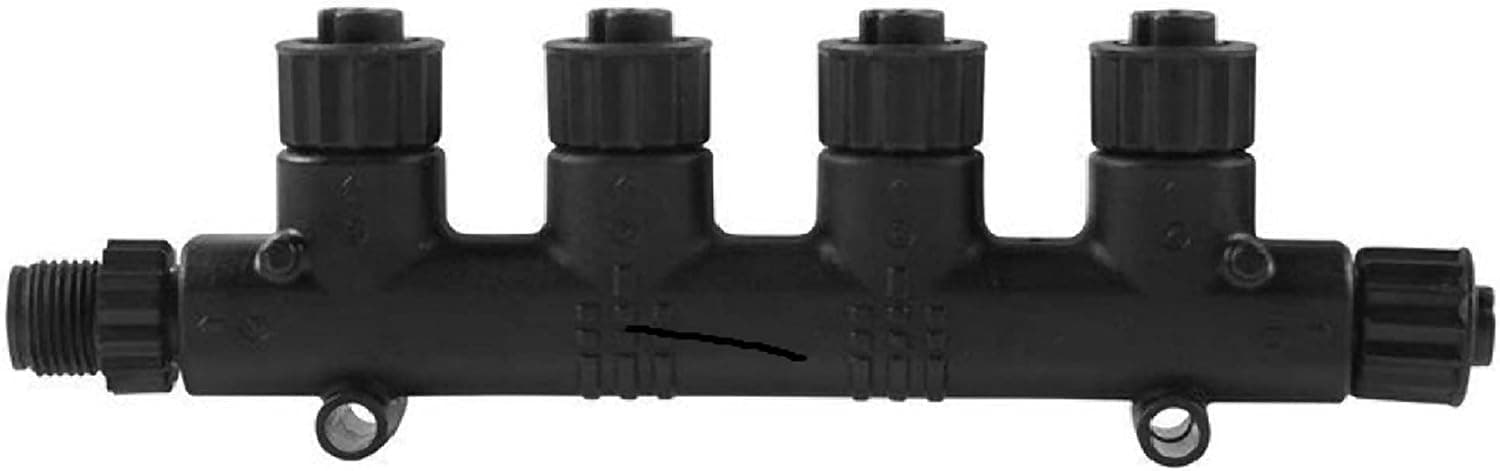
This article covers the Regatta Processing NMEA 2000 (N2k) 4-Port Multi-Port (Tee) T-Connector for Garmin, Lowrance, Simrad, B&G and Navico networks — the published specs, the review record, and the wiring mistakes that actually bite people.
Overview
This is a multi-port tee that adds four drop points to an NMEA 2000 marine backbone at once. It is not a performance product; it is a tidiness-and-headroom product.
The buyer is someone putting several N2K devices on one boat — an MFD, a sounder module, a GPS/heading sensor, wind instruments, an engine gateway — and who wants one clean branching point instead of a daisy chain of single tees.
The published specs are: 4 ports, IP67 waterproof rating, gold-plated contacts, 14 × 1.9 × 4.4 cm, and NMEA 2000 certification.
On Amazon.co.jp it carries 135 reviews at 4.7 out of 5 (94% positive) — a solid sample size for a niche marine part.
Note that this article sits in the site's "network_card" category for classification reasons only. This is not a PC expansion card.
If you arrived looking for a computer NIC, this is the wrong product.
Compatibility Guide
The manufacturer's own compatibility note is blunt: this is a marine NMEA 2000 T-connector, not a PC component, with no PC compatibility whatsoever. Confirm that first.
On the marine side, any NMEA 2000 certified device should interoperate. Garmin, Lowrance, Simrad, B&G and Navico all ship NMEA 2000 compliant gear, so at the standard level they connect.
NMEA 2000 is a DeviceNet-derived bus: a backbone trunk with devices hanging off it via drop cables, each through a tee. This product is simply four of those tees in one body.
| Check | General rule of thumb | Symptom if missed |
|---|---|---|
| Terminators | One at each end of the backbone | Unstable bus, devices not seen |
| Power | One 12 V feed into the backbone | Nothing powers up |
| Drop length | Keep drops short, trunk long | Distant devices drop out first |
| Load (LEN) | Total device draw within supply | Voltage sag as you add gear |
| Physical fit | 14 cm needs straight-ish space | Won't fit behind the helm |
These are standard NMEA 2000 design principles rather than product-specific guarantees — confirm against each device's manual.
At 14 × 1.9 × 4.4 cm this is noticeably longer than a single tee.
Behind a helm or inside a console, dry-fit for length plus cable bend radius before committing.
Also watch connector families. Standard N2K plugs mate directly, but proprietary variants (Raymarine's SeaTalkNG, Simrad's SimNet) may need adapter cables.
Assume none are included and check your device ends first.
Product Info
Published specs: 4 ports, IP67, gold-plated contacts, 14 × 1.9 × 4.4 cm, NMEA 2000 certified.
IP67 covers temporary immersion — appropriate for spray, condensation and bilge-area humidity, but not for permanently submerged mounting. Gold plating targets contact resistance in salt air, which is a sensible spec for marine use.
As captured on 27 August 2026, Amazon.co.jp listed it at ¥8,506.
Prices move with stock, currency and sales, so treat that as a snapshot and check the product page for the current figure. The eBay entry is a search link only, with no confirmed price.
Against equivalent first-party parts this sits below OEM pricing while still offering certification, IP67 and four ports in one body.
Reviews: 135 total, 4.7 out of 5, 94% positive (captured 27 August 2026).
Holding 4.7 across a three-figure sample suggests few complaints about DOA units or poor contact — though reviews say nothing about multi-season salt-corrosion life.
The listing mentions accessories as "1 tube, 4 fittings," which reads like machine translation and may not describe the box contents accurately. Check the product images for whether backbone cable, drop cables or terminators are included.
Building a network from scratch requires all of those separately; the tee alone is not a complete system.
Product Disclosure (Amazon)
- Manufacturer: Regatta Processing
- Seller: Amazon US
- Fulfilled by: Amazon US
- ASIN: B08BTN134M
- Note: This article covers a manufacturer-made product based on Amazon listing details.
Best Use Cases
- Three or more N2K devices on one boat. Chained single tees multiply connection points and therefore failure points; one four-port body is easier to inspect later.
- Expanding an existing network. Splice this into a working backbone and you bank three spare ports for the radar or AIS you might add next season — cheaper than rewiring later.
- Long-term use in salt air. IP67 plus gold-plated contacts is a sensible pairing at this price.
- Anyone tidying a messy helm. Consolidating branch points makes fault isolation far quicker.
If you run one or two devices and have no expansion plans, a single tee is enough. Don't buy ports you won't use.
Things to Check Before Buying
It is not a PC part. Worth repeating: the category label says network_card, but this is marine hardware. There is no PC compatibility.
A tee alone does nothing. NMEA 2000 needs backbone cable, a terminator at each end, a 12 V feed, and drop cables.
The two classic first-build failures are a missing terminator and no power injected into the backbone. "No devices detected" is almost always one of those, not a faulty connector.
Cap every unused port. Leave one open and the IP67 rating is void at that point.
Confirm whether caps ship with the unit; if not, buy them. Skipping this is how contacts corrode a few seasons in.
Mind orientation and space. 14 cm eats more room than expected.
Mount connector faces sideways or downward and build a drip loop into the cabling so condensation cannot pool at the contacts.
Add up your LEN. NMEA 2000 rates device draw in LEN units, and the backbone supply has a ceiling.
Total the figures from the device manuals before hanging four things off this tee.
Listing data can be wrong. This page shows machine-translated accessory wording and US-side seller/fulfilment fields.
Amazon listing metadata is not always accurate, so verify from the product images and title that you are getting a standard NMEA 2000 four-port tee — especially the connector shape — before ordering.
Who should skip it. If you want a single-vendor warranty path, or your rigging is done by a dealer who won't sign off on third-party parts, buy the manufacturer's own multi-port.
Mixed-brand builds complicate warranty conversations when something goes wrong.
FAQ
Q. Can I mix Garmin and Lowrance devices on one network? A.
Yes, if both are NMEA 2000 compliant. Standard data will pass; vendor-specific features may not.
Check the supported PGNs in each manual.
Q. Can I leave unused ports open?
A. No. Cap them, or the IP67 sealing is defeated and salt-laden moisture will attack the contacts.
Q. Are terminators included?
A. Nothing in the specs says so, so assume not. Your backbone still needs one at each end.
Q. Will it work with Raymarine gear? A.
Some Raymarine devices use SeaTalkNG connectors and need an adapter cable to standard N2K. Assume no adapters are included and check your device ends first.
Q. Can I use it as a PC network card?
A. No. It is a marine-only NMEA 2000 part with no PC compatibility.
Q. What does it cost?
A. ¥8,506 on Amazon.co.jp as captured on 27 August 2026. Prices change — check the product page before buying.