This article is a deep-dive rewrite covering ODO LUCK スプリングモッズキット THRUSTMASTER T-LCMペダル用 改造スプリングパーツアクセサリー 3個セット — what the ODO LUCK Spring Mod Kit for the Thrustmaster T-LCM pedals actually changes, and where it disappoints.
Overview
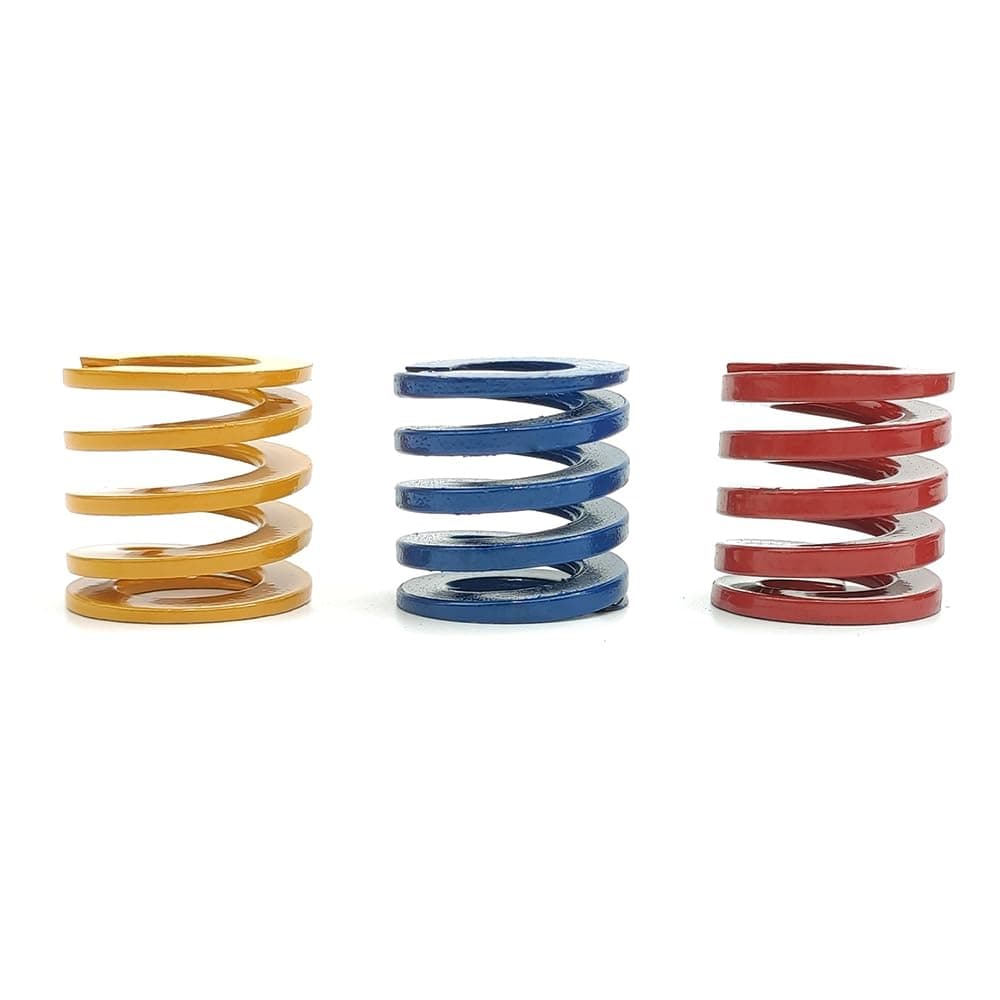
The ODO LUCK Spring Mod Kit is a set of three replacement springs for the Thrustmaster T-LCM pedal set. Stiffness comes in three grades — red (medium), blue (light) and yellow (soft) — and the springs are described as high-quality steel.
The honest framing is this: it does not make your pedals more capable. It swaps a resistance curve that does not suit your leg for one that does.
The T-LCM brake is a load cell design, so input is driven by the force you apply rather than by travel. Softer springs therefore let the pedal sink further for the same applied force, which most drivers read as finer resolution.
Stiffer springs shorten travel and push the fine modulation into your ankle. Neither is inherently faster; the question is which one you can repeat lap after lap.
It is also worth noting that the T-LCM already ships with its own stiffness-adjustment hardware. This kit widens that range — it does not add adjustability that was previously missing.
Buyers who miss that distinction are the ones who come away saying it barely changed anything.
Which Spring For Which Job
| Goal | Colour | Why |
|---|---|---|
| Long endurance stints without leg fatigue | Yellow (soft) | Lowest holding force required |
| Precise brake modulation in GT/F1 sims | Red (medium) | Tighter travel, steadier force steps |
| Fast rally / dirt footwork | Yellow or blue | Quicker return, easier rhythm |
| Stock feels too soft, you bottom out | Red (medium) | Builds a firmer wall near full travel |
Treat the table as a starting point only. Body weight, seat position and pedal face angle all shift the answer.
Fit one spring, run two or three races, and only then try the next colour. Changing everything at once tells you nothing about what worked.
Compatibility Guide
This kit is exclusive to the Thrustmaster T-LCM pedal set. The supplied compatibility note is unambiguous: T-LCM only, no other models.
Do not force these into Logitech G PRO / G923, Fanatec CSL Pedals, or Thrustmaster T3PA / T3PA-PRO units, even if the coil looks similar. Mismatched free length or wire gauge means the arm either fails to return or binds under load.
The swap itself is genuinely tool-free and takes minutes: pull the original spring off the arm, seat the new one, done. No firmware update, no driver change.
But "no setup needed" applies to the installation, not to calibration. Because the force range shifts, revisit your deadzone and input curve in the Thrustmaster control panel and in-game.
Skip that and you will see inputs that never reach 100%, or a brake that hits 50% on contact.
Physically, if your pedals are bolted into a rig, check you can actually reach the spring before you start. Prying at an awkward angle is how springs end up across the room.
Keep the stock springs — being able to revert is the single best safety net this kit offers.
Product Info
The package contains the three springs and nothing else: no tools, no shims, no meaningful documentation. Release was around autumn 2023.
No warranty terms are stated, which is consistent with treating these as consumables.
On pricing, the figures captured were ¥5,114 on Amazon as of 24 June 2026 and ¥5,069 as of 26 August 2026. Both are capture-time values and will move with sales and stock.
Always check the current price on the product page before ordering. Given the roughly ¥45 drift across two months, waiting for a dramatic discount is probably not worth it.
The review picture deserves plain language. As of 24 June 2026 the listing showed 15 reviews averaging 3.3 out of 5 stars — 66% as a favourability score.
Fifteen reviews is far too thin to be statistically solid, but it is clearly not a universally loved product either. For an accessory that bundles coil springs for one specific pedal set, some unit variance and some "it didn't change as much as I expected" feedback is predictable.
At roughly ¥5,000, anyone expecting a dramatic transformation will rate it harshly.
What Actually Changes
Three things change. Travel: softer springs move the pedal further for the same force, which reads as better resolution.
Fatigue: over stints longer than an hour, lower holding force is a real, measurable comfort gain. Footwork tempo: return speed affects heel-toe and rally rhythm.
Three things do not change: load cell resolution, pedal structural rigidity, base plate flex, and your lap times. A spring alters feel, not precision.
Confusing the two is, in my reading, exactly what sits behind that 3.3-star average.
Things To Check Before Buying
The biggest trap is buying for the wrong pedal. Thrustmaster sells T3PA, T3PA-PRO and T-LCM sets with similar names but fundamentally different brake mechanisms.
Only the T-LCM works here. Confirm your model from the marking on the pedal body or the Thrustmaster control panel, not from a box you half remember.
Second, expectations. A 3.3-star average across 15 reviews is not the profile of a safe default purchase.
If you have a specific, articulated complaint about the stock feel — "too stiff to modulate", "too soft, I bottom out" — then roughly ¥5,000 is defensible. If your reasoning is "it'll probably feel nicer", you will almost certainly be underwhelmed, and that budget would do more for you spent on rigid pedal mounting or a better seating position.
Third, the listing itself. The captured prices are consistent and plausible for this class of part, but Amazon pages do change sellers and variations.
Before you order, confirm from the images and title that you are buying a three-spring set for the T-LCM. Registration details such as manufacturer and model number are not always accurate on accessories like this.
Finally, warranty and reversibility. With no stated warranty, a sagged or broken spring is a repurchase at your own cost.
Faults attributed to non-OEM parts may also fall outside your pedal warranty. Keep the stock springs, and restore the pedals to standard before sending anything in for service.
Best Use Cases
- Drivers with a specific complaint about stock feel — a clear direction ("softer", "firmer") is what makes this worth buying.
- Long-session sim racers — for endurance and league stints past an hour, the yellow spring's fatigue reduction earns its money.
- Multi-discipline players — swapping colours gives you two usable setups for GT and rally.
- Anyone considering a pedal upgrade — testing direction for ~¥5,000 before spending several times that on a new pedal set is sound reasoning.
Skip it if you are already happy with the stock setting, if you are chasing lap time, or if you own anything other than a T-LCM.
FAQ
Q. Will these fit T3PA or Logitech G923 pedals? A.
No. Compatibility is stated as Thrustmaster T-LCM only.
Similar-looking dimensions are not a reason to try.
Q. Do I need tools?
A. Normally no, and it takes a few minutes. Removing the pedals from the rig first makes access far easier.
Q. Is recalibration required afterwards? A.
Recommended. The force range shifts, so review deadzone and input curve in the Thrustmaster control panel and in-game, or inputs may not reach full scale or may become over-sensitive.
Q. Can I use all three springs at once? A.
The intent is to try one grade at a time and keep the one that suits you. Fit one, run several races, then decide.
Q. A 3.3-star average sounds bad — is it junk? A.
Fifteen reviews is too few to be conclusive. But it is not a transformative part, and buyers expecting one tend to be disappointed.
It suits people with a defined goal.
Q. Can I throw away the stock springs? A.
Keep them. They are your route back if the new feel is wrong, and they matter for service or resale.