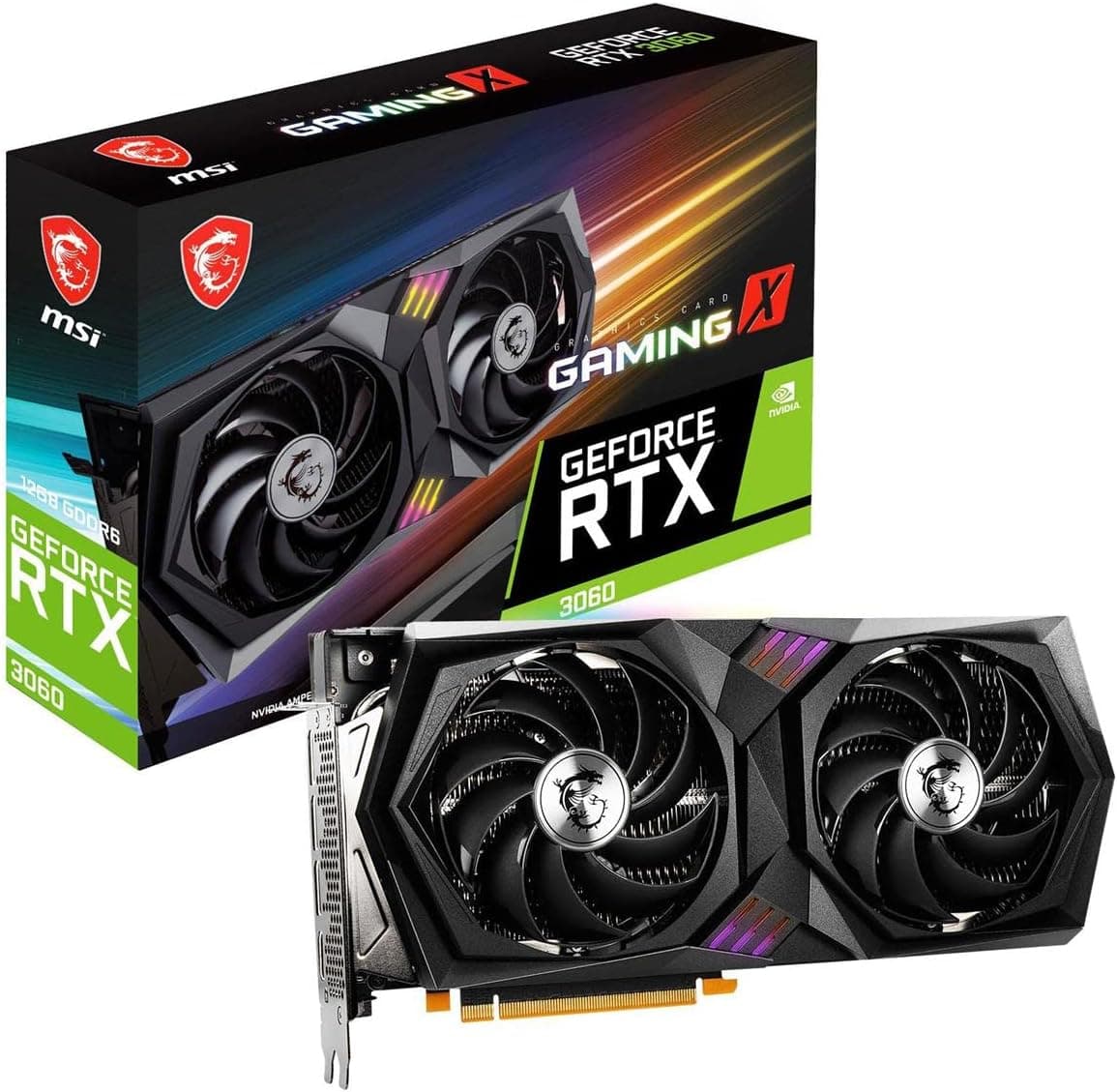
This article covers MSI GeForce RTX 3060 GAMING X 12G グラフィックスボード VD7552.
Overview
The MSI GeForce RTX 3060 GAMING X 12G (model VD7552) is a mid-range graphics card built on NVIDIA's Ampere architecture. It features the GeForce RTX 3060 GPU with 12GB of GDDR6 VRAM, a generous amount for its class. The boost clock reaches 1,837 MHz, and the custom TWIN FROZR 8 dual-fan cooler keeps temperatures in check under load. This card is ideal for 1080p to 1440p gaming, offering solid performance in modern titles with ray tracing and DLSS support. The 12GB frame buffer also makes it a capable companion for light creative work, such as photo editing or 3D modeling with moderate textures. Positioned firmly in the mid-range segment, the GAMING X strikes a balance between price and performance. It's a popular choice among builders who want reliable 1080p high-refresh-rate gaming without breaking the bank.
Compatibility Guide
PCIe Interface: PCIe 4.0 x16, backward compatible with PCIe 3.0 with negligible performance loss. Power Connector: One 8-pin PCIe power connector required. Ensure your power supply has a dedicated 8-pin cable. Recommended PSU: At least 550W for the whole system. The card itself draws up to 170W, but a quality 550W unit provides headroom for a typical mid-range CPU and peripherals. Form Factor: Dual-slot design, approximately 278mm in length. Fits most mid-tower ATX cases, but check clearance in smaller builds. * Video Outputs: Three DisplayPort 1.4a and one HDMI 2.1, supporting up to four displays simultaneously.
Product Info
Released in February 2021, the MSI GeForce RTX 3060 GAMING X 12G is an officially distributed model (VD7552) in Japan, backed by a 1-year manufacturer warranty. It belongs to MSI's GAMING X series, known for enhanced cooling and subtle RGB lighting via Mystic Light. Key specifications include: GPU: NVIDIA GeForce RTX 3060 (Ampere, 8nm process) CUDA Cores: 3,584 Boost Clock: 1,837 MHz Memory: 12GB GDDR6, 192-bit bus, 15,000 MHz effective Memory Bandwidth: 360 GB/s Ray Tracing Cores: 28 Tensor Cores: 112 FP32 Performance: ~13.2 TFLOPS TDP: 170W Cooler: TWIN FROZR 8 dual-fan with semi-passive mode API Support: DirectX 12 Ultimate, OpenGL 4.6, Vulkan Software: Dragon Center for monitoring and tuning
Best Use Cases
1080p High-Refresh Gaming: Perfect for gamers targeting 144+ fps in esports titles and 60-100 fps in AAA games with DLSS. Not suitable for 4K gaming at high settings. Light Creative Work: The 12GB VRAM handles large photo files, 1080p video editing, and moderate 3D modeling. For heavy 4K video or complex renders, step up to an RTX 3070 or higher. Quiet Mid-Range Build: The semi-passive fan mode keeps the card silent at idle, and the dual-fan cooler remains relatively quiet under load. If absolute silence is critical, consider a larger triple-fan or liquid-cooled model. Budget-Conscious First Build: Offers excellent value for money with future-proof VRAM and DLSS support. Easy to install and configure, making it a great choice for first-time builders.
Things to Consider
Power Supply Check: Ensure your PSU has a spare 8-pin connector and at least 550W capacity. Older or lower-wattage units may need an upgrade. Physical Dimensions: At 278mm length, it may not fit in compact cases like the Cooler Master NR200 or Fractal Design Node 202. Always measure your case's GPU clearance. Competitor Landscape: Within the RTX 3060 lineup, the GAMING X sits in the middle tier. Higher-end models like the SUPRIM offer better cooling and higher clocks but cost more. Compare prices before buying. Overkill Scenarios: If you only play indie games, watch videos, or do office work, an integrated GPU or a budget card like the GTX 1650 will suffice. * Price Volatility: GPU prices fluctuate. Check multiple retailers and consider waiting for sales if the current price is above MSRP. ## FAQ
Q: Can I use this card with a PCIe 3.0 motherboard? A: Yes, it works perfectly fine. PCIe 4.0 offers higher bandwidth, but the RTX 3060 doesn't saturate PCIe 3.0 x16, so real-world performance is nearly identical. Q: Is 12GB VRAM enough for future games? A: For the next few years, yes. Most current games use 6-8GB at 1440p, so 12GB provides a comfortable buffer. It's a better long-term investment than 8GB models. Q: Does this card support ray tracing well? A: It supports ray tracing, but performance varies. With DLSS enabled, many games run smoothly at 1080p with ray tracing on medium settings. For heavier ray tracing, consider an RTX 3070 or higher.