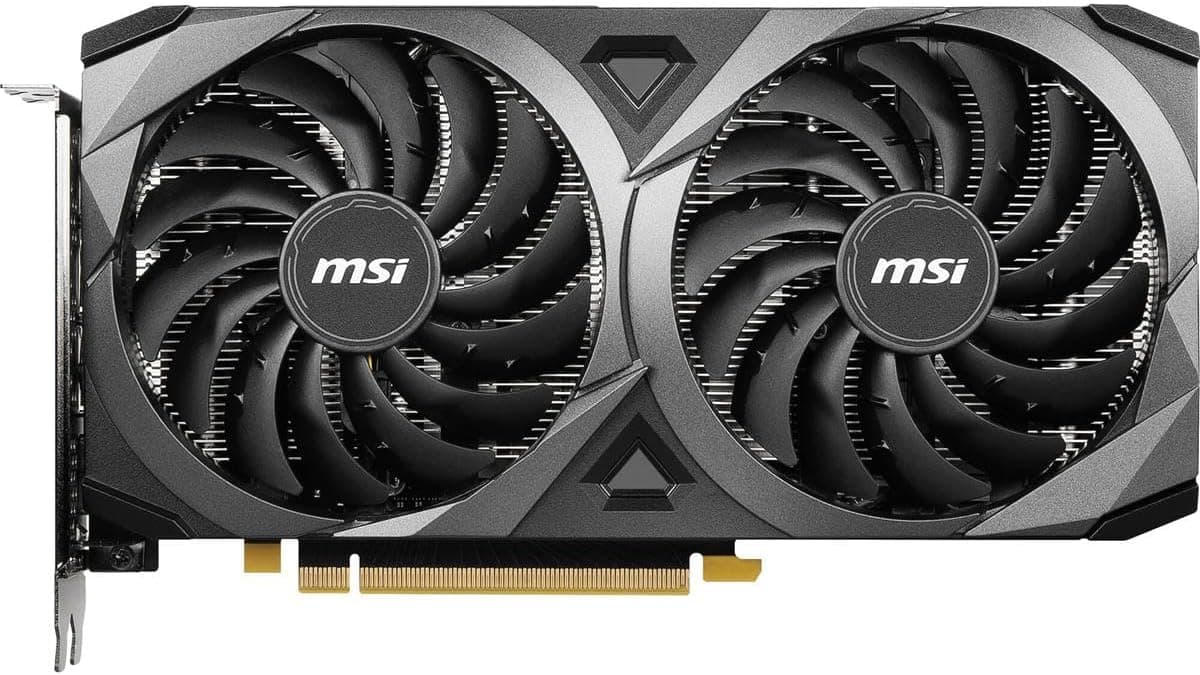
This article covers MSI GeForce RTX 3060 VENTUS 2X 8GB GDDR6 グラフィックスボード.
Overview
The MSI GeForce RTX 3060 VENTUS 2X 8GB GDDR6 is a dual-fan graphics card built on NVIDIA's Ampere architecture. It features 3584 CUDA cores, a boost clock of 1807 MHz, and 8GB of GDDR6 memory. This card sits comfortably in the entry-level high segment, delivering smooth 1080p and capable 1440p gaming performance. Cooling is handled by MSI's TORX Fan 3.0 design, which combines traditional and dispersion fan blades for improved airflow. The card measures approximately 235mm in length, making it compatible with most mid-tower and many compact cases. Power requirements are modest at 170W TDP with a single 8-pin PCIe power connector. With support for real-time ray tracing, DLSS, and G-SYNC, this card brings modern gaming features to a more accessible price point. It's a solid choice for gamers looking to upgrade from older GPUs without breaking the bank.
Compatibility Guide
The card uses a PCI Express 4.0 x16 interface and is backward compatible with PCIe 3.0 slots. At 235mm long, it fits in most ATX and MicroATX cases, but Mini-ITX builders should double-check clearance. A single 8-pin power connector is required, and a 550W or higher power supply is recommended. Display outputs include three DisplayPort 1.4a and one HDMI 2.1, supporting multi-monitor setups up to 4K resolution. The 128-bit memory bus is paired with 8GB GDDR6, providing sufficient bandwidth for 1080p and 1440p gaming.
Product Info
The MSI GeForce RTX 3060 VENTUS 2X 8G OC (model VD8308) ships with a factory overclock of 1807 MHz boost clock. It is an official Japanese market product with a 1-year manufacturer warranty. Positioned as an entry-level high-tier card, it offers a strong balance of price and performance for mainstream gamers. With a maximum power draw of 170W, it runs relatively cool and quiet under typical gaming loads, though the dual-fan setup can become audible under sustained heavy load.
Best Use Cases
First, this card is ideal for 1080p high-refresh-rate gaming. It handles most modern titles at high settings with ease, and DLSS support provides an extra performance headroom for demanding games. Second, it's a great option for budget-conscious 1440p gamers. While not a native 1440p powerhouse, it can deliver playable frame rates at medium-to-high settings in many titles, especially with DLSS enabled. Third, it works well as a GPU for a secondary or HTPC gaming build. Its compact size and low power draw make it easy to integrate into smaller cases without major cooling or PSU upgrades. ## Alternatives
Direct competitors include the AMD Radeon RX 6600 series. The RX 6600 offers competitive rasterization performance at a similar price, but lacks DLSS and has weaker ray tracing capabilities. The RTX 3060 pulls ahead in DLSS-supported titles and CUDA-accelerated creative workloads. If your budget allows, the RTX 4060 is a step up with lower power consumption and better performance, but the price premium may not be justified for 1080p-focused gamers. For those prioritizing raw value, the RTX 3060 remains a compelling choice.
Things to Consider
The 8GB VRAM and 128-bit memory bus can be limiting for 4K gaming or texture-heavy mods. If you plan to play at 4K or use high-resolution texture packs, consider a card with more memory. While the dual-fan cooler is adequate for most scenarios, it can get noisy under prolonged heavy loads. Users sensitive to fan noise may prefer a triple-fan model or an aftermarket cooling solution. Finally, ensure your power supply has a spare 8-pin PCIe connector and at least 550W capacity. Older or lower-wattage PSUs may need an upgrade to avoid instability.