Overview
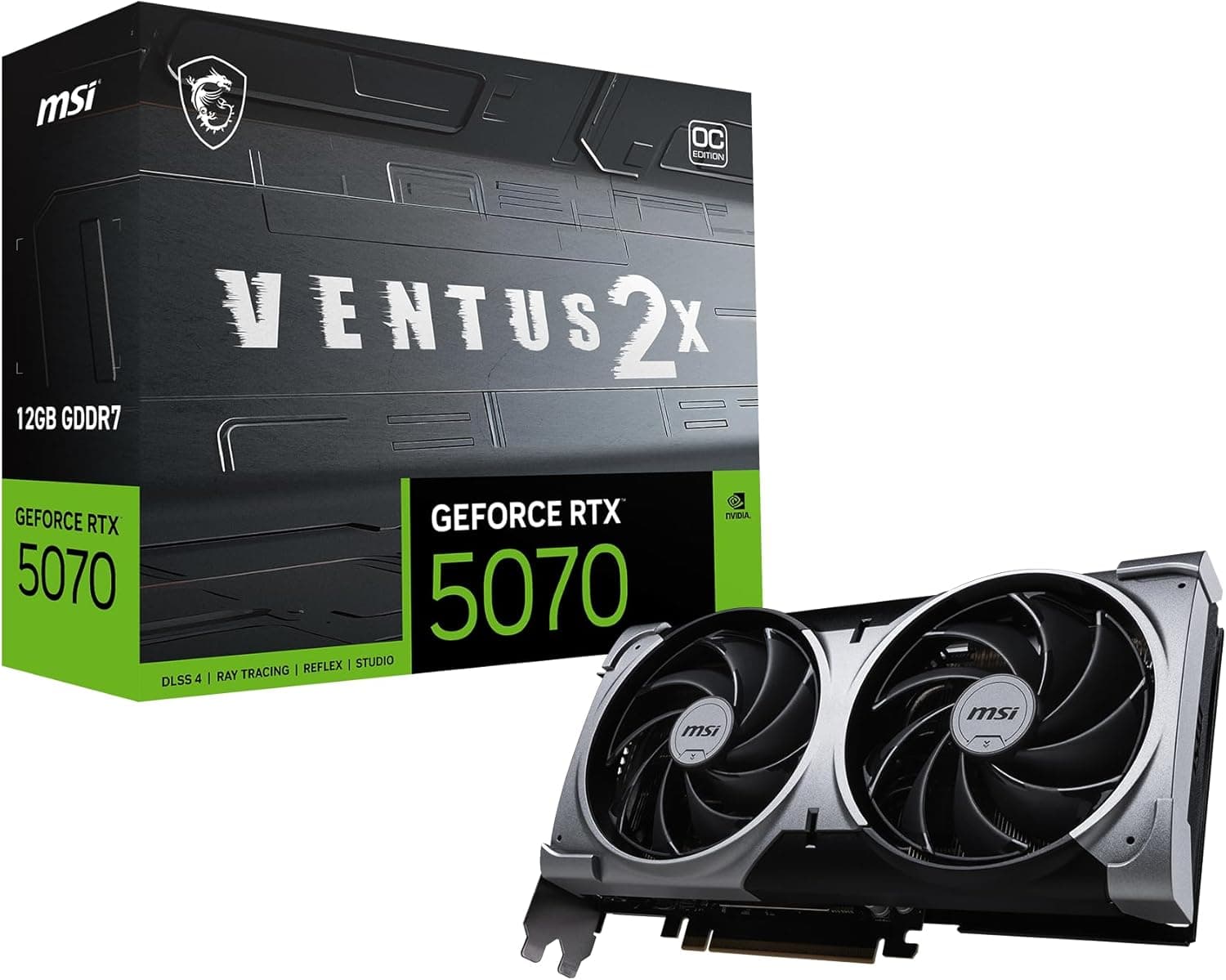
MSI's GeForce RTX 5070 12G VENTUS 2X OC (model VD9102) brings NVIDIA's latest Blackwell architecture to a compact, dual-fan design. Equipped with a GeForce RTX 5070 GPU packing 6,144 CUDA cores, a boost clock of 2542 MHz (2557 MHz with MSI Center), and 12 GB of GDDR7 memory on a 192-bit bus running at 28 Gbps, this card delivers solid 1440p gaming performance with ray tracing and DLSS 4. The VENTUS series focuses on practical value — no RGB, no oversized coolers — making it an excellent choice for builders who want Blackwell performance without the premium of a high-end model. The card measures just 236 mm in length, easily fitting into most mid-tower and even many Mini-ITX cases. While the RTX 5070 Founders Edition is also compact, the VENTUS 2X OC offers a slightly more accessible cooling solution with two TORX FAN 5.0 fans and a nickel-plated copper baseplate. Positioned as a mid-to-high tier GPU, the RTX 5070 sits directly against AMD's Radeon RX 9070 but holds an edge in ray tracing and DLSS-based upscaling. Market positioning is squarely mid-high: it's the entry point for Blackwell gaming, offering a balance of performance and price that targets 1440p at high refresh rates. The VENTUS 2X OC is the no-frills variant, aimed at users who prioritize raw performance and compatibility over aesthetics.
Compatibility Guide
The card uses a PCIe 5.0 x16 interface, backward compatible with PCIe 4.0 and 3.0 motherboards. It requires one 16-pin (12VHPWR) power connector — an adapter (dual 8-pin to 16-pin) is included. MSI recommends a 650W power supply, though a 750W unit is advisable for headroom with high-end CPUs. Physical dimensions: 236 x 126 x 50 mm (dual-slot). The 236 mm length fits most standard ATX and MicroATX cases, but check clearance if you have a particularly narrow case or a front-mounted radiator. The 50 mm thickness means it may block a neighboring PCIe slot on motherboards with tight slot spacing. Video outputs include three DisplayPort 2.1b and one HDMI 2.1b, supporting up to four simultaneous displays at 8K (7680 x 4320).
Product Info
Released in March 2025, the MSI GeForce RTX 5070 12G VENTUS 2X OC (VD9102) carries a 2-year warranty via MSI Japan authorized distributors. The retail price hovers around ¥116,000, putting it at a competitive spot in the RTX 5070 lineup. Built on TSMC's 4 nm process (Blackwell architecture), the card has a TDP of 250W. Cooling is handled by two TORX FAN 5.0 fans, a nickel-plated copper baseplate, and Core Pipes — a design that keeps temperatures manageable under sustained loads. A metal backplate with ventilation holes adds rigidity and aids airflow. This is a mid-to-high tier product. It's the most affordable way to experience Blackwell's new features, including DLSS 4 with Multi Frame Generation and improved ray tracing efficiency. The VENTUS 2X OC specifically targets gamers who don't need RGB or factory overclocked extremes but want reliable performance.
Best Use Cases
1440p high-refresh gaming: The RTX 5070 handles most titles at 1440p with settings maxed out, hitting 100+ fps in esports and 60–90 fps in AAA games with ray tracing on. DLSS 4's Frame Generation can push frame rates further. Not ideal for 4K native gaming — the 12 GB VRAM and memory bandwidth are limiting, so consider the RTX 5070 Ti for that. Creative work on a budget: For Blender, DaVinci Resolve, and Adobe Premiere, the 6,144 CUDA cores and 12 GB VRAM provide solid acceleration for 1080p/1440p projects. Large 3D scenes or 8K video may require more VRAM, so this card is best for mid-range creative workflows. Compact PC builds: Its 236 mm length and dual-fan design fit into most small-form-factor cases. Be aware of the 50 mm thickness when pairing with slim cases or those with limited GPU clearance. Ideal for a powerful yet space-efficient rig. NVIDIA ecosystem loyalists: If you depend on CUDA, NVENC, or DLSS, the RTX 5070 is the most cost-effective entry point to Blackwell. Competitors like the RX 9070 lack these features, making NVIDIA a must for certain software. ## Alternatives
Direct competitor: AMD Radeon RX 9070 (16 GB). The RX 9070 offers more VRAM (16 GB vs 12 GB) and similar rasterization performance at around the same price. However, the RTX 5070 pulls ahead in ray tracing workloads and benefits from DLSS 4, which provides better image quality and performance in supported games. For pure rasterization and VRAM-heavy tasks (e.g., 4K texture mods, machine learning), the RX 9070 is the better value. For ray tracing and NVIDIA-specific features, stick with the RTX 5070. Previous-generation competitor: RTX 4070 Super (12 GB GDDR6X). The 5070 delivers roughly 10–15% higher raster performance and adds DLSS 4 support. If you find a 4070 Super at a significantly lower price, it could be a decent budget alternative, but at similar prices, the 5070 is clearly superior.
Things to Consider
First, 12 GB of VRAM is a pot
Product Disclosure (Amazon)
- Manufacturer: MSI
- Seller: ✔prime DC-LIFE
- Fulfilled by: ✔prime DC-LIFE
- ASIN: B0DYGDT9YD
- Note: This article covers a manufacturer-made product based on Amazon listing details.