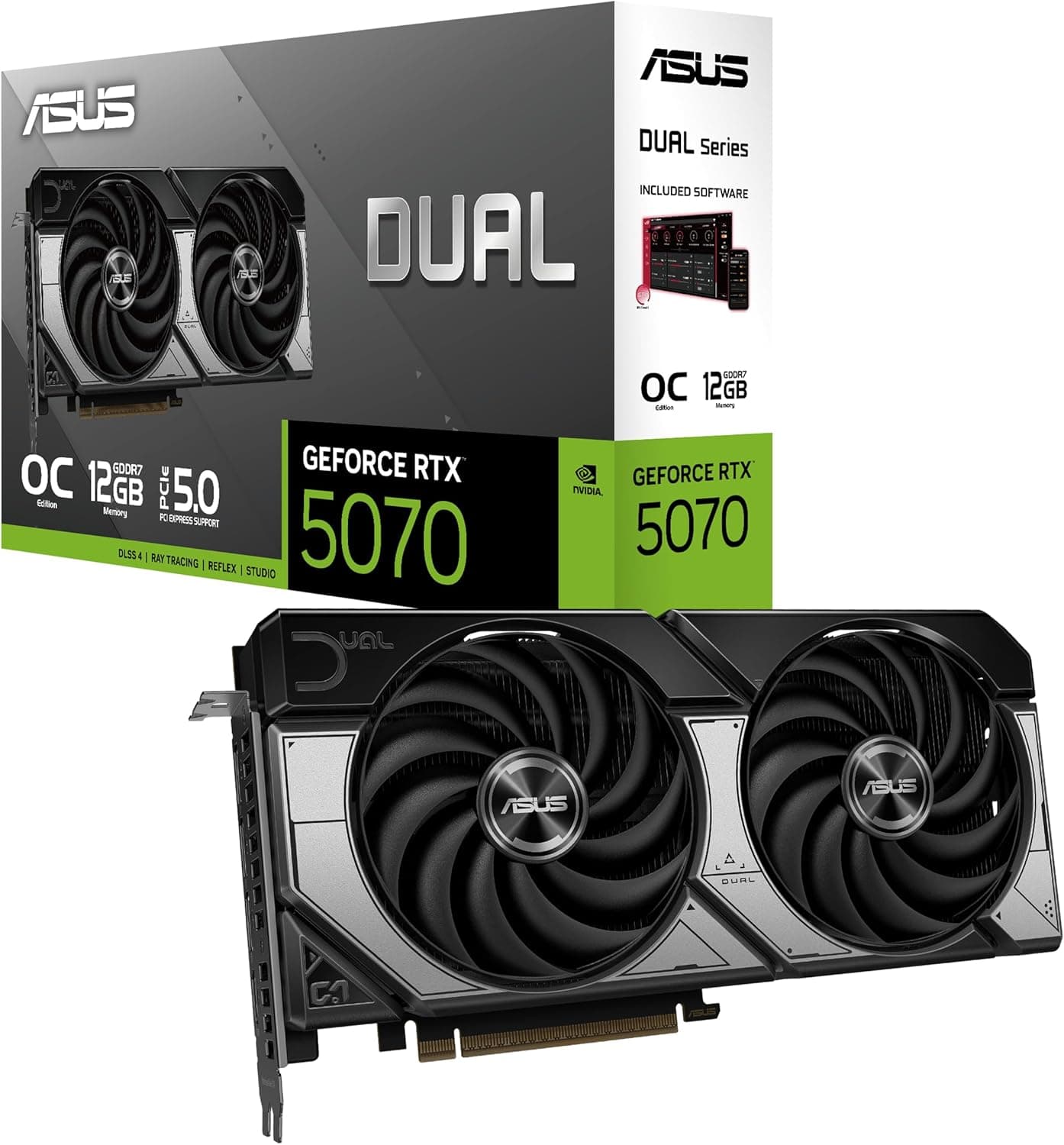
This article covers ASUS RTX5070 12GB GDDR7 SFF対応モデル.
Overview
The ASUS Dual GeForce RTX 5070 12GB GDDR7 OC Edition (model DUAL-RTX5070-O12G) brings NVIDIA's Blackwell architecture to the mid-high tier in a compact, SFF-ready form factor. Powered by the GeForce RTX 5070 GPU with 6144 CUDA cores and 30.87 TFLOPS FP32 performance, this card delivers outstanding 1440p gaming and capable creative performance. It features 12GB of GDDR7 memory on a 192-bit bus, offering 672 GB/s of bandwidth. This OC edition boosts up to 2572 MHz (OC mode) or 2542 MHz (default) and uses PCI Express 5.0 for modern platform compatibility. The dual-fan Axial-tech cooler with dual ball bearings moves up to 23% more air than standard fans, and the 0dB technology stops the fans entirely below 50°C for silent operation. Positioned between the RTX 5060 and RTX 5070 Ti, the RTX 5070 offers superb value for gamers and creators who want Blackwell features without jumping to the top-tier SKU. At a street price around ¥108,000 in Japan, it competes directly with the RTX 4070 SUPER and AMD Radeon RX 7800 XT.
Compatibility Guide
The card uses a PCI Express 5.0 x16 interface and is backwards compatible with PCIe 4.0/3.0 slots. Physical dimensions are 249mm (length) x 126mm (width) x 50.6mm (height), occupying 2.53 slots. It fits most standard ATX, mATX, and many Mini-ITX cases, but always check the maximum GPU length and slot clearance of your case beforehand. Power is delivered via a single 12VHPWR (12+4 pin) connector. The recommended PSU wattage is 600W or higher; a 650W unit is advisable for typical builds, while 750W+ is safer if pairing with a high-end CPU or overclocking. Outputs include one HDMI 2.1b and three DisplayPort 2.1b, supporting up to four displays simultaneously at up to 8K.
Product Info
Released in March 2025, this ASUS card is widely available through official retailers and Japan. Warranty is three years (extendable with product registration). Market positioning: mid-high tier. The RTX 5070 delivers generational improvements in ray tracing, DLSS 4 frame generation, and AI workloads compared to the RTX 4070 series. TDP is 250W, almost unchanged from the RTX 4070, but performance gains are significant.
Best Use Cases
- 1440p High-FPS Gaming - User: Gamers who demand 144+ fps in competitive titles at 1440p with max settings. - Why: DLSS 4 and strong raw performance make this ideal for the latest FPS and battle royale games. - Not for: Those aiming for consistent 4K 60+ fps native — consider RTX 5070 Ti or RX 7900 XT. 2. Small Form Factor Builders - User: Enthusiasts building compact Mini-ITX or small mid-tower PCs. - Why: The 2.5-slot, 249mm length fits most SFF cases. Dual fan cooling keeps temperatures in check without excessive noise. - Not for: Builders who want maximum OC headroom and lower temps — triple-fan models are better. 3. Creative Professionals (Light to Medium) - User: Video editors, photographers, and 3D artists working at 1440p or 4K. - Why: 12GB VRAM handles 4K timelines and multi-layer compositions. CUDA acceleration speeds up renders. - Not for: Heavy 3D rendering or large AI model training — 16GB+ cards recommended. 4. Upgrade from RTX 30 Series - User: Owners of RTX 3060 Ti / RTX 3070 looking for a meaningful performance jump. - Why: 30-40% faster in raster, much stronger ray tracing, and DLSS 4 support. - Not for: RTX 4070 owners — gains are modest; wait for next generation. ## Alternatives
Direct competitors are the NVIDIA RTX 4070 SUPER ($600-650) and AMD Radeon RX 7800 XT ($500-550). The RTX 4070 SUPER is marginally cheaper but lacks Blackwell features like DLSS 4 and has lower memory bandwidth (504 vs 672 GB/s). The RX 7800 XT offers 16GB VRAM at a lower price, ideal for 4K texture-heavy gaming and raw rasterization, but lags in ray tracing and lacks NVIDIA's DLSS ecosystem. For CUDA-dependent creative work, the RTX 5070 is the clear winner.
Things to Consider
First, verify that your power supply has a 12VHPWR connector or includes the necessary adapter (ASUS includes one). Older PSUs may require a separate adapter cable. Second, while SFF-ready, the 249mm length still exceeds some ultra-compact cases (e.g., some ITX cases like the Velka 3 require shorter GPUs). Double-check your case specs. Third, the 12GB VRAM is sufficient for 1440p gaming in 2026, but future AAA titles with heavy ray tracing may push beyond that. If you plan to keep the card for 4+ years, saving for a 16GB model might be wise. Finally, this card is overkill for 1080p gaming on a 60Hz monitor. Pair it with a high-refresh 1440p display to avoid bottlenecking your GPU. ## FAQ Q: Is this a good upgrade from an RTX 3070? A: Yes — expect roughly 50% performance improvement at 1440p, plus DLSS 4 and much better ray tracing. Your PSU may need upgrading if it's below 600W. Q: Does it support DLSS 4? A: Yes, RTX 5070 fully supports DLSS 4 with Multi Frame Generation, giving significant
Product Disclosure (Amazon)
- Manufacturer: ASUS
- Seller: Amazon.co.jp
- Fulfilled by: Amazon.co.jp
- ASIN: B0FB8W92JZ
- Note: This article covers a manufacturer-made product based on Amazon listing details.