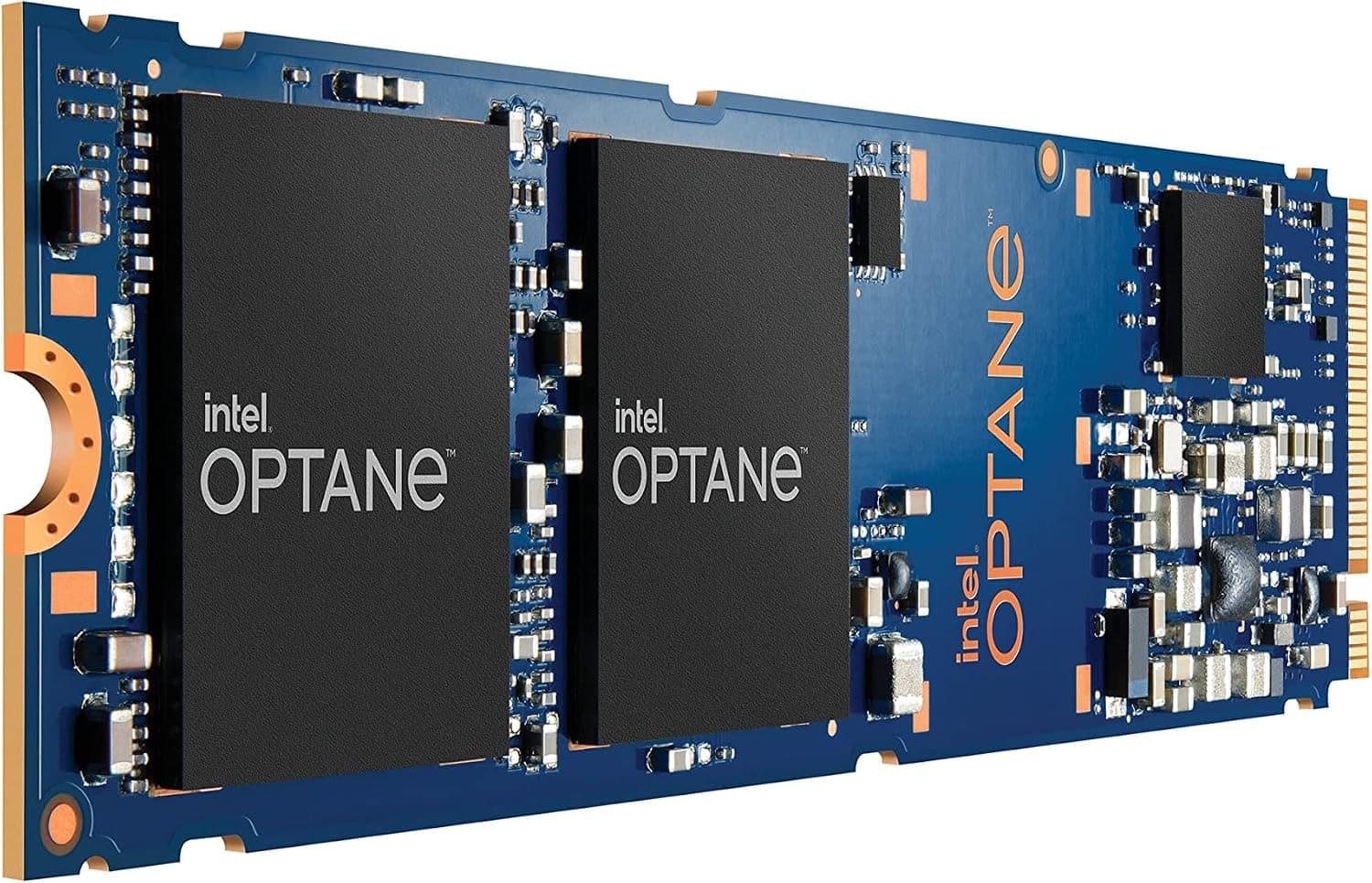
This article covers Intel OPTANE SSD P1600Xシリーズ 118GB M.2 PCIE 80MM 3.0 3DX シングルパック.
Overview
The Intel Optane SSD P1600X series is a 118GB M.2 NVMe drive built on 3D XPoint memory technology. Unlike conventional NAND flash, it offers bit-addressable access, resulting in extremely low latency and exceptional endurance. This drive is specifically designed for caching, logging, and write-intensive workloads, delivering over four times the throughput of SATA SSDs in real-world scenarios.
With a modest 118GB capacity, the P1600X compensates with a staggering 365 TBW endurance rating and a 2 million hour MTBF. It uses the M.2 2280 form factor and connects via PCIe 3.0 x4, making it compatible with a wide range of motherboards, including older Intel platforms that support Optane memory.
Market positioning places this drive in the prosumer and workstation segment — it is not a general-purpose OS drive but a specialized cache/logging solution for users who need extreme write endurance and consistent low latency. It is overkill for everyday use but invaluable for specific high-write workloads.
Compatibility Guide
- Form factor: M.2 2280 (Type 2280) — fits most motherboard M.2 slots physically.
- Interface: PCIe 3.0 x4 NVMe. Requires a PCIe 3.0-capable M.2 slot. Works in PCIe 4.0 slots but limited to PCIe 3.0 speeds.
- Memory type: 3D XPoint. Requires Intel-specific drivers (Intel RST) and BIOS settings (VMD controller) on some platforms.
- Power: Powered directly from the M.2 slot; no extra cables needed.
- Note: AMD platforms have limited official support. Compatibility is best guaranteed with Intel chipsets (200-series and newer). Always check motherboard QVL before purchase.
Product Info
Released in 2021, the Intel Optane SSD P1600X 118GB remains available today. Its price hovers around ¥150,000 (approx. $1,000 USD), which is extremely high for a 118GB drive — a reflection of its specialized 3D XPoint technology and endurance rating. The warranty period is 5 years. In the market, it sits in the mid-high tier as a niche product for write-heavy caching and logging, not for general storage.
Best Use Cases
- Server administrators managing logging or database caches: The P1600X’s 365 TBW endurance handles massive write volumes that would quickly wear out NAND SSDs. Ideal for write-intensive workloads where reliability is critical.
- Creative professionals needing a dedicated cache drive: Video editors and 3D renderers can use it as a scratch disk for project caches and media previews, eliminating write bottlenecks. However, you’ll still need a large-capacity drive for final storage.
- DIY builders setting up Optane-accelerated NAS or workstations: When paired with an Intel Optane Memory-compatible chipset, this drive can accelerate HDD-based storage, improving system responsiveness. Requires BIOS configuration and Intel RST.
- Industrial PC or embedded system developers with extreme write cycles: For applications that log data continuously, the P1600X offers longevity that no NAND SSD can match. But its 118GB capacity limits it to cache-only roles.
Things to Consider
- The 118GB capacity is too small for an OS drive or game library. This is strictly a cache/logging drive — do not expect to use it as primary storage.
- The price is astronomical compared to NAND SSDs of similar capacity (which cost a few thousand yen). For most users, a standard NVMe SSD like the Samsung 990 Pro offers far better value.
- AMD platform compatibility is limited. While the drive physically fits, it may not be recognized or may perform poorly on Ryzen systems. Intel motherboards are strongly recommended.
- Sequential read/write speeds top out around 2000 MB/s due to PCIe 3.0 x4 — slower than modern PCIe 4.0/5.0 SSDs. The strength is random I/O and endurance, not raw throughput.
FAQ
Q: Can I use this SSD as my OS drive?
A: Technically yes, but the 118GB capacity is insufficient for Windows plus applications. Moreover, sequential performance is lower than typical NVMe SSDs, so boot times and app loading will be slower. It is designed as a cache drive, not an OS drive.
Q: How does the Intel Optane SSD P1600X compare to a standard NVMe SSD like the Samsung 980 Pro?
A: The key difference is memory technology and endurance. The P1600X uses 3D XPoint, offering vastly higher write endurance (365 TBW) and lower latency. However, it has lower sequential speeds, much higher cost per GB, and smaller capacity. For most users, a standard NVMe SSD is more practical.
Q: Will it work on an AMD motherboard?
A: Physically yes, but official support is limited. Intel Optane SSDs are designed for Intel chipsets. On AMD platforms, you may encounter detection issues or suboptimal performance. For guaranteed compatibility, use an Intel motherboard (200-series or newer).
Product Disclosure (Amazon)
- Manufacturer: インテル
- Seller: TAISEI商店
- Fulfilled by: TAISEI商店
- ASIN: B09MSB59SK
- Note: This article covers a manufacturer-made product based on Amazon listing details.