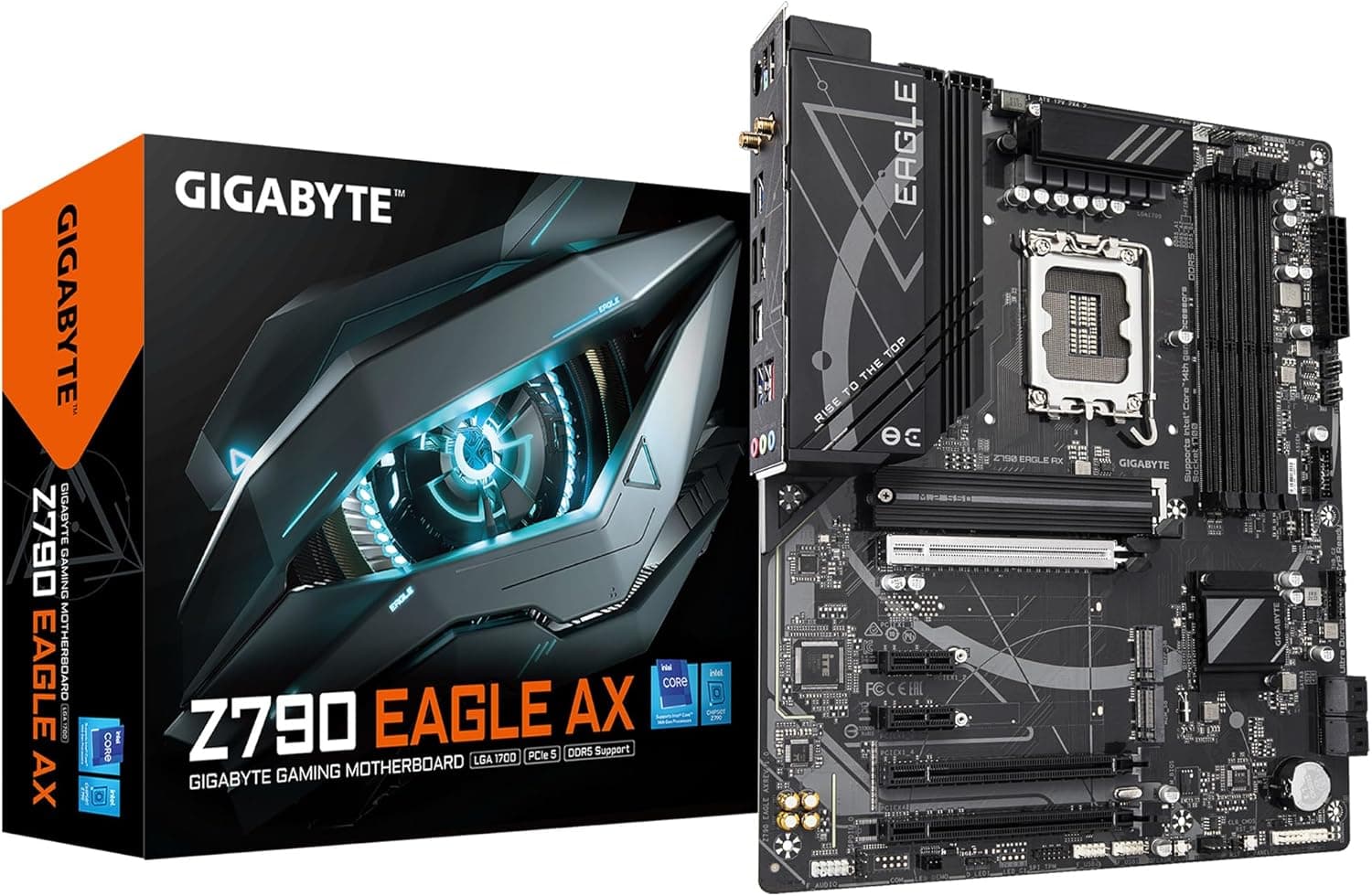
Overview
The Gigabyte H510M H V2 is a Micro ATX motherboard built around the Intel H510 chipset, supporting 10th and 11th Gen Intel Core processors on the LGA1200 socket. It accommodates up to 64GB of DDR4 memory, making it a cost-effective foundation for entry-level to mid-range PC builds.
This board is ideal for office productivity, light creative work, and budget-conscious gaming rigs. It provides essential expansion via PCIe 3.0 slots and SATA storage, striking a balance between affordability and functionality.
Positioned firmly in the entry-level segment, the H510M H V2 sacrifices features like PCIe 4.0 and memory overclocking found on B560/Z590 boards, but delivers reliable performance at a lower price point.
Compatibility Guide
The LGA1200 socket supports Intel Core i9/i7/i5/i3 10th Gen (Comet Lake) and 11th Gen (Rocket Lake) processors. Memory support includes DDR4-3200 (11th Gen) or DDR4-2933 (10th Gen) in dual-channel configuration, with a maximum capacity of 64GB.
Its Micro ATX form factor (244mm x 244mm) fits most mid-tower cases. Power delivery requires a 24-pin ATX main connector and an 8-pin CPU power connector. A 450W power supply is sufficient for entry-level builds with a modest GPU.
Storage connectivity includes four SATA 6Gb/s ports and one M.2 slot supporting PCIe 3.0 x4 (chipset-based). Note that the M.2 slot does not support PCIe 4.0 even with 11th Gen CPUs.
Product Info
Released in 2021, the Gigabyte H510M H V2 is an entry-level motherboard. Its street price is approximately ¥15,250 (as of September 2026), and it carries a standard three-year manufacturer warranty. It is widely available through electronics retailers and online stores.
As an entry-class product, it omits PCIe 4.0 and memory overclocking, but offers stable performance for budget-oriented builds. It competes directly with other H510 boards like the ASUS Prime H510M-A and MSI H510M-A PRO.
Best Use Cases
- Budget Office PC Builders: For document editing, web browsing, and light multitasking, pairing this board with a Celeron or Pentium yields an extremely affordable system.
- Entry-Level Gamers: Combined with a GPU like the GeForce GTX 1650, it handles 1080p gaming at modest settings. PCIe 3.0 bandwidth is adequate for such cards.
- Secondary PC or File Server Builders: Its low power draw and compact size make it suitable for always-on systems or home servers.
Users who need PCIe 4.0 for fast SSDs or want memory overclocking should consider B560 or Z590 boards instead.
Things to Consider
The H510 chipset lacks PCIe 4.0 support, limiting bandwidth for modern GPUs and NVMe drives. Memory overclocking (XMP) is not supported; RAM speed is capped by the CPU's official specification (DDR4-3200 with 11th Gen, DDR4-2933 with 10th Gen).
The VRM design is basic, so pairing this board with high-TDP CPUs like Core i7 or i9 may lead to elevated VRM temperatures under load. It is best suited for Core i5 or lower TDP processors.
Competing H510 boards from ASUS and MSI offer similar features but may differ in port layout and BIOS options. Always check the rear I/O panel to ensure it matches your peripheral needs.
FAQ
Q: Can I use a Core i9-11900K with this motherboard?
A: The socket is compatible, but the weak VRM makes it inadvisable. Stick with 65W TDP CPUs like the Core i5-11400 or i3-10100.
Q: Will a PCIe 4.0 graphics card work?
A: Yes, it will function, but the slot runs at PCIe 3.0 x16. For cards above the RTX 3060 class, you may see a slight performance drop.
Q: Is it worth buying DDR4-3200 memory?
A: With an 11th Gen CPU, DDR4-3200 is officially supported, but XMP is not available, so manual BIOS configuration is required. With 10th Gen CPUs, the maximum is DDR4-2933.