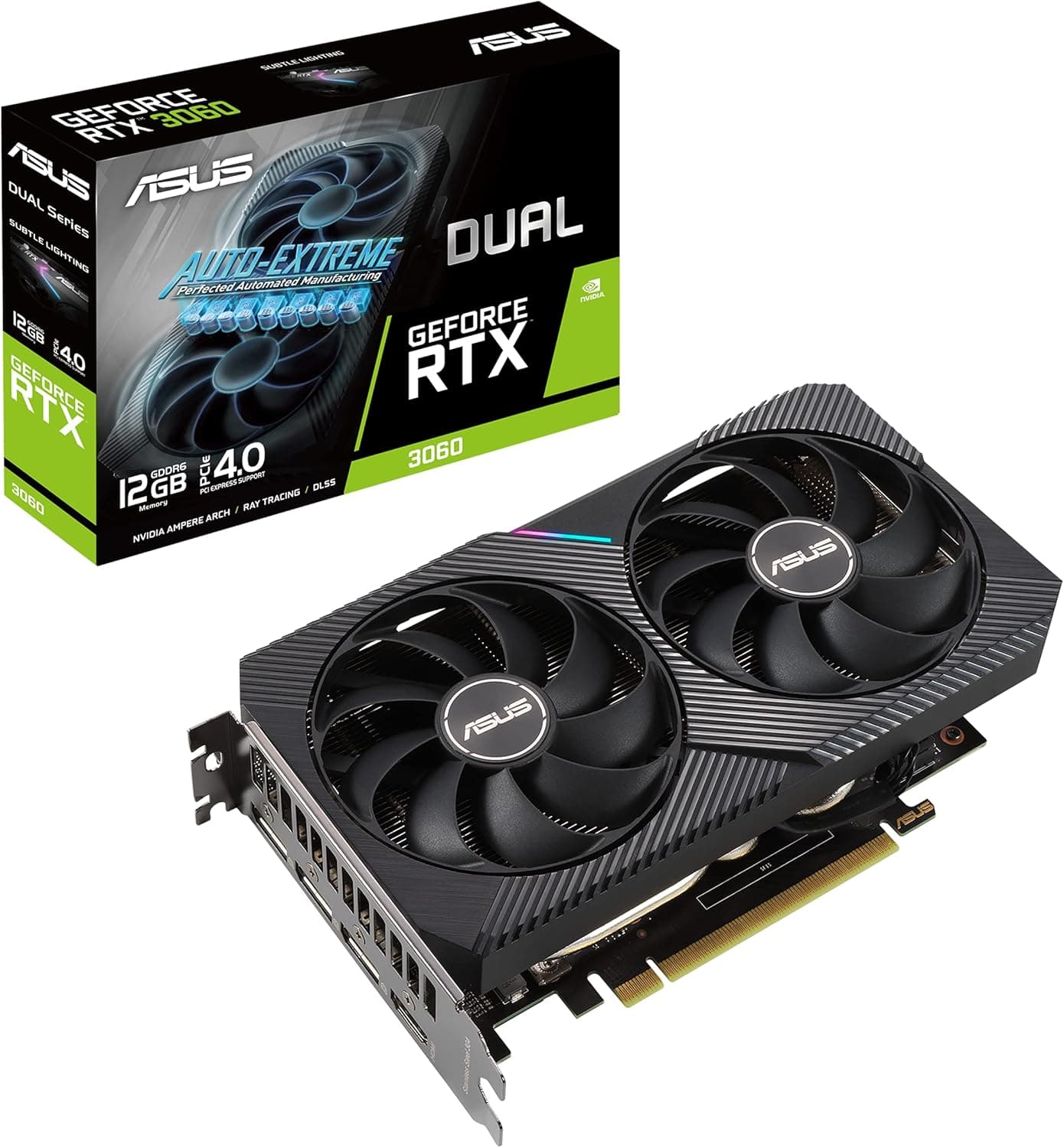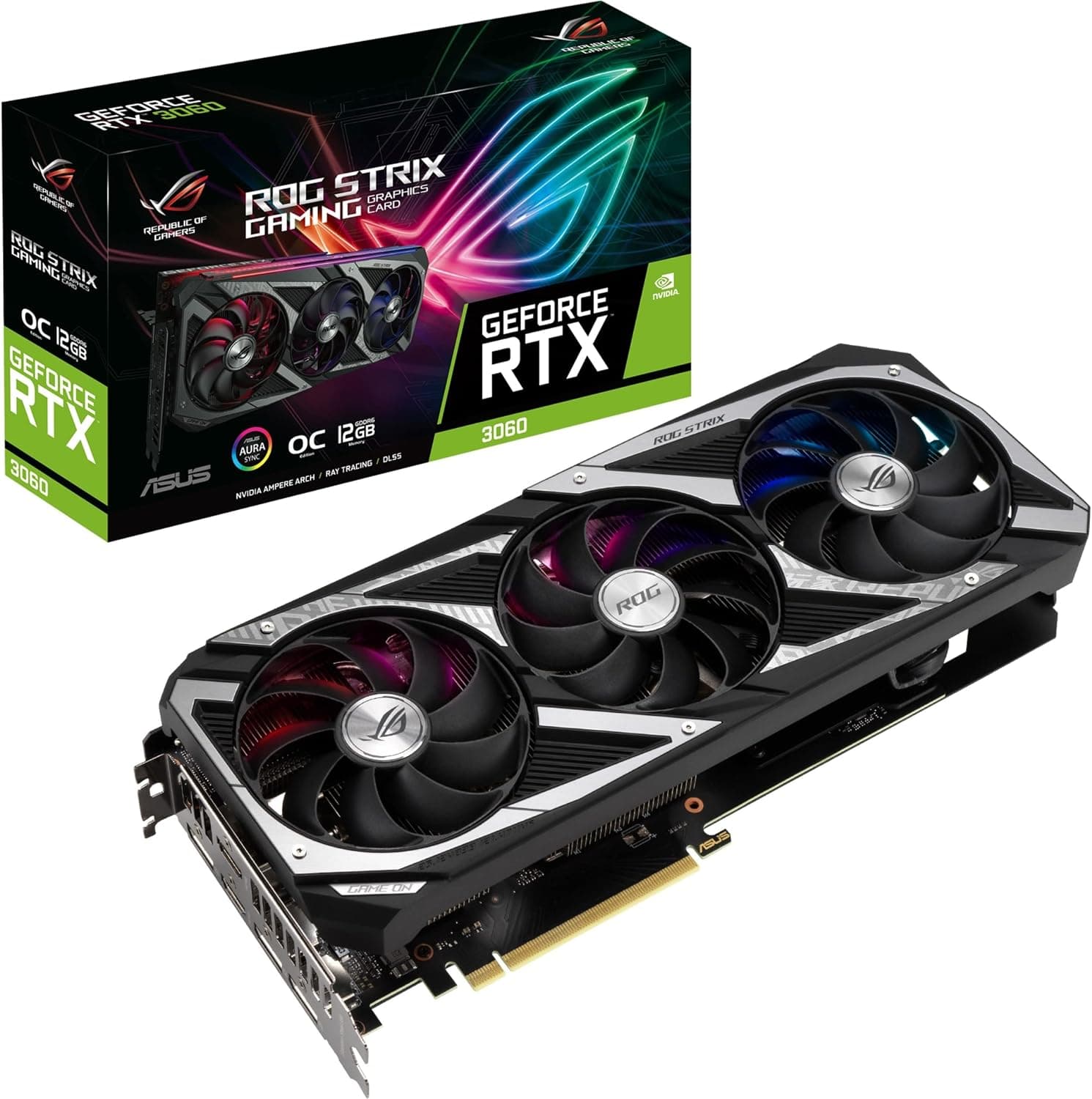
This article covers ASUS ROG Strix NVIDIA GeForce RTX 3060 V2 OCエディション ゲーミング グラフィックスカード (PCIe 4.0 12GB GDDR6 HDMI 2.1 DisplayPort 1.4a Axial-tech ファンデザイン 2.7スロット Super Alloy Power II GPU Tweak II).
Overview
The ASUS ROG Strix GeForce RTX 3060 V2 OC Edition is a premium mid-range graphics card built on NVIDIA's Ampere architecture. It features 12GB of GDDR6 VRAM on a 192-bit bus, making it well-suited for 1080p and entry-level WQHD gaming. The V2 revision brings refined cooling and PCB layout, with an OC boost clock of 1912 MHz. As part of the ROG Strix lineup, this card uses high-quality Super Alloy Power II components and ASUS's Axial-tech fan design with reversed center fan rotation for higher static pressure and quieter operation. PCIe 4.0 compatibility ensures it's ready for modern motherboards without bandwidth bottlenecks. Market positioning: this is a high-end variant of the RTX 3060, offering higher clock speeds, robust cooling, and premium build quality compared to standard models. It's ideal for gamers who want extra performance headroom and aesthetic features like RGB lighting.
Compatibility Guide
Interface: PCIe 4.0 x16; backward compatible with PCIe 3.0 slots. Performance impact at PCIe 3.0 is negligible for this card. Power: One 8-pin PCIe power connector required. Recommended PSU wattage: 550W minimum; 600W+ for systems with high-power CPUs or multiple drives. Physical fit: 2.7-slot design, about 28 cm length. Check case clearance carefully before purchase; it may not fit small form factor or mini-tower cases. Display outputs: 3x DisplayPort 1.4a, 1x HDMI 2.1. HDMI 2.1 supports 4K 120Hz+ HDR. Multi-monitor setups are straightforward. * Memory: 12GB GDDR6 at 15 Gbps effective clock, 192-bit bus. Ample for high-resolution textures and moderate content creation.
Product Info
The ASUS ROG Strix GeForce RTX 3060 V2 OC Edition launched in 2021. Current pricing on Japan is around ¥154,617. The card sits at the upper end of the mid-range market, offering superior cooling and higher factory overclock compared to standard RTX 3060 models. Features include Axial-tech fans with 0dB technology (fan stop under low load), ASUS Super Alloy Power II capacitors, and a reinforced metal backplate. Warranty: 3 years.
Best Use Cases
1080p high-refresh gaming: Perfect for 1080p monitors up to 144Hz for most modern games at high/ultra settings. DLSS and ray tracing are usable with moderate settings. Not ideal for maxed-out ray tracing at high resolutions. Entry-level WQHD gaming: Capable of 60fps at 2560×1440 in many titles with adjusted graphics. Best used with DLSS to maintain performance and visual quality. Budget content creation: 12GB VRAM is helpful for 4K video editing, medium 3D scenes, and rendering. The 3584 CUDA cores provide good compute performance for the price segment. Noise-sensitive users: With semi-passive fan operation, the card stays silent under light load, making it a good choice for quiet home theater or office-adjacent gaming rigs.
Things to Consider
Price vs performance: At roughly ¥154k, you could also consider newer cards like the RTX 4060 Ti or RX 7700 XT. The RTX 3060 is one generation older, but still holds its own at 1080p and moderate 1440p gaming. Large footprint: The ~28cm length and 2.7-slot thickness require a reasonably spacious case. Measure internal clearance, especially GPU clearance past drive cages. Potential overkill: For purely office work or light 1080p gaming (60fps), a cheaper card may be more cost-effective. This card's main advantages are its OC headroom and build quality. Power supply headroom: While 550W is the minimum, if your CPU draws over 150W or you plan overclocking, a 650W unit is safer. ## FAQ
Q: Will this graphics card work in a PCIe 3.0 motherboard slot? A: Yes, it will work fine. The bandwidth difference between PCIe 3.0 and 4.0 is minimal for RTX 3060 class cards, so you won't see significant performance loss. Q: How good is ray tracing performance on the RTX 3060? A: Ray tracing performance is entry-level. With DLSS enabled, you can achieve playable frame rates at 1080p with medium ray tracing. For heavy ray tracing workloads, consider a higher-tier card like RTX 3070 or RTX 4070. Q: Can this card handle 4K gaming? A: For older titles or with significantly reduced settings, yes. However, for modern AAA games at 4K 60fps, this card lacks sufficient memory bandwidth and compute power. WQHD (1440p) or 1080p is recommended for optimal experience.
Product Disclosure (Amazon)
- Manufacturer: ASUS
- Seller: Y,s Market
- Fulfilled by: Y,s Market
- ASIN: B0985Z47C8
- Note: This article covers a manufacturer-made product based on Amazon listing details.