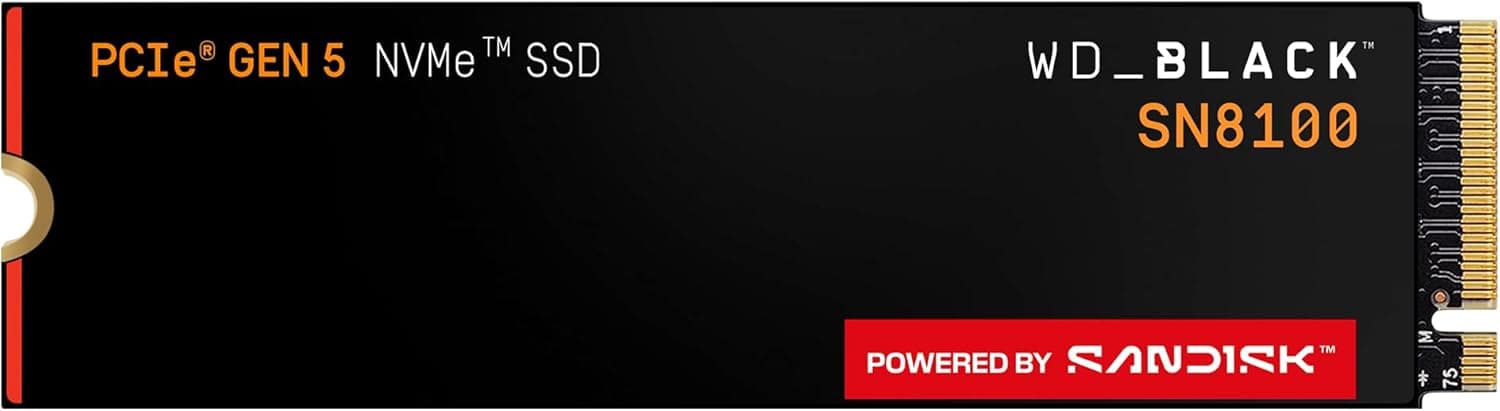
This article covers Western Digital Black SN8100 1 TB 4 TB.
Overview
Western Digital's Black SN8100, launched in May 2025, is a PCIe 5.0 x4 NVMe M.2 SSD that targets the high-end storage market. It's available in capacities of 1TB (model WDS100T2X0E) and 4TB (model WDS400T2X0E). The drive uses a Silicon Motion SM2508 controller paired with TLC NAND flash, and the 1TB variant includes 1024 MB of DRAM cache. With a street price around ¥42,480 as of September 2026, it competes directly with other top-tier PCIe 5.0 SSDs. Its primary use cases include demanding content creation and high-end gaming where maximum throughput is required.
Compatibility Guide
The SN8100 comes in the M.2 2280 form factor and requires a PCIe 5.0 x4 interface for full performance. It is backward compatible with PCIe 4.0 slots but will operate at reduced speeds. Compatible motherboards include those with Intel Z690/Z790/X299 or AMD X670E/B650E/X870E chipsets that provide PCIe 5.0 M.2 slots. For optimal thermal management, we strongly recommend using a heatsink—either a motherboard-integrated one or an aftermarket cooler—since the drive can generate significant heat under sustained loads.
Product Info
Released in May 2025, the Western Digital Black SN8100 carries a 5-year warranty. It is available through Japanese online retailers and Joshin. Market positioning is firmly high-end, leveraging PCIe 5.0 bandwidth to achieve sequential read speeds exceeding 10,000 MB/s (official specs not disclosed in evidence). The SM2508 controller and TLC NAND place it alongside competitors such as the Samsung 990 Pro and Seagate FireCuda 540. However, for most everyday workloads, the real-world speed advantage over a fast PCIe 4.0 drive may be less pronounced than benchmark numbers suggest.
Best Use Cases
- Professional content creators working with 4K/8K video: The sequential read/write speeds dramatically reduce file transfer times for large media projects. Ideal for video editors who frequently move multi-gigabyte files. Not recommended for office tasks or light media use.
- Enthusiast gamers building a cutting-edge PC: Those who want the fastest possible loading times in DirectStorage-aware games will benefit. However, the number of titles fully utilizing DirectStorage remains small, so a PCIe 4.0 SSD may be more cost-effective.
- PC builders who want to future-proof: If you plan to keep your system for 4–5 years and want the fastest available storage today, the SN8100 is a solid choice. Be aware that PCIe 6.0 SSDs may arrive in the next few years, though.
- System integrators offering premium configurations: For pre-built high-end PCs, this SSD adds a performance halo even if the practical benefits vary by workload.
Things to Consider
First and foremost, the SN8100 requires a PCIe 5.0 slot to deliver its full potential. In a PCIe 4.0 system, you'll only get about half the bandwidth, making a cheaper PCIe 4.0 drive a more sensible purchase. Heat management is also critical; the drive can throttle if not properly cooled. Ensure your motherboard has a heatsink or you have a compatible aftermarket solution. Additionally, the 1TB model's TBW rating (not officially confirmed in our source) should be checked if you plan heavy write workloads. Competitors like the Samsung 990 Pro and Seagate FireCuda 540 offer similar performance, but the SN8100's SM2508 controller brings updated features. Finally, consider whether your workflow actually benefits from 10,000+ MB/s sequential speeds—most gamers and even many creators will be well served by a high-end PCIe 4.0 drive.
FAQ
Q: Can I use the SN8100 in a PCIe 4.0 slot?
A: Yes, it will work and be recognized, but the speed will be limited to PCIe 4.0 x4 (about 7,000 MB/s). You won't get the higher throughput the drive is capable of.
Q: Is a heatsink required?
A: While not strictly required for brief usage, sustained writes can push temperatures high enough to trigger thermal throttling. We strongly recommend a heatsink—either the motherboard's built-in one or an aftermarket model.
Q: Is this SSD compatible with the PlayStation 5?
A: Physically yes, but the PS5 only supports PCIe 4.0, so the drive won't run at full speed. Moreover, PS5's heat dissipation constraints and thickness requirements may not align with this drive's cooling needs. A PCIe 4.0 SSD is a safer and more cost-effective choice for PS5 expansion.