Game Overview
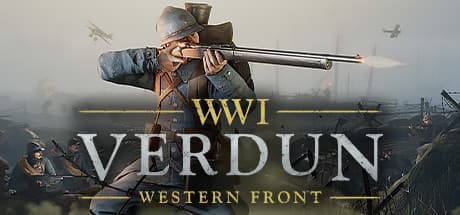
Verdun: Experience Authentic World War 1 Trench Warfare is a multiplayer FPS based on the Western Front between 1914 and 1918. Its battles revolve around leaving cover, crossing exposed ground, and fighting for control of trench lines.
Developed and published by BlackMill Games, it was released on April 28, 2015.
This is not a shooter built around constant sprinting and prolonged exchanges of automatic fire. Survival depends on where you expose yourself, when you cross a firing lane, and whether your advance matches the movement of your team.
Attackers must push the front forward, while defenders use narrow approaches and trench corners to stop them.
What Makes the Trench Combat Distinctive
The weapons, uniforms, and battlefields are modeled around the First World War's Western Front. Rifles make each shot consequential, so positioning, careful aim, and landing the first hit matter more than sustained fire.
Bayonets become relevant when the distance closes, giving cramped trenches a different tension from long-range engagements.
Individual reflexes help, but battles are not decided by reflexes alone. One group can reveal enemy firing positions while another advances under cover, and coordinated pressure is more useful than an isolated rush.
Players who chase eliminations without watching the front line are likely to be exposed from several directions.
Four game modes present different aspects of First World War combat. The back-and-forth struggle over trench lines expresses the game's identity most clearly, with advances followed by organized counterattacks.
Verdun concentrates its reward in capturing and holding hard-fought ground rather than delivering a constant stream of flashy moments.
Practical Advice for New Players
Avoid running directly across no man's land without first observing the routes used by teammates. Firing can reveal your position, so waiting for a controlled shot is often safer than repeatedly shooting at a target you are unlikely to hit.
After entering a trench, check where allies are aiming before moving around a blind corner.
When you die repeatedly, consider the firing lane that caught you rather than focusing only on aiming speed. Enemies may have a view through a break in the trench or from elevated ground on the flank.
Staying close enough to follow the team's movement is a useful way to learn the maps and understand how the front shifts.
PC Requirements
The minimum requirements list Windows 8 or 10, an Intel Core i5-2500K at 3.3GHz or an AMD Phenom II X4 940, and a GeForce GTX 960M or Radeon HD 7750 or better.
The GPU needs 1GB of video memory, while the system requires 4GB RAM, 12GB of available storage, and DirectX 10.
The recommended information specifies 8GB RAM and 4GB of video memory. Meeting the minimum is a starting point, but the recommended memory figures are the more sensible target when consistency during crowded battles matters.
No detailed recommended CPU or GPU model is provided, so players seeking higher resolutions or frame rates should adjust settings gradually.
Verdun is multiplayer-only and requires a stable, fast internet connection. Latency and packet loss can affect the feel of aiming even when the PC produces an acceptable frame rate.
If wireless play feels inconsistent, checking the network or trying a wired connection may help.
Reception and Common Impressions
Verdun has retained support over time because its historical subject and deliberate gunplay remain clearly defined. Instead of emphasizing modern equipment or hero abilities, it focuses on battlefield pressure and the danger attached to every exposure.
Players interested in period weapons and uniforms are especially likely to appreciate the attention given to the setting.
The same design can also be frustrating. New players may be eliminated from a distance before they understand the map, and identifying a concealed firing position takes patience.
Because the experience depends on online opponents, matchmaking conditions may vary by region and time of day; checking current activity for your usual play period is sensible.
Who Should Play It
Verdun suits players interested in the Western Front who prefer tension over speed. It is a strong match for those who enjoy lining up deliberate rifle shots and advancing with a team instead of relying on solo movement.
Players willing to learn terrain and sightlines through repeated defeats will get the most from its demanding combat.
Caveats and Who May Not Enjoy It
Players looking for constant mobility, plentiful automatic weapons, and rapid streaks of eliminations may find the pacing restrictive. Death can arrive before an opponent is clearly visible, particularly while crossing exposed terrain.
Enjoyment therefore depends on accepting observation and map knowledge as central parts of the shooting experience.
There is no offline story campaign to replace the multiplayer component. Anyone planning to play regularly should also consider whether opponents are available during their normal gaming hours.
The best reason to choose Verdun is a specific interest in historical equipment, deliberate marksmanship, and team-based trench assaults.