Game Overview
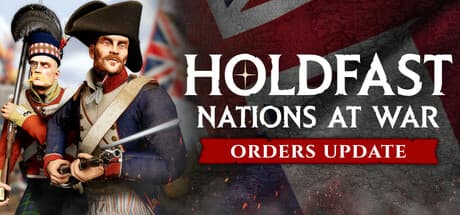
Holdfast: Nations At War: Epic Multiplayer Historical Battles is a multiplayer shooter built around historical land and naval warfare with up to 150 players on one server. Unlike a competitive FPS decided mainly by individual aim, its battles gain their identity from crowds moving in formation, reacting to local commands, and creating both organized advances and memorable chaos.
A typical session begins by choosing a server and faction, then moving toward the front or an objective with nearby allies. On a battlefield of this scale, repeatedly hunting enemies alone is usually less useful than matching the timing of a larger group.
The inclusion of both land and sea combat also means that positioning and coordination can change substantially between battlefields.
Features and Systems
Proximity voice chat is central to the experience. Nearby players can report danger, call others into formation, issue improvised commands, or simply role-play within the battle.
It supports serious coordination, but the overlapping shouts and unexpected conversations can be just as entertaining as a disciplined plan.
Gunfights do not feel like the rapid, sustained fire of a modern military shooter. Each shot makes timing, distance, and the next action matter, while an isolated player is vulnerable to a coordinated group.
When fighting shifts to close range, spacing and the number of nearby allies can matter as much as quick reactions.
Players seeking a structured experience can join regiments, the game's equivalent of clans, and take part in organized training or events. Public servers still allow a more casual approach, so regiment membership is not required for every session.
The coexistence of disciplined line battles and spontaneous role-play is one of the game's clearest distinctions.
Beginner Priorities
New players will learn more by following a visible group than by immediately trying to operate alone. Listen for movement or firing calls and observe where experienced allies stop, aim, and take cover.
Even when a death seems confusing, nearby formations often reveal which routes are exposed and where the front line has shifted.
Common mistakes include remaining exposed after firing, crossing open ground with too few allies, and drifting too far from the main force. Focus first on surviving long enough to participate in group actions, then learn the effective spacing and timing of each weapon.
You can benefit from proximity chat by listening even if you prefer not to speak.
PC Requirements
The minimum specification lists 64-bit Windows 10 or Windows 11, an Intel Core i5-4670K or AMD Ryzen 7 1800X, a GeForce GT 1030 or Radeon RX 550, and 8 GB of RAM. DirectX 11 is required, along with 22 GB of available storage.
Treat this as a baseline for running the game rather than a guarantee of consistent performance in the densest engagements.
The recommended specification rises to an Intel Core i7-8700K or AMD Ryzen 5 3600X, a GeForce GTX 1060 6GB or Radeon RX 580 8GB, and 10 GB of RAM. The substantial step up in both CPU and GPU guidance suggests that battles approaching the 150-player limit can stress more than graphics hardware alone.
If large clashes cause slowdowns, test demanding options such as shadows and view distance before lowering every setting.
Although 22 GB is listed for storage, leaving extra free space is sensible for updates and temporary files. On an 8 GB system, closing background applications may also help.
PCs below the recommended configuration should prioritize stable frame delivery over visual detail.
Reception and Player Experience
Holdfast: Nations At War has maintained a broadly positive reputation over time. Players commonly value the spectacle of formations acting together, the accidental comedy produced by local voice chat, and the sense of scale found in community events.
Its strongest moments often come from stories created by the participants rather than from the final result of a match.
The unusual weapon pacing and the importance of group movement will not suit everyone. Population, atmosphere, and the presence of active leadership can also vary by server and time of day.
Casual public play provides immediate entertainment, while organized regiment play reveals a more tactical and committed side of the same systems.
Who Should Play It
The game is a strong fit for players who want to move with a large force, enjoy historical battle atmosphere, and are comfortable with spontaneous voice interaction. It particularly rewards people who value supporting a formation and sharing unpredictable moments more than optimizing a personal ranking.
Regiments give regular groups a reason to train and participate in organized battles. Players with less predictable schedules can still experience the intended scale by joining public servers and following active groups.
Both approaches are valid, though they produce different levels of coordination.
Limitations and Who May Not Enjoy It
This is a poor fit for anyone expecting consistently balanced competitive matches or nonstop, tightly controlled firefights. Large battles can involve travel, waiting, and sudden deaths soon after reaching the front.
Enjoyment depends partly on accepting that confusion and unfair-looking outcomes are elements of the battlefield experience.
Proximity chat is a major attraction, but it can feel noisy to players who dislike hearing strangers or improvised role-play. Some coordination also depends on spoken information, which may be harder to follow in an unsuitable audio environment.
Before playing, check the Steam product page for current language support, regional server conditions, and available voice-chat settings.