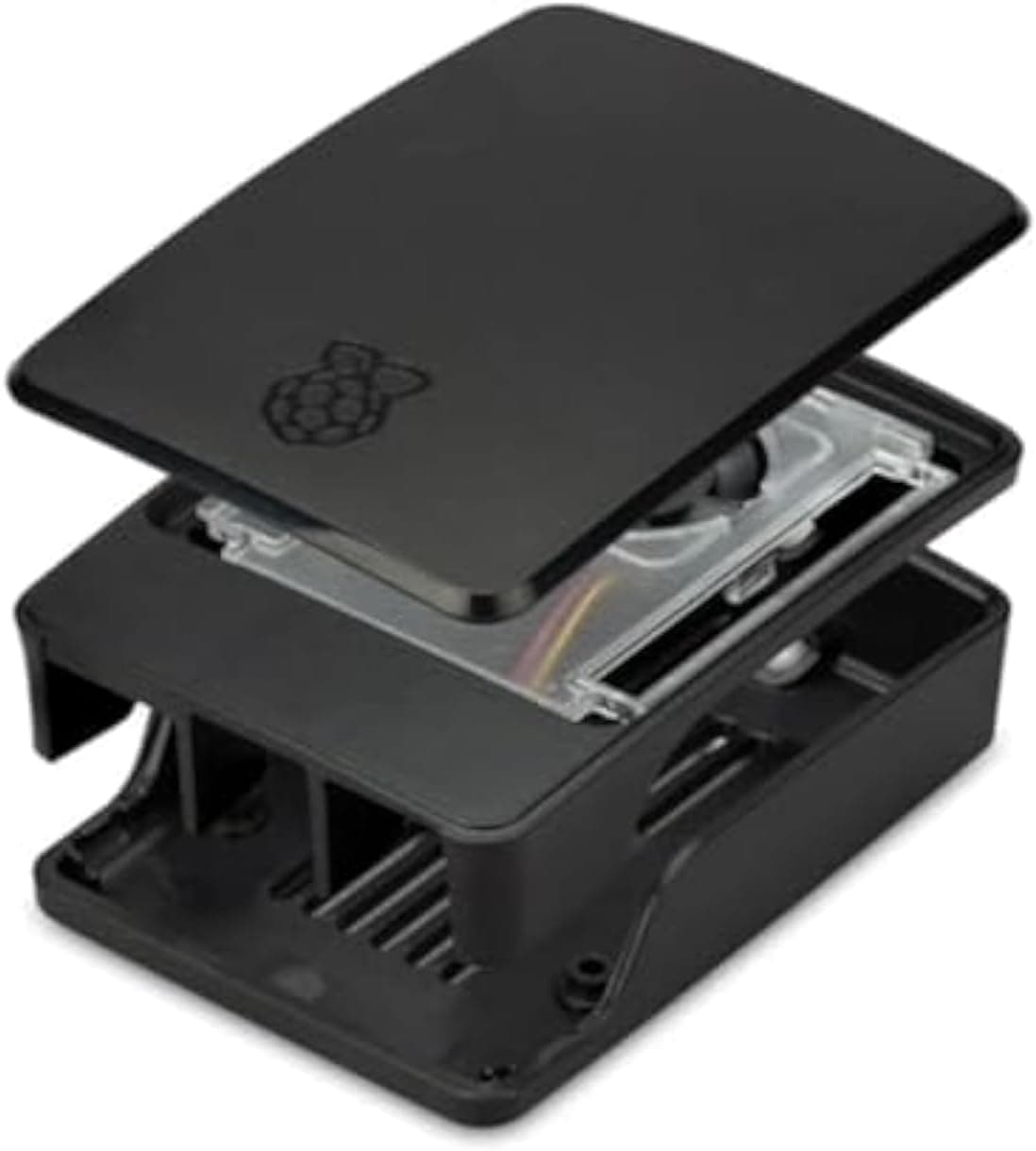
This article covers Raspberry Pi 5用公式ケース (the official Raspberry Pi 5 case, model SC1160).
Overview
The Raspberry Pi 5 Case SC1160 is the official enclosure from Raspberry Pi, designed specifically for the Raspberry Pi 5 single-board computer. The short verdict: if you run a stock Pi 5 as a desktop or small always-on server, this is the lowest-risk case you can buy.
If you swap GPIO wires daily, stack HATs, or plan to add an NVMe drive, it is the wrong choice.
Its snap-together construction needs no tools: you press the board into the lower half, clip on the upper half, and the build is done — no screws, no standoffs, a few minutes at most. At around 75 g the case stays light enough for both desktop use and travel, while the black/grey finish matches the Pi 5's professional look.
Unlike the earlier Pi 4 case, this model ships with an integrated PWM fan that plugs directly into the Pi 5's fan header. The fan automatically adjusts speed based on board temperature, so the Pi stays cool under load and quiet when idle.
As an official accessory it sits in the entry-to-mid tier, trading exotic materials for a precise fit and dependable cooling.
On Amazon.co.jp the listing showed 4.7 out of 5 stars from 95 reviews (94% positive) as captured on 7 September 2026.
That is a modest review count, but for a single-purpose accessory it signals that the product mostly does exactly what buyers expect.
Compatibility Guide
This case is built exclusively for the Raspberry Pi 5. It will not fit a Raspberry Pi 4, Pi 3, Zero, or any other single-board computer.
The Pi 4 and Pi 5 look similar in outline, but the USB and Ethernet blocks are swapped, and the Pi 5 adds a PCIe connector, a power button, and a dedicated fan header in positions the older cases do not account for. Check the silkscreen on your board before ordering — buying for the wrong generation is the single most common mistake here.
| Item | Value |
|---|---|
| Compatible board | Raspberry Pi 5 |
| Model name | SC1160 |
| Case type | Snap-fit (tool-free) |
| Cooling | Active — 1 integrated PWM fan |
| Weight | 75 g |
| Material | Plastic |
| Color | Black / grey |
The snap-fit design leaves every major connector accessible: USB-C power, dual micro HDMI, Ethernet, USB ports, the microSD slot, and the camera/display flat-flex cutouts. The GPIO header remains reachable through the side opening, the power button is accessible from the case, and the activity LED stays visible.
"Accessible" and "comfortable" are not the same thing, though. The GPIO opening is a narrow slot that exposes the 40-pin header from above, so you are dropping jumper wires in from the top.
Rewiring one pin at a time is fiddly. More importantly, you cannot close the lid with a tall HAT or a stacked board installed.
If HATs are central to your project, run the case open-topped or pick a third-party chassis that advertises HAT clearance.
The flat base gives the unit good stability on a desk. The bundled PWM fan connects to the dedicated fan header on the Pi 5, so no separate power is required — but that also means it competes for the same header if you already own a separate Active Cooler.
If you want a large heatsink or a bigger fan, a third-party case will give you far more room to work with.
PCIe users should think twice. The Pi 5's PCIe connector sits on the top of the board, and routing a flat cable out of a closed shell is awkward.
If an M.2 HAT and NVMe SSD are in your plan, buy a case designed for that from the start.
How Good Is the Cooling, Really?
The spec is straightforward: active cooling via a single integrated PWM fan. Because it is PWM-controlled, the OS ramps the fan up and down with SoC temperature.
At idle it either stops or spins very slowly, so it disappears into a quiet room. Push the CPU to 100% for a long compile or a video encode and the fan spins up, producing the higher-pitched airflow noise typical of small fans.
Expect "quiet most of the time, audible when it works" rather than silence.
The key framing is that this cooling targets a stock Pi 5. The Pi 5 runs hotter than the Pi 4 and will thermally throttle under sustained load without active cooling; the built-in fan exists to prevent that at default clocks.
If you overclock and hold full load, a large heatsink or a machined aluminium case has more headroom.
A fan is also a moving part. Over years of 24/7 duty the bearing may start to whine.
That is worth planning for on a server build — the upside of an official accessory is that spares circulate widely.
Compared With the Alternatives
| Type | Cooling | Expandability | Best for |
|---|---|---|---|
| Official SC1160 | Active (PWM fan) | Low — closed shell, no HAT clearance | Everyday desktop, light server, classrooms |
| Aluminium / heatsink case | Mostly passive, silent | Medium, varies by model | Silence, dusty environments |
| Open-frame / stackable | Optional, board exposed | High — HATs and M.2 fit easily | Prototyping, expansion-heavy builds |
The official case's unique advantage is guaranteed fit against the actual board layout. Third-party shells can be cheaper or cool harder, but misaligned cutouts and mismatched fan connectors are a real risk.
For a first build, that certainty is worth paying for. If silence is your top priority, go passive; if you need expansion, go stackable.
"Official" does not mean "best for everything."
Product Info
The SC1160 launched alongside the Raspberry Pi 5 and is sold worldwide through official channels and major retailers. As captured on 7 September 2026, the Amazon.co.jp listing price was ¥5,164 including tax. Prices move with exchange rates and stock, so check the product page for the current figure before buying.
The package includes the two-piece plastic shell and the PWM fan; no screws or tools are needed. The fan cable is built into the lid, so wiring is just one plug into the board header.
Market positioning is firmly entry-to-mid tier. Aluminium heat-spreader cases dissipate more heat passively and third-party chassis often add mounting points or drive slots, but the official case offers what those kits cannot: a fit matched to the Pi 5 board layout and fan header.
For a stock, unmodified Raspberry Pi 5, it provides sufficient active cooling.
Warranty terms follow the seller's policy rather than a single global standard, but official Raspberry Pi accessories are supported through the Raspberry Pi distribution network, making replacement parts easy to source. The SC1160 ships only in black/grey; if you want other colors, look elsewhere.
Best Use Cases
- Beginners setting up their first Raspberry Pi 5: the tool-free snap assembly removes the intimidating part of the build, and there is no risk of buying an incompatible fan or the wrong standoffs.
- Daily desktop use: the PWM fan keeps the SoC within acceptable temperatures under sustained load, while the enclosed design protects the board from accidental shorts and dust.
- Always-on light servers and IoT gateways: closed, dust-resistant, and light enough at 75 g to tuck onto a shelf.
- Schools, labs, and corporate fleets: standardizing on the SC1160 means every unit mounts and cools identically, which makes support far simpler.
For makers who constantly swap GPIO wires, the side opening works but is cramped. If your prototype changes wiring every few minutes, an open-frame or stackable case is more practical.
Before You Buy
1. Pi 5 only. It will not fit a Pi 4 or Pi 3. Confirm the generation on the silkscreen first.
2. Expansion is essentially off the table. Tall HATs and M.2 adapters will not fit under the closed lid.
If NVMe storage is in your future, buy an expansion-friendly case now rather than a second case later.
3. Not silent. The fan ramps up under load. For bedrooms or recording spaces, a passive heatsink case is the better fit.
4. The price is a snapshot. The ¥5,164 figure above was captured on 7 September 2026 and will drift while this article does not.
Always confirm on the product page.
5. Do not trust listing metadata blindly. Marketplace listings sometimes carry manufacturer, model, or seller fields that do not match the actual item.
Nothing here contradicts the product, but verify from the product images and title that you are buying the official Raspberry Pi 5 case SC1160 — lookalike third-party cases appear in the same search results, and choosing on price alone can get you a different product.
6. It is plastic. The shell protects against knocks and shorts, not against being dropped or stepped on.
Industrial deployments should look at metal enclosures.
FAQ
Q. Does it fit a Raspberry Pi 4?
A. No. Raspberry Pi 5 only — the connector layout and fan header differ.
Q. Does the fan need its own power supply?
A. No. It plugs into the Pi 5's dedicated fan header and is PWM-controlled automatically.
Q. Is it noisy? A.
Quiet at idle and light load; audible when the CPU runs flat out for long stretches. Choose a passive case if you need silence.
Q. Can I use the GPIO header?
A. Yes, through the side opening — but the space is tight and you cannot close the lid over a tall HAT.
Q. Do I need tools to assemble it?
A. No. It snaps together in a couple of minutes.
Q. Is the cooling enough for overclocking? A.
It is designed for stock clocks. Sustained overclocking is better served by a large heatsink or machined aluminium case.
Product Disclosure (Amazon)
- Manufacturer: Raspberry Pi
- Seller: Amazon US
- Fulfilled by: Amazon US
- ASIN: B0CN5Q28TX
- Note: This article covers a manufacturer-made product based on Amazon listing details.