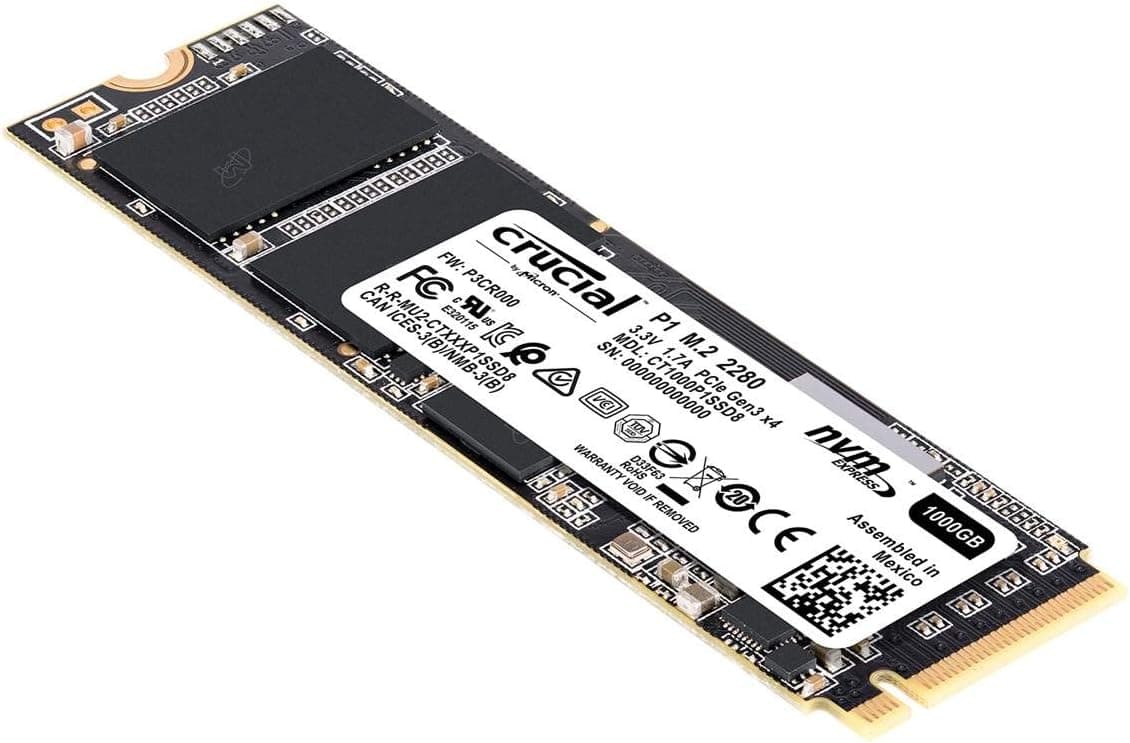
This article covers 重要なP1 1TB 3D NAND NVMe PCIe M.2 SSD.
Overview
Crucial's P1 series is widely recognized as a budget-friendly NVMe SSD line that prioritizes value over raw performance. The Crucial P1 1TB (model CT1000P1SSD8) offers a large 1TB capacity at a price point that often rivals SATA SSDs, yet delivers NVMe-class speeds. It uses a PCIe 3.0 x4 NVMe interface and achieves sequential read speeds up to 2,000MB/s and write speeds up to 1,700MB/s. The key differentiator is its QLC (Quad-Level Cell) 3D NAND flash memory, which lowers cost per gigabyte compared to TLC alternatives while still providing snappy everyday performance. Positioned as an entry-level NVMe SSD, this drive is ideal for users who want a cost-effective upgrade from a hard drive or SATA SSD without breaking the bank. Backed by Micron's manufacturing expertise (Crucial is Micron's consumer brand), the P1 offers reasonable reliability for general desktop and laptop use.
Compatibility Guide
The Crucial P1 uses the M.2 2280 form factor with an M-key edge connector, fitting most modern motherboards and laptops that have an M.2 slot supporting NVMe. It uses PCIe 3.0 x4 lanes but is backward compatible with PCIe 2.0 and forward compatible with PCIe 4.0 slots (where it will run at PCIe 3.0 speeds). Before purchasing, check that your system supports NVMe booting (most UEFI systems do). Older platforms (e.g., Intel 6th gen or earlier, AMD AM4 first-gen) might require a BIOS update or additional NVMe driver. For notebooks, verify the M.2 slot supports NVMe—some older laptops only support SATA M.2 drives.
Product Info
Launched in 2019, the Crucial P1 1TB is a mature product that has remained popular due to its aggressive pricing. It uses a Silicon Motion SM2263EN (or SM2263XT) controller, is DRAM-less, and relies on Host Memory Buffer (HMB) to cache mapping tables. The NAND is Micron's QLC 3D NAND, and the drive carries a 3-year limited warranty with a TBW rating of 220TB for the 1TB model. The drive is widely available through major retailers like and electronics stores. Street prices fluctuate, but the 1TB variant typically ranges from $60 to $80 USD in global markets.
Best Use Cases
Budget-conscious users wanting NVMe speed: Perfect for upgrading from HDDs or SATA SSDs. Boot times and application loading will improve dramatically. Ideal for office work, web browsing, and light gaming. Game storage drive (read-heavy workloads): Storing your Steam library on this drive provides fast level loading. Since gaming involves mainly reading, the QLC write penalty rarely becomes an issue. Laptop storage expansion: The single-sided M.2 design fits most ultrabooks and thin laptops. Low power consumption helps preserve battery life. Who should avoid this drive: Content creators who frequently write large video files or databases will experience SLC cache exhaustion, leading to slow write speeds (often below 200MB/s). For such workloads, consider TLC drives like the Crucial P5 Plus or WD SN850.
Things to Consider
The QLC NAND in the Crucial P1 results in slower write speeds after the SLC cache (dynamic portion) is filled—typically after 30–50GB of continuous writes. After cache depletion, write speeds can drop to around 100–200MB/s. If you regularly transfer large files (e.g., 4K video footage, large backups), this drive might feel sluggish. The lack of DRAM can impact performance on systems that don't support HMB (e.g., old OS like Windows 7 or certain Linux configurations). For best results, use Windows 10/11 with UEFI boot. Competitors: Western Digital SN550/SN570 (TLC, similar pricing) and Crucial's own MX500 SATA SSD (SATA but DRAM-equipped). The P1 is best suited for read-dominant workloads where raw write speed isn't critical. ## FAQ
Q: Can I use this SSD with a PlayStation 5? A: No. The PS5 requires a PCIe 4.0 SSD for internal expansion. The Crucial P1 is PCIe 3.0 and lacks the required speed. It can be used as an external USB drive for PS4 games, but not for PS5 game storage. Q: Will it work in a PCIe 4.0 M.2 slot? A: Yes, it will work and run at PCIe 3.0 speeds. The drive's performance won't be bottlenecked because its maximum speed (2,000 MB/s) is well within PCIe 3.0 x4 bandwidth (approx. 3.5 GB/s). Q: What is the lifespan in terms of writes? A: The drive has a TBW rating of 220TB. For a typical user writing 30–50GB per day, this translates to over 10 years of use. However, QLC NAND wears faster per write than TLC, so heavy, sustained writes will shorten its lifespan. For long-term reliability, use it for OS and applications rather than as a scratch disk.
Product Disclosure (Amazon)
- Manufacturer: Crucial(クルーシャル)
- Seller: ウエストモール
- Fulfilled by: Amazon
- ASIN: B07J2Q4SWZ
- Note: This article covers a manufacturer-made product based on Amazon listing details.
![WD10EZRZ-RT [WD Blue(1TB 3.5インチ SATA 6G 5400rpm 64MB)]](/_next/image?url=https%3A%2F%2Fm.media-amazon.com%2Fimages%2FI%2F61JZoC3TdxL._AC_SL1000_.jpg&w=1920&q=75)