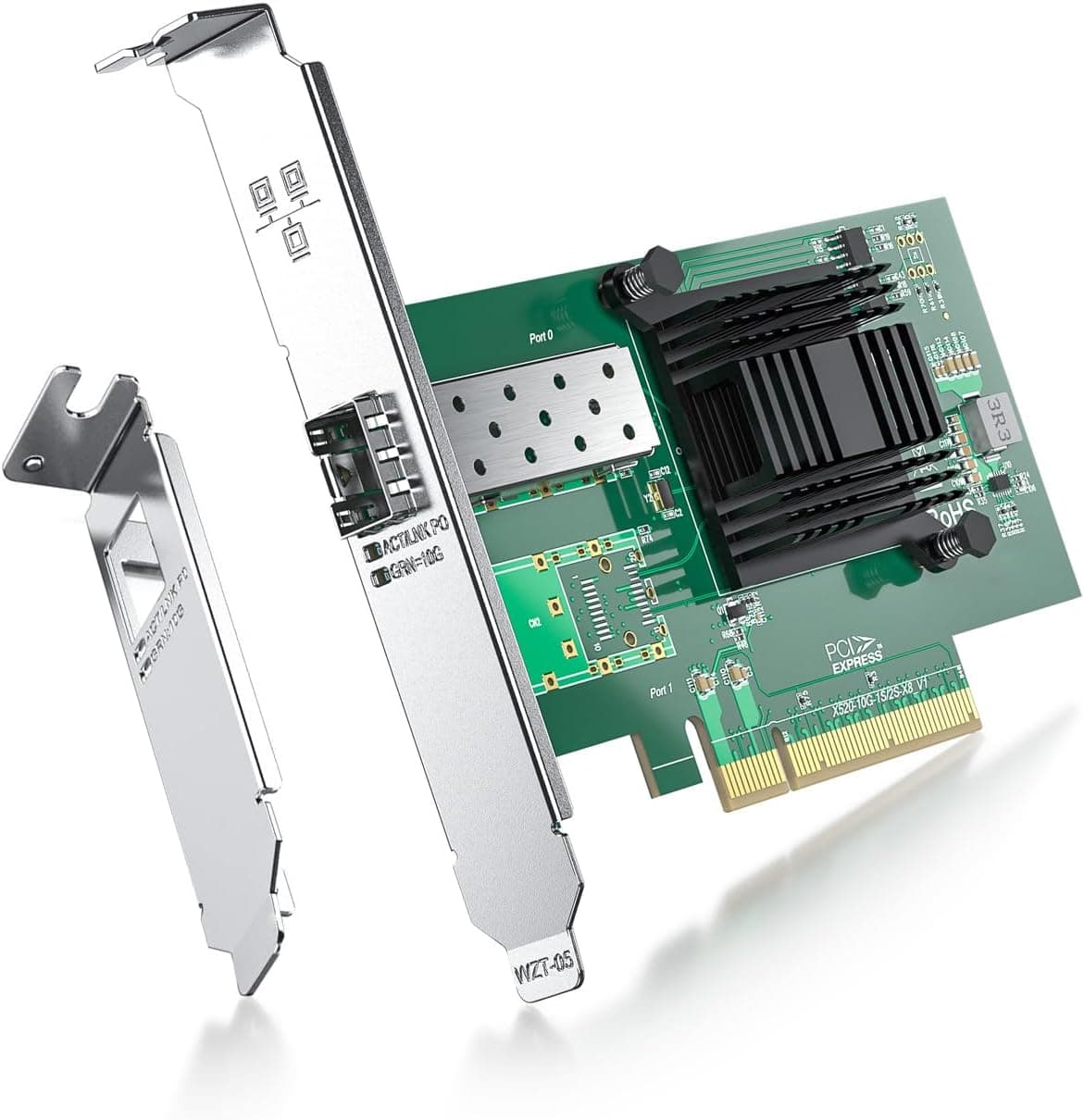
The ipolex 10Gネットワークカード Intel X520-DA1 is a single-port SFP+ 10GbE add-in card built around the Intel 82599EN controller. While branded enterprise 10GbE NICs command a heavy premium, this one was listed at ¥7,599 on Amazon.co.jp as captured on June 8, 2026, making it a realistic entry point for home labs and small offices.
This article digs into which environments it drops into cleanly, where people get stuck, and who should skip it.
Overview
At its core this is an Intel 82599EN NIC on a PCI Express 2.0 x8 board with exactly one SFP+ cage and no RJ45 jack.
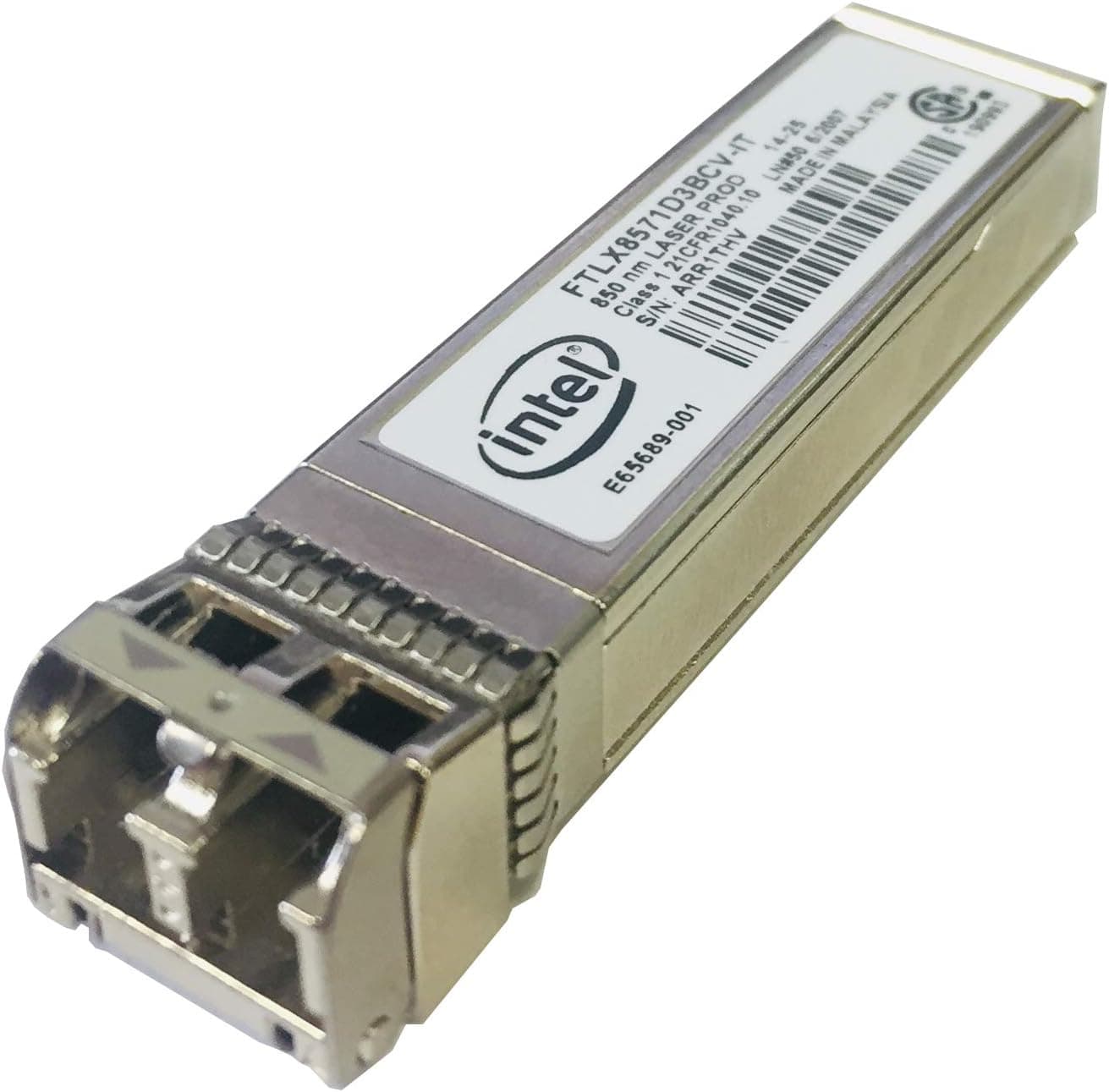
That distinction matters: you cannot simply plug in an Ethernet patch cable. You need either an SFP+ optical transceiver or a direct-attach copper (DAC) cable before any link comes up.
Buyers who miss this end up with a working card and nothing to connect it to.
The short verdict: this suits people who want cheap 10GbE and are willing to build out SFP+ cabling themselves. Because it carries genuine Intel silicon, Linux and ESXi usually recognize it with in-box ixgbe-family drivers, which is far less painful than wrestling with obscure 10G controllers.
Virtualization features — SR-IOV, VMDq, flexible port partitioning, on-chip QoS and traffic management — make it a fit for hypervisors splitting bandwidth across VMs.
Being a third-party board, though, it does not come with Intel retail-grade support. Windows 11 in particular no longer has native driver coverage, so manual installation per the seller's guide is required.
Amazon.co.jp reviews stood at 6 ratings and 4.8 out of 5 stars (96% positive) as captured on June 8, 2026 — a strong score, but six samples is too small to read much into.
Compatibility Guide
Physically, the card is PCI Express 2.0 x8 and seats in either x8 or x16 slots; running electrically at x8 in a x16 slot is fine.
The trap is slots that are mechanically x16 but wired x4 or x1. At 5.0 GT/s across eight lanes there is ample headroom above 10Gbps, but drop it into a x4-wired slot and you may not sustain wire rate.
Mid-range boards frequently wire their second x16-shaped slot at x4, so check the block diagram in your motherboard manual.
Power is a non-issue. There is no auxiliary power connector; the card draws entirely from the PCIe slot, so your PSU budget stays untouched.
Thermals are a different story. 10GbE NICs run warm, and a heatsink starved of airflow — in a sealed SFF case, or buried directly under a graphics card — can cause link instability during long sustained transfers.
Give it a slot with air moving across it.
Supported operating systems are Windows Server 2003/2008/2012, Windows 7/8/10, Linux, and ESX/ESXi. Linux and ESXi ship 82599 support in-box, so it generally just appears.
Windows 11 is the exception and needs manual driver installation. A clean Windows 11 install with no working network is a chicken-and-egg trap — stage the driver on a USB stick before you start.
Hot-plug is not supported. The card will not be detected if inserted while the system is running; a cold boot is required, so schedule downtime for always-on servers.
For QNAP or Synology NAS units, verify 82599 support against the vendor compatibility list first — a card that works in a generic PC can still be rejected by a NAS kernel.
| Check | This card | Easy to miss |
|---|---|---|
| Slot | PCIe 2.0 x8 (x16 OK) | x16-shaped slots wired at x4 |
| Port | SFP+ x1 | No RJ45; module or DAC required |
| Power | Slot-powered only | No aux connector, but needs airflow |
| OS | Linux / ESXi in-box | Windows 11 needs manual driver |
| Insertion | No hot-plug | Requires a cold boot |
Choosing Modules and Cables
The most common question is what cable to buy. DAC cables — copper with SFP+ ends fixed on — are cheapest, coolest, and lowest-power for runs within a few meters, such as inside one rack or beside a desk.
Optical transceivers plus fiber are the choice for longer runs or between rooms.
Watch for vendor lock. Intel 82599-based cards have historically rejected non-Intel transceivers, and on Linux the usual workaround is the ixgbe allow_unsupported_sfp option.
How strictly a third-party board enforces this varies by firmware, so confirm supported modules on the product page, or test one unit through a return-friendly channel before buying a batch. Skip this and you land in the hardest fault to diagnose: a healthy card that never links.
Also remember SFP+ needs a matching far end — a switch or NAS with an SFP+ port. If everything you own is 10GBASE-T over RJ45, you will need media converters or RJ45 transceivers, adding cost and heat.
In that case an RJ45-native 10GbE NIC is usually cheaper overall.
Product Info
Key specs: Intel 82599EN chipset, PCI Express 2.0 x8 interface, one SFP+ port, 10 Gbps data rate, 5.0 GT/s bus speed across x8 lanes, and support for Windows Server 2003/2008/2012, Windows 7/8/10, Linux, and ESX/ESXi.
Virtualization support covers SR-IOV, VMDq, flexible port partitioning, and on-chip QoS.
On pricing: ¥7,599 on Amazon.co.jp as captured June 8, 2026, and ¥11,018 at Rakuten (StyleLogic) as captured August 16, 2026.
Both are point-in-time figures that move with sales, stock, and exchange rates — a spread of over 3,000 yen between channels is reason enough to compare before ordering. The eBay entry showed only "See listing" with no figure captured, so it offers no usable price guidance.
Always confirm current pricing on the product page.
Reviews were 6 ratings at 4.8 out of 5 stars (96% positive) as captured June 8, 2026 — high, but too few to reveal failure patterns.
Only the card is included; SFP+ modules and DAC cables are sold separately, and warranty terms vary by seller. Budget for one DAC or two transceivers on top of the card price.
How It Compares
Against 2.5GbE RTL8125-class cards, the trade is clear: those use existing RJ45 cabling and install in minutes but cap at 2.5Gbps, while this card reaches 10Gbps at the cost of building an SFP+ path.
Four times the speed, plus cabling effort and extra spend.
Moving up, 25GbE dual-SFP28 cards like ConnectX-4 Lx exist but demand PCIe 3.0 x8 and a bigger budget — overkill if 10GbE is enough.
Among the many Intel 82599 (X520-DA1) boards on the market, internals are broadly similar, so choose on price, seller responsiveness, and how easy returns are in your region.
Best Use Cases
- Home labbers building a 10GbE backbone: Intel-grade stability at a fraction of branded pricing, and a high chance of working out of the box under ESXi or Proxmox.
- NAS users stuck at 1GbE: moving past the ~110MB/s ceiling transforms video and backup workflows — provided the NAS also has 10GbE and storage fast enough to fill it.
- Virtualization hosts: SR-IOV and VMDq offload packet handling and cut host CPU overhead.
- Anyone who already owns an SFP+ switch: the only added cost is the card and a DAC.
Before You Buy
First and loudest: this is SFP+ only. RJ45 patch cables do not fit.
If your home network is entirely RJ45, look at a 10GBASE-T card instead.
Second, Windows 11. No native driver means ongoing exposure to signing issues and update breakage.
If you just want reliable 10GbE on a Windows 11 desktop, this is not the straightforward pick. On a Linux server or ESXi host, that concern mostly disappears.
Thermals get overlooked. These cards draw real power even at idle and the heatsink can get too hot to touch.
In an airflow-starved case, long bulk transfers show up as link drops or throughput decay. If transfers start fast then collapse, point a fan at it first.
No hot-plug means no live installation, and a lane-starved slot will cost you throughput. In mini PCs or slim cases, verify low-profile support and bracket contents on the product page before ordering; if a spec is not listed, ask the seller rather than assume.
Finally, listing metadata. Amazon product pages occasionally carry another product's manufacturer, model, or ASIN details.
Nothing in this listing's data contradicted the product, but readers do sometimes see mismatches between registered details and photos. Confirm the product image, title, and the single SFP+ port visually before ordering, and treat any price quoted here as a point-in-time capture.
FAQ
Q. Can I plug in an RJ45 Ethernet cable?
A. No. There is one SFP+ port only; you need an SFP+ module or DAC cable.
Q. Does it work on Windows 11? A.
Not with native drivers. Manual installation per the seller's guide is required — stage the driver files beforehand so you are not stranded without a network.
Q. Is auxiliary power needed?
A. No. The card is powered entirely from the PCIe slot.
Q. Can I use a x16 slot?
A. Yes, but a x16-shaped slot wired at x4 may limit throughput. Check your motherboard manual for lane counts.
Q. Can I install it in a running server?
A. No. Hot-plug is unsupported; power down and cold boot for detection.
Q. Will my NAS instantly hit 10Gbps? A.
Not necessarily. Switches, the far-end NIC, and storage speed all cap throughput — a single HDD cannot saturate 10Gbps.
Product Disclosure (Amazon)
- Manufacturer: ipolex
- Seller: Ipolex-jp 【適格請求書の発行対象】
- Fulfilled by: Amazon
- ASIN: B087TC7TCP
- Note: This article covers a manufacturer-made product based on Amazon listing details.