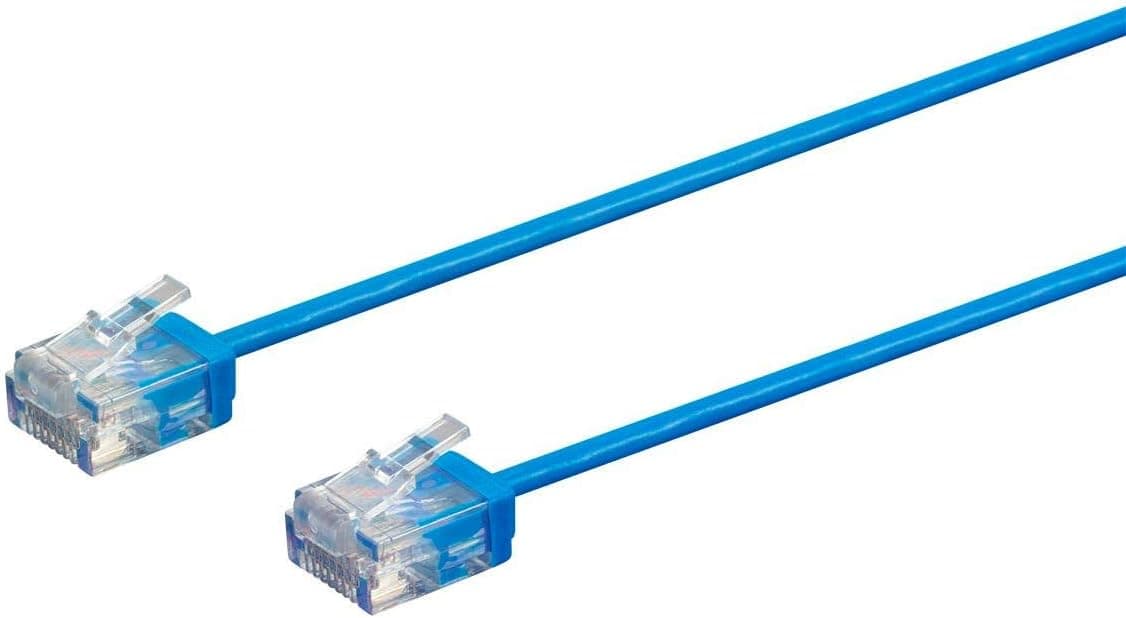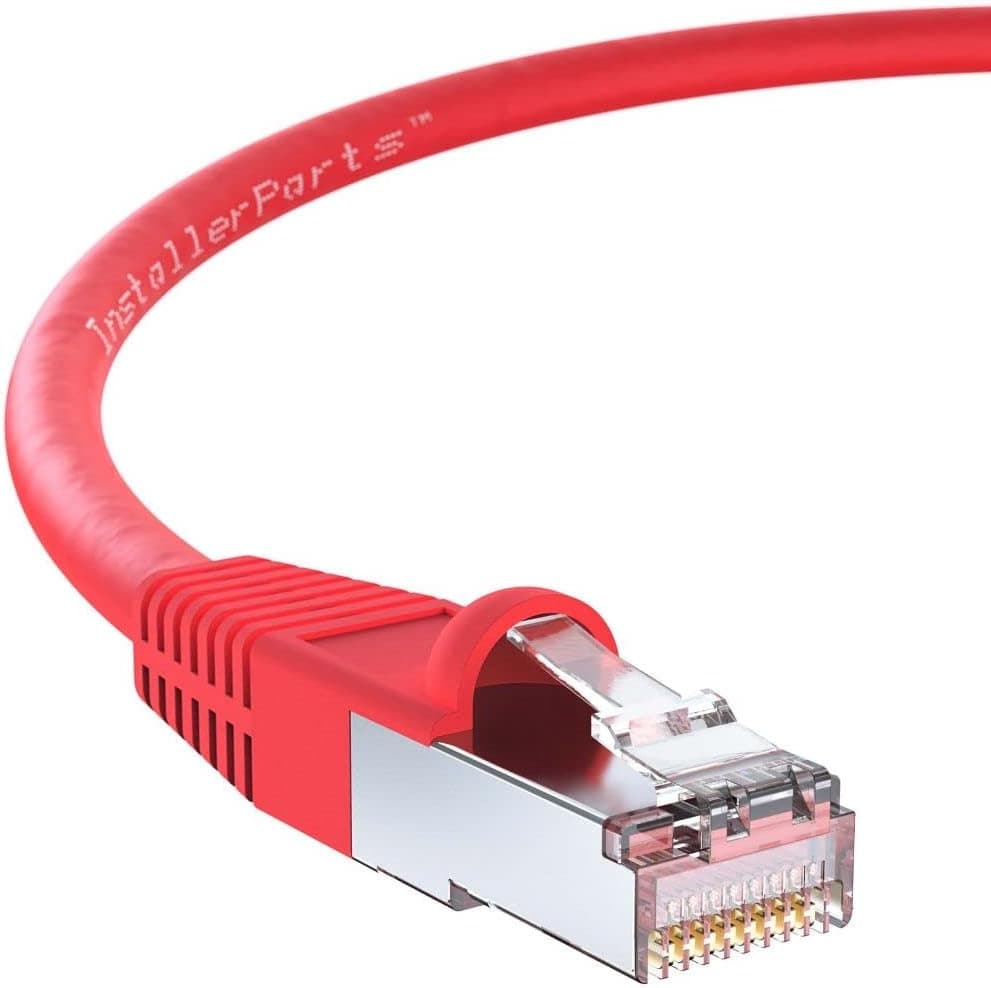
InstallerParts (イーサネットケーブルCAT6ケーブルシールド(SSTP is a short patch cable built to fill the few dozen centimetres between gear in a rack or behind a desk. It is 2 feet (about 0.6 m) long, uses SSTP/SFTP dual shielding, 100% bare copper conductors, 26 AWG stranded wire and 50-micron gold-plated contacts.
On Amazon.co.jp it holds a 4.8-star average across 610 reviews (96% positive) — high marks for what is essentially an unglamorous piece of infrastructure.
Overview
The short version: this cable is for links where the two devices sit only centimetres apart — patch panel to switch, NAS to a 10GbE switch in the same rack — and where you want shielding without a coil of slack to tie down. It is not a general-purpose cable.
It will not cross a room, let alone a floor. Treat it as a rack-hygiene component, not as the one cable you buy for the house.
On paper it is rated to 10 Gbps at 550 MHz, near the top of what Cat6 offers. 10GBASE-T over Cat6 is generally limited to roughly 55 m (about 37 m in high-crosstalk bundles), but at 0.6 m that ceiling is irrelevant.
Shorter runs mean less attenuation and less crosstalk, so this is the easiest distance band in which to hold a stable 10G link.
Quick Answer by Use Case
| Where you want to use it | Does 2 ft work? | Notes |
|---|---|---|
| Patch panel ↔ switch | Ideal | 0.6 m is the standard jumper length within a rack |
| NAS ↔ 10GbE switch (same rack) | Yes | 550 MHz / 10 Gbps leaves headroom |
| Router ↔ desktop PC | Usually too short | Only if they sit side by side |
| Another room or floor | No | Pick a longer length from the same series (up to 200 ft) |
| In-wall or outdoor runs | No | Stranded patch cable is not for permanent structured wiring |
Almost every buying mistake here is a length mistake. The 26 AWG stranded conductor is flexible and easy to route, but it attenuates more than solid core and is not meant to be punched down into a keystone or wall jack.
Use solid-core bulk cable for fixed runs and stranded patch cables like this one for the moving, re-pluggable ends.
Compatibility Guide
Both ends are standard RJ45 male connectors wired straight-through to TIA/EIA-568B. Anything with a normal Ethernet port — PCs, Macs, servers, NAS units, printers, routers, switches, consoles — accepts it as-is.
Cat6 is backward compatible with Cat5e and Cat5, so mixing it into a 1 Gbps network causes no trouble; the link simply negotiates down to the slower end.
The part worth thinking about is the shield. SSTP/SFTP means braid plus foil, but a shield only does its job when it is grounded.
If the ports at each end are plastic-bodied, unshielded RJ45 jacks, the shield has nowhere to drain and the noise benefit is limited. On a consumer router or unmanaged switch, consider the shielding a mild bonus rather than a feature you are paying for.
In a rack full of metal-chassis managed switches, or anywhere the cable must run alongside mains wiring, motors or inverters, the dual shield genuinely earns its place.
Physically, the 5.7 ±0.2 mm outer diameter matters more than it sounds.
That is normal for shielded Cat6, but next to a slim Cat6A cable (around 3 mm) the difference in bundle thickness across 24 ports is obvious. On densely spaced ports, or where you need a tight bend right at the jack, check that you have room for the bend radius — and that the connector boot clears the neighbouring port's latch.
Product Info
The conductors are 100% bare copper, not copper-clad aluminium. CCA is cheaper but less conductive, which shows up as heat and voltage drop under PoE load, so pure copper is a practical advantage when a switch is powering the far end.
Contacts are 50-micron gold plated, which keeps contact resistance low on ports that get re-plugged often. The cable carries UL/cUL certification and is RoHS compliant.
The Professional Series spans 19 lengths from 1 ft to 200 ft in nine colours: black, blue, grey, green, orange, purple, red, white and yellow. This article covers the red 2 ft variant.
If your site uses colour-coded cabling — red for production, blue for management, and so on — that palette is reason enough to standardise on the series.
One caution on price. The figure captured from the Amazon.co.jp listing is far above what a single 0.6 m patch cable normally costs, which suggests the data may have been pulled from a different item or a multi-pack.
We are deliberately not quoting a number here. Check the product page yourself and confirm that the quantity, length and colour match the price shown.
Comparable short shielded patch cables typically sell for a few hundred to a couple of thousand yen as singles, with lower per-cable cost in multi-packs.
How It Compares
The main alternative in the short-run, data-centre niche is slim Cat6A. Cat6A guarantees 10GBASE-T to 100 m at 500 MHz, and slim variants bundle far more neatly.
At 0.6 m, though, Cat6 and Cat6A perform effectively the same, so the real decision is thickness, quantity and colour coding — not headroom.
A 24-pack of slim Cat6A and a single shielded Cat6 jumper are answering different questions.
The other alternative is Cat8, marketed at 2000 MHz and 40 Gbps. Almost no consumer equipment speaks 40GBASE-T, so throughput is capped by your hardware regardless.
Buying Cat8 for a 10GbE network buys you a bigger number on the jacket and nothing else. If noise is your problem, shielded Cat6 or Cat6A already solves it.
Best Use Cases
- Tidying a rack or server room — 0.6 m leaves no slack to coil, and rear-panel airflow visibly improves. The dual shield helps where cables must run parallel to power.
- 10GbE NAS and switch in the same rack — short Cat6 holds 10 Gbps reliably. Only reach for Cat6A when distance grows.
- Sites that colour-code cabling — nine colours make per-system identification easy to enforce.
- PoE devices — bare copper beats CCA on heat and voltage drop.
Before You Buy
Length is the trap. Two feet is about 60 cm.
That is shorter than most people picture when they search for a "short" cable, which usually means 1–2 m. If you assume it will reach from the router to your desk, it almost certainly will not.
Measure the actual path — including the detour around obstacles and the slack needed at each connector — and confirm it fits inside 0.6 m.
Then price. As noted, the captured figure is implausible for a single 0.6 m cable.
Automated price collection sometimes latches onto a different product or bundle. Do not be surprised if the listing shows something different from what you expected; the product page is always the authority.
While you are there, check that the listed manufacturer, model number and ASIN line up with the product image and title — marketplace listings occasionally carry another item's metadata.
Shielded is not automatically better. An ungrounded shield can behave like an antenna and deliver less than you hoped.
In an ordinary home, with unshielded RJ45 ports at both ends, thinner and cheaper UTP Cat6 is usually the smarter buy. Shielding improves noise immunity, not link speed — the ceiling is set by the standard and your hardware.
Stranded, not solid. The 26 AWG stranded conductor flexes well but should not be punched down or pulled through walls.
Plan permanent runs with solid-core bulk cable instead.
FAQ
Q. How long is 2 feet, really?
A. About 0.6 m. Think "devices sitting next to each other," or two points inside the same rack.
Q. Will I actually get 10 Gbps? A.
The cable supports 10 Gbps at 550 MHz, but the link speed is set by your equipment. Both ends need 10GbE hardware.
At 0.6 m the cable itself is operating in the easiest possible conditions for 10GBASE-T.
Q. Wouldn't Cat6A or Cat8 be better? A.
At 0.6 m there is no meaningful real-world difference.
Cat8's 40 Gbps is meaningless without matching hardware; spend the money on the hardware instead.
Q. Can I use it for PoE? A.
Yes. 100% bare copper at 26 AWG handles typical PoE and PoE+ fine and runs cooler than CCA.
High-power PoE++ over long distances calls for a thicker gauge.
Q. Can it go outdoors or inside a wall? A.
No. Use UV- and moisture-rated outdoor cable outside, and CM/CMR-rated solid-core bulk cable in walls.
Product Disclosure (Amazon)
- Manufacturer: InstallerParts
- Seller: KIRARISHOP
- Fulfilled by: KIRARISHOP
- ASIN: B075KQB37B
- Note: This article covers a manufacturer-made product based on Amazon listing details.