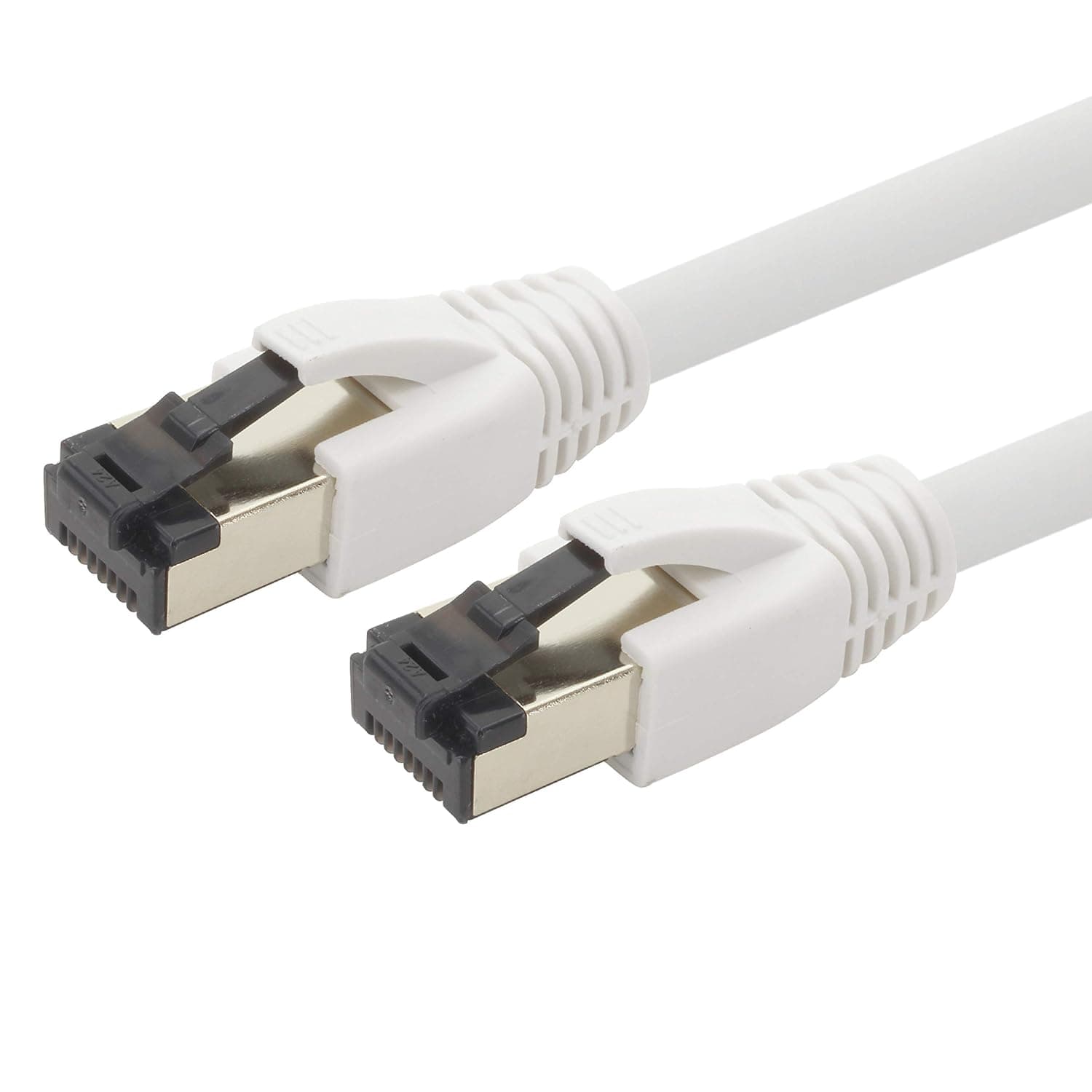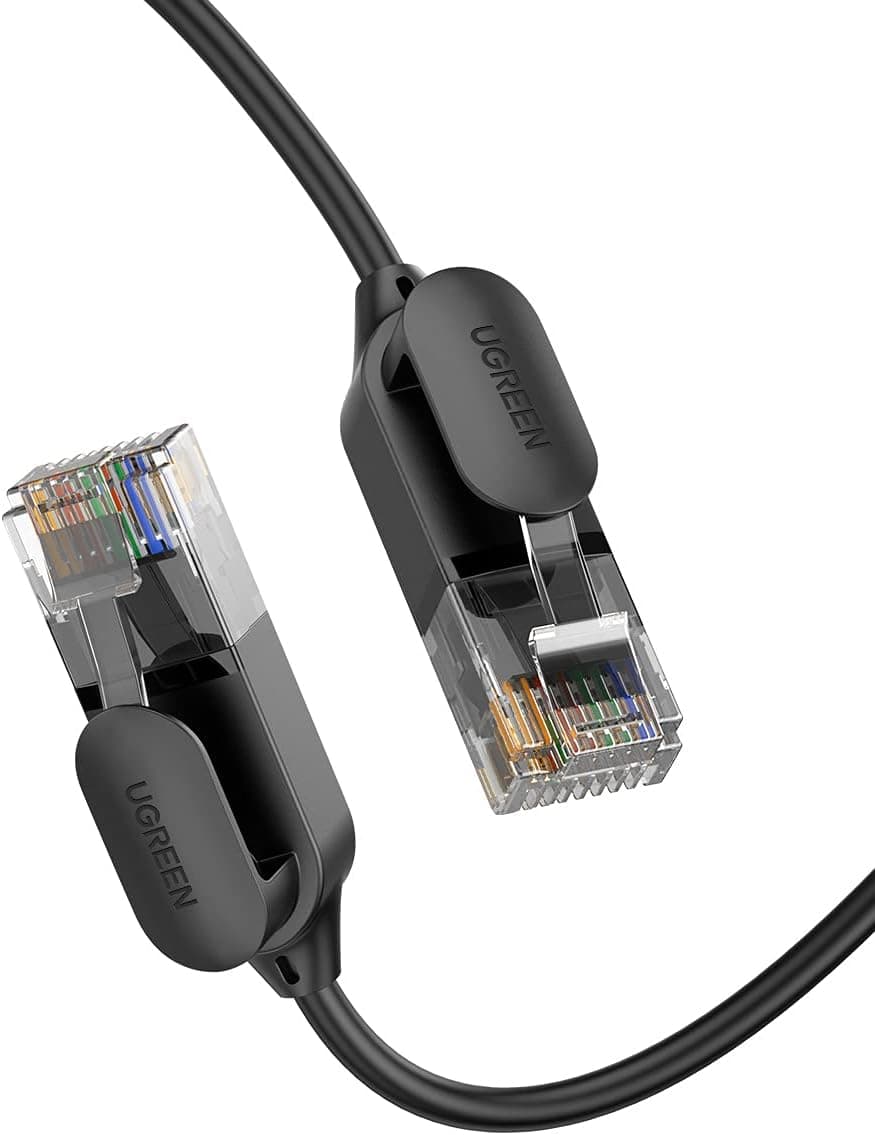
The UGREEN CAT6 ultra-slim flat LAN cable in 10m is bought less for speed than for disappearing. This article looks at what the flat UTP design gains and gives up, how far to trust the "10Gbps" label, and how a 10m run actually behaves in a real room.
Overview
This is a CAT6-rated, 10-meter, RJ45-to-RJ45, UTP (unshielded) flat Ethernet cable. Think of it as purpose-built for the situation where the router lives in the living room and the PC or console sits in another room — a long run that has to hug a wall.
The value of the flat profile is installation, not performance. At a few millimeters thick it slides under carpets, along baseboards, through the gap beneath a door, or up the back of a desk.
A 10m round cable is visually loud; a flat one, paired with clips or a cable raceway, effectively vanishes.
As captured on June 5, 2026, the Amazon.co.jp listing showed 494 reviews averaging 4.8/5 (96% positive).
For a cable, that means your odds of getting a good unit are high — but keep in mind most of those reviews reflect gigabit use. How many come from users running sustained 10GBASE-T is unknown.
Compatibility Guide
The connectors are standard RJ45, and per the supplied compatibility notes the cable works with any device that has an RJ45 Ethernet port: onboard PC NICs, consoles, router LAN ports, switches, NAS units, TVs and recorders. Physical fitment is a non-issue.
On speed, understanding the standard prevents disappointment. CAT6 is a 250MHz specification: 1000BASE-T runs the full 100m without drama.
10GBASE-T over CAT6, however, is generally limited to roughly 37–55m under good conditions — it is CAT6A that guarantees 100m. At 10m, this cable sits comfortably inside that limit.
The real constraints are your hardware and your noise environment. Hitting 10Gbps requires 10GbE ports on both ends, which in a home usually means a NAS and a PC on a 10GbE switch.
If your router's LAN ports are gigabit, any cable gives you gigabit.
And this cable is UTP. Unshielded designs cancel noise through the balance of twisted pairs, and a flat geometry constrains pair spacing more than a round jacket does, which can work against it under external interference.
Avoid running it across a power strip, along the back of a microwave, or past fluorescent ballasts. 10GBASE-T has less noise margin than gigabit, so instability shows up there first.
| Scenario | Fit |
|---|---|
| Router to PC at 1Gbps | Ideal; 10m is easy |
| NAS to PC at 10GbE, routed away from power | Workable; worth trying first |
| Bundled or parallel with power cables | Not advised; use round/shielded |
| Outdoors or inside walls | No; use outdoor-rated solid cable |
| Under furniture legs or pinched in a door | Not advised; thin conductors |
In short: strong for long gigabit runs, compromised for maximum 10GbE effort or harsh routing.
Product Info
Key specs: CAT6 rated, 10m length, up to 10Gbps, RJ45 connectors, unshielded UTP, black. The box contains the cable only, in simple retail packaging.
Prices, at the time each figure was captured: Amazon.co.jp showed ¥1,899 as of June 5, 2026, and the same ASIN showed ¥594 as of August 27, 2026.
A threefold gap on one listing most likely reflects a coupon, a sale, or a different length/color variant being selected. Neither is a current price — check the page with 10m and your color chosen before buying.
An overseas marketplace (eBay) showed $29.99 as of July 14, 2026.
That is clearly steep for a product sold domestically for a few hundred to under two thousand yen, and is best read as an export listing with shipping included; it is of little use to buyers in Japan.
Product Disclosure (Amazon)
- Manufacturer: UGREEN
- Seller: Ugreen Japan Co., Ltd
- Fulfilled by: Amazon
- ASIN: B07Z8R22HQ
- Note: This article covers a manufacturer-made product based on Amazon listing details.
How It Compares
Ethernet cable choices reduce cleanly to three: flat UTP, round UTP, and round shielded (FTP/STP).
Flat UTP — this cable — wins on concealed routing. Ten meters of round cable is always visible along a wall; flat is not.
The trade-off is that a flat jacket handles crushing and sharp bends poorly and holds a crease once it takes one.
Round UTP offers the best price-to-durability balance. If the run is hidden behind a desk or inside a rack anyway, there is no reason to pay the flat-cable penalty.
Shielded FTP/STP earns its keep in electrically noisy spaces or when pushing 10GBASE-T near the distance limit. But shielding only works when it is properly grounded at both ends, which consumer gear does not always do.
Shielded is not automatically better.
Should you step up to CAT6A or CAT8? For most homes, no.
At 10m, CAT6 already reaches the 10GBASE-T ballpark, and most households are gigabit end to end regardless. Money spent on a faster router or switch changes what you feel; money spent on a higher cable category usually does not.
Best Use Cases
This cable suits you if:
- Your router and your PC or console are roughly 10m apart.
- You want the run hidden under a carpet or along a baseboard, especially in a rental where drilling is out.
- Wi-Fi is unreliable and you want wired stability for gaming or streaming. On a gigabit network this cable is entirely sufficient.
- You are simply trying wired for the first time; at this price the cost of changing your mind is small.
Look elsewhere if you plan to saturate a 10GbE link between NAS and PC around the clock, if the route unavoidably parallels power cabling, or if chair casters will roll over it. Those cases call for round, shielded, or a proper floor raceway.
Things to Check Before Buying
"10Gbps" is a ceiling, not a measurement. If your router or NIC tops out at 1Gbps, so will you, and your internet plan will not get faster.
Most "it didn't speed anything up" complaints trace to a bottleneck that was never the cable.
Flat cables dislike crushing and creasing. Repeated door pinches, furniture legs, or right-angle folds stapled down will damage the conductors.
Failure usually appears as intermittent link drops or a port negotiating 100Mbps instead of 1Gbps — hard to diagnose. Use clips or a raceway and keep bends gentle.
Not for in-wall or outdoor runs. This is an indoor patch cable.
In-wall or exterior installations need outdoor-rated, fire-rated solid-conductor cable.
Verify the price yourself. Our source data showed ¥1,899 and ¥594 for the same listing on different dates, plus $29.99 overseas.
Listings like this often bundle several lengths and colors, so the headline price may belong to the shortest variant. Confirm the figure with 10m selected.
Listing metadata can disagree with the product. Manufacturer names, model numbers, and spec fields sometimes come from another variant.
Confirm length (10m), color, and the flat profile from the title and photos before ordering.
Treat the RJ45 latch as a consumable. Frequent unplugging eventually snaps the tab, and a tab-less plug drifts loose and causes intermittent faults.
For high-churn ports, prefer a booted cable or terminate the run at a switch and use a short patch cable at the device.
FAQ
Q. Will this make my internet faster? A.
Moving from Wi-Fi to wired improves stability and latency. If you are already wired at 1Gbps, swapping cables changes nothing.
Q. Does 10m cost me speed?
A. No. CAT6 is specified to 100m for 1000BASE-T, and 10m leaves ample margin even for 10GBASE-T.
Q. Does it work with PS5 or Nintendo Switch? A.
Yes, if the device has an RJ45 port. Consoles often cap at 1Gbps or 100Mbps, and that cap sets your speed.
Q. Are flat cables really worse with interference? A.
Unshielded flat construction can be more susceptible than round cable, but it rarely matters at 1Gbps in a home. Just avoid long parallel runs beside power strips or large appliances.
Q. CAT6 or CAT6A? A.
At 10m with no immediate 10GbE gear, CAT6 is enough. Consider CAT6A when you actually need 10GbE over long runs (40m+).
Q. Can I run it under a carpet? A.
Foot traffic is within its design intent. Avoid spots where furniture legs rest or chair casters repeatedly roll — that is where intermittent faults start.