Game Overview
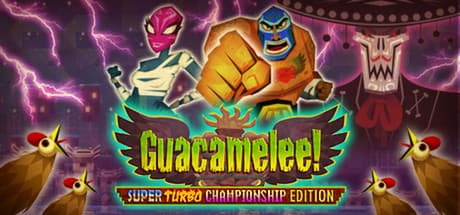
Guacamelee! Super Turbo Championship Edition: Luchador's Metroidvania Adventure is a 2D action game built around Mexican folklore and lucha libre.
Juan Aguacate begins as an agave farmer, gains a legendary luchador mask, and pursues Carlos Calaca, who plans to merge the worlds of the living and the dead. Rescuing El Presidente's Daughter provides the goal, but exploration and mastery of Juan's expanding move set drive the moment-to-moment play.
The core loop is classic Metroidvania design: explore a connected map, clear combat and platforming challenges, earn a new ability, and revisit barriers that could not be crossed before. Progress depends on recognizing how each move interacts with the environment rather than simply completing a fixed sequence of stages.
Combat and Traversal Share One Move Set
Combat involves more than repeating a basic punch. Juan can launch opponents, continue attacks in the air, and throw enemies into nearby threats.
Positioning matters when several targets enter the arena, giving encounters some of the crowd-control rhythm associated with beat 'em ups.
Many wrestling moves also function as traversal tools. Learning a technique can therefore expand both Juan's combo options and the parts of the map he can reach.
This shared design makes upgrades easy to understand: practicing a move in battle also prepares the player to recognize its environmental use.
Switching Between Living and Dead Worlds
The signature mechanic is the ability to move between the worlds of the living and the dead. Platforms may appear or vanish after a switch, while some enemies can only be handled in the appropriate realm.
The mechanic affects navigation, puzzles, and combat rather than serving as a cosmetic change.
Later challenges can ask the player to jump, use special moves, and change worlds in quick succession. The underlying rule is readable, but executing the required sequence takes timing and practice.
Players should expect a mechanically demanding action game, not a relaxed exploration game with occasional fights.
How Local Co-op Changes the Experience
The game supports single-player and same-screen local co-op. Two players can divide groups of enemies, attack from opposite sides, and turn ordinary encounters into lively shared brawls.
It is not presented as a conventional built-in online co-op game, so players planning to join from separate locations should check what their setup supports.
Platforming still requires both participants to account for the shared play space. A stronger player rushing ahead can make coordination harder, especially during sequences built around precise movement.
Co-op works best when both players communicate and approach difficult jumps at a compatible pace.
PC Requirements
The listed minimum requires a 2 GHz or faster CPU, 512 MB RAM, a Shader Model 3.0 GPU with 512 MB VRAM, 800 MB of available storage, and DirectX 9.0c.
Those requirements are modest by modern PC standards, and the game does not call for a large installation or a recent high-end graphics card.
The OS list names Windows 2000, XP, Vista, 7, and 8, reflecting the period in which the game was released. Players using a current version of Windows should still check the latest Steam compatibility information and their own configuration.
Xbox 360 and other XInput-compatible controllers are supported, and a gamepad is a natural fit for the directional movement and rapid combinations of attacks and traversal moves.
Reception and Player Expectations
The game has maintained strong user sentiment over the long term. Its clearest strength is the way melee combos, ability-based exploration, and world switching reinforce one another instead of feeling like unrelated systems.
Colorful presentation and playful humor also keep the journey energetic without obscuring the action.
The more demanding platforming sections are likely to divide players. Anyone mainly seeking slow, low-pressure exploration may find that precision jumping occupies more of the experience than expected.
Enjoyment depends partly on whether repeating a sequence and improving execution feels satisfying rather than frustrating.
Who Should Play It
Guacamelee! Super Turbo Championship Edition suits players who want Metroidvania exploration and close-range combo combat in equal measure.
It is particularly appealing to those who enjoy returning to familiar locations after earning a move and spotting routes that previously looked decorative or unreachable. The Mexican-inspired visual identity and wrestling theatrics also distinguish it from darker examples of the genre.
It is also a practical choice for two people who want to complete an action adventure together on one screen. Solo play emphasizes mechanical improvement and clean execution, while co-op turns coordination and occasional chaos into part of the appeal.
Caveats and Who May Not Enjoy It
Players who strongly dislike precision platforming, repeated attempts, or rapid multi-button sequences should approach with caution. World switching can become part of a longer chain of movement inputs, so later obstacles demand more dexterity than the cheerful presentation might suggest.
Keyboard play is possible, but checking and adjusting the control layout may help before difficult sequences.
Co-op is local and shared-screen, which may not suit players specifically looking for native online matchmaking. The game was released on August 21, 2014, and its published OS list contains older versions of Windows.
Before buying, verify current store information for operating-system behavior, controller support, and any other compatibility concerns relevant to your PC.