Game Overview
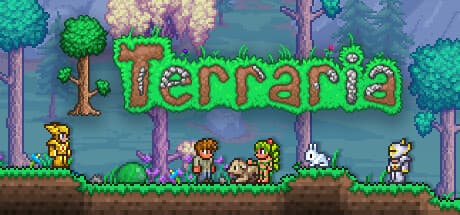
Terraria — A World of Endless Adventure and Creation is a two-dimensional sandbox action-adventure built around a repeating loop: gather wood and ore, craft equipment, explore farther, and return home with materials that unlock the next expedition. Building is a substantial part of the game, but Terraria is not merely an unrestricted construction toy.
Boss victories and newly accessible resources create recognizable stages of progression.
Each generated world connects its surface to caves, floating islands, and increasingly dangerous underground regions. Players decide where to dig, which threat to prepare for, and whether scarce resources should improve equipment or the base.
Instead of following a fixed mission line, you form new goals from the materials, enemies, and locations discovered during exploration.
Released on May 16, 2011, Terraria remains distinctive because mining, combat, collection, and construction directly support one another. Its pixel presentation may look simple, but terrain can be altered extensively, and vertical excavation is as important as horizontal movement.
That makes exploration much less linear than in a conventional side-scrolling action game.
Exploration and Progression
A new character begins by gathering wood, making basic tools, and securing shelter from nighttime enemies. Deeper caves contain useful ore, accessories, and chests, but darkness, falls, traps, and stronger creatures make preparation essential.
Torches, platforms, and a reliable way home can improve an expedition as much as a stronger weapon.
Equipment progression is not limited to increasing damage. Melee, ranged, magic, and summoning gear reward different positioning and resource-management habits, while accessories can improve movement, jumping, defense, and other capabilities.
When a boss proves difficult, players can change weapons, prepare supplies, and construct an arena with platforms rather than relying only on reflexes.
Bosses serve as progression milestones, and defeating them can lead to new materials or areas. Later phases can also change the enemies and resources found in the world.
Small outposts near important regions therefore become more useful than relying on one distant base for every trip. If progress becomes unclear, explore an unvisited cave, speak with available NPCs, and check which equipment can now be crafted.
Crafting and Practical Building
Crafting is a central progression system rather than a decorative extra. Available recipes depend on materials and nearby crafting stations, so unfamiliar finds are usually worth taking home before discarding them.
Separating storage into materials, equipment, and building supplies also prevents an expanding collection from becoming unmanageable.
Housing has a functional purpose because valid rooms allow NPCs to move in and provide shops or other services. This gives players who do not care about elaborate architecture a practical reason to build.
Large artistic projects are optional, however; compact rooms are sufficient for anyone who prefers exploration and combat.
Solo and Multiplayer
Solo play gives one player full control over exploration speed, resource use, and the timing of boss attempts. It suits players who want to experience every equipment upgrade and retry difficult encounters with revised preparation.
The limited early guidance can still be confusing if you prefer objectives to be assigned automatically.
Co-op allows players to divide mining, building, and combat duties, accelerating base and equipment development. Different weapon styles can create useful roles during boss battles, but the group should agree on shared resources and progression decisions.
Bringing an advanced character into a fresh world can bypass much of the discovery curve, so first-time groups are better served by starting new characters together.
System Requirements
The listed minimum requirements specify a 2.0GHz CPU, 2.5GB of RAM, 128MB of video memory with Shader Model 2.0 support, 200MB of storage, and DirectX 9.0c or later.
The recommended requirements call for a dual-core 3.0GHz CPU, 4GB of RAM, and 256MB of compatible video memory, while retaining the same storage figure.
These are modest requirements, although large worlds, extensive builds, and busy battles may run more consistently on hardware above the minimum tier.
The minimum OS listing covers Windows XP, Vista, 7, 8/8.1, and 10, while the recommended listing begins with Windows 7.
Because this information includes legacy operating systems, check the current Steam product page for compatibility with a modern setup and online features. The storage requirement is small, but backups remain sensible when a character and world have accumulated substantial playtime.
Reception and Common Feedback
Terraria has maintained strong long-term user sentiment. Players commonly value the steady expansion of movement and combat options, the frequency of useful discoveries, and the way building shares one world with structured progression.
A short mining trip can produce materials for a new tool or another expedition, creating natural stopping points without exhausting the long-term goals.
Potential frustrations come from the same open structure. Crafting conditions and the intended progression order are not always obvious from early in-game guidance.
Inventory sorting, repeated resource gathering, and arena preparation can feel like chores to players who only want immediate combat. The side-view controls and pixel-art presentation are also matters of taste worth considering.
Who Should Play It
Terraria is a strong fit for players who enjoy discoveries that feed directly into crafting and progression. It particularly rewards people who like defining personal goals, such as exploring a deeper cave, preparing new housing, or assembling equipment for a boss.
Builders and combat-focused friends can also contribute different skills within the same co-op world.
It also suits players who want to develop one world over a long period or experiment with multiple equipment styles. Elaborate architecture is never mandatory, so an interest in crafting does not require confidence in decorative building.
Caveats and Who May Not Enjoy It
Players who expect a constant quest marker or a story that clearly announces every next step may find the opening opaque. Researching materials, reorganizing equipment, and rebuilding a battlefield after failure are central parts of the experience.
Anyone seeking a strictly linear campaign or wishing to avoid repeated mining may therefore struggle with its core loop.
The supplied language listing includes English and several other languages but does not list Japanese. Language support can change, so verify the current Steam listing if a particular localization is essential.
The published requirements also name older Windows versions; use the current store information when judging compatibility with a modern system.