Overview
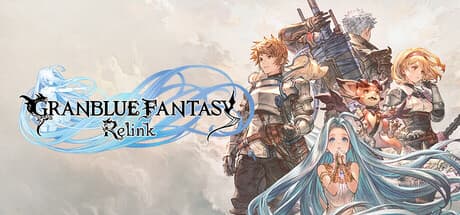
Granblue Fantasy: Relink is a 3D action RPG developed and published by Cygames, released on February 1, 2024. It is set in the Zegagrande Skydom, a region of floating islands, where you play the captain of an airship crew traveling with the dragon Vyrn and a girl named Lyria toward the legendary island of Estalucia.
The play loop is mission-based: prepare your gear and party at a hub town, pick a quest, deploy, fight, and return. This is not a seamless open world.
Encounters run a few minutes to a bit over ten, which makes the game easy to play in short sessions, but disappointing if you came for free-roaming exploration. That distinction is the single biggest fit-or-not factor, so settle it before buying.
Systems and Combat
Combat is real-time with a party of four. Playing solo, the other three are AI-controlled.
You can steer their behavior to a degree, and they function acceptably unattended, but on higher difficulties they cannot carry the fight — your own positioning and damage matter.
You can switch which character you control between fights, and each one has distinct animations and resource management. Some are melee bruisers, some are cast-and-nuke backliners, some depend on spacing.
The variety is wide enough that a character you dislike does not mean you dislike the game; trying another can change the impression completely.
The other pillar is build tuning through sigils. Materials earned from quests are slotted into your gear to raise attack, critical rate, healing and so on.
Because drops vary in quality, the later hours involve repeating quests to chase the effects you want. Whether that reads as satisfying optimization or as busywork decides how long the game lasts for you.
PC Requirements
The minimum specification listed on Steam is as follows.
| Item | Minimum |
|---|---|
| OS | Windows 11 (64-bit required) |
| CPU | Intel Core i3-9100 / AMD Ryzen 3 3200G |
| GPU | GeForce GTX 1060 6GB / Radeon RX 580 8GB |
| RAM | 16 GB |
| Storage | 90 GB available space |
| DirectX | Version 11 |
The official note states this configuration targets 1080p / 30fps with graphics set to Standard, and that an SSD is recommended. In other words, a GTX 1060 6GB is the "it runs" line, not the "it runs well" line.
For a stable 60fps at 1080p, plan on a GPU several tiers newer.
Worth noting: 16 GB of RAM sits in the minimum, so 8 GB systems are excluded from the start. The 90 GB install is not small either, and an HDD will cost you loading time in towns and between quests.
Free up SSD space before installing. The Windows 11 64-bit requirement is also easy to overlook.
The data available for this article did not include a recommended specification. Check the Steam store page for the current recommended configuration.
What Reviews Tend to Say
Praise centers on how the action feels and how well the presentation is built — hit feedback, boss set pieces, and the clear differentiation between characters. In short, the quality of the minute-to-minute play.
The game has held favorable reception over a long period, and the Japanese voice and text work is generally well regarded.
Criticism clusters around post-clear repetition and drop luck. The story is comparatively compact, and once you move into endgame content the design becomes repeating quests for materials.
A fair number of players feel the game turns monotonous at that transition. The other common complaint is AI ally behavior on harder content.
So opinion splits along a predictable line: the action is strong, the grind is selective. Which one you weigh more heavily determines your verdict.
Finishing the Story, and After
The main campaign is short by action RPG standards, and treating it as your goal is perfectly reasonable. What follows is the endgame: harder quests unlock, gear caps rise, and sigil hunting begins.
From that point it is explicitly a grind game. If you bought it for the story, stopping at the credits is a legitimate way to play.
If you enjoy refining builds to beat harder content, that is where the game actually starts. Deciding which player you are beforehand prevents most of the disappointment.
Co-op
Online co-op is supported, replacing AI slots with other players. High-difficulty quests are where that design pays off; solo works, but grinding goes faster with a group.
One caveat: co-op is quest-based matchmaking, not a persistent shared world. If you expect an MMO-style always-together experience, this is not that.
Platform support, crossplay availability and matchmaking activity can change over time, so if you are buying specifically to play with friends, confirm the multiplayer details on the store page first.
Who It Suits
- Players who like character-swap action where execution visibly changes outcomes
- Players whose schedule fits mission-based sessions of roughly ten minutes
- Players who enjoy optimizing gear and skill builds to clear harder content
- Players who value Japanese voice and text with anime-styled visuals
- Groups who want four people attacking the same boss
Who Should Skip It
The worst fit is anyone expecting open-world exploration. The structure is hub-and-quest, with no free-roaming map to wander.
Two games can both be RPGs and offer completely different experiences.
Next, anyone who dislikes repetition. The primary post-story activity is rerunning the same quests, and without enjoying that the honest reaction is "there is nothing left after the credits." Buying for the story alone is fine as long as you go in knowing it.
Technically, the minimum bar of 16 GB RAM, 90 GB storage and Windows 11 64-bit is not light. A GTX 1060 6GB class card is a 1080p / 30fps target; 60fps needs headroom, and an HDD install should be avoided.
Finally, on store listings: edition contents, language support and multiplayer details are all subject to change. Confirm the edition from the store page image and title, and check the listed requirements against your own machine before purchasing.