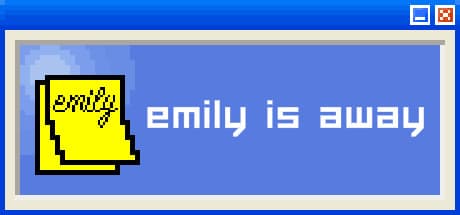
Game Overview
"Emily is Away: Relive the Dawn of Online Chat" is a narrative adventure presented through an instant-messaging client modeled after the Windows XP era. You create a screenname, choose buddy icons and away messages, then talk with your high-school friend Emily by selecting responses to her messages.
The story spans five chapters and follows the relationship across five years. Each session revolves around signing in, catching up, and deciding what kind of reply to send.
There is no combat or physical exploration; the tension comes from interpreting short messages and living with words that may sound different to Emily than they did in your head.
Released on November 19, 2015, Emily is Away was developed and published by Kyle Seeley. It is a single-player game with Steam Achievements and Trading Cards.
How the AIM-Style Interface Tells the Story
The messenger window is not merely a nostalgic frame. Buddy icons, text colors, profile details, and away messages recreate the limited ways people expressed themselves online in the early 2000s.
Those details can also provide context for a conversation before either character says what is actually bothering them.
You select the intent of a response and type to advance it, but the protagonist ultimately determines the exact wording. That small separation between intention and the sent message is central to the experience.
It captures how online conversations can feel personal while still leaving both people unable to control how their words are understood.
Choices, Consequences, and Replays
Choices alter conversations and can lead to different outcomes. However, this is not a romance simulator in which every problem has a perfect answer.
Earlier statements and missed moments can carry forward, so the story works best when the first playthrough reflects what you would genuinely say rather than an attempt to solve the dialogue tree.
The five-chapter structure offers over an hour of play according to the supplied game information. Its compact length makes another run practical if you want to test different replies.
Completion-focused players should expect to revisit similar exchanges, so an unspoiled first run followed by selective replays is more satisfying than immediately searching for an ideal route.
PC Requirements
The listed minimum requirements are Windows XP Service Pack 2 or later, an Intel Pentium 4 or later, and 512 MB of RAM. These requirements indicate a lightweight, text-centered game rather than a modern 3D workload.
A powerful gaming GPU is therefore less important than confirming that the application runs correctly on your current operating system.
No recommended configuration or storage requirement is included in the supplied Steam data. Check the current store listing for supported operating systems and available-space requirements before installing.
The mention of Windows XP in the minimum specification describes the low baseline; it should not be read as a guarantee about every newer system configuration.
Reception and Common Expectations
Emily is Away has maintained strong player sentiment over time. Its most distinctive strength is the way familiar interface details, pauses, and restrained replies become part of the emotional storytelling.
The focused runtime also suits players who want a complete indie narrative without a large time commitment.
The narrow format is also its main limitation. This is scripted interactive fiction, not an open-ended chatbot where you can freely compose any response.
Players expecting puzzles, exploration, or precise control over the relationship may find it restrictive, while those comfortable with ambiguity are more likely to appreciate its deliberately uncomfortable moments.
Who It Suits
The game is an especially natural fit for anyone who remembers AIM, Windows XP, buddy icons, and away-message culture. It also works for players who enjoy short visual novels, dialogue choices, and stories built around subtle changes in a relationship rather than external action.
Prior experience with AIM is not required. Overthinking a reply, regretting a sent message, and watching friends drift after school are broadly recognizable experiences.
That gives the story relevance beyond its retro presentation.
Caveats and Who Should Skip It
Skip it if you mainly want combat, puzzles, exploration, character progression, or a long campaign. Reading and choosing replies account for almost the entire interaction, and the deliberately simple desktop presentation does not become mechanically complex later.
Choices matter, but they do not grant complete control over Emily or guarantee a comfortable resolution. Frustration, poor timing, and emotional distance are part of the subject rather than obstacles that can always be optimized away.
The supplied data does not confirm Japanese-language support, so players who require it should check the current Steam language listing before starting.