Overview
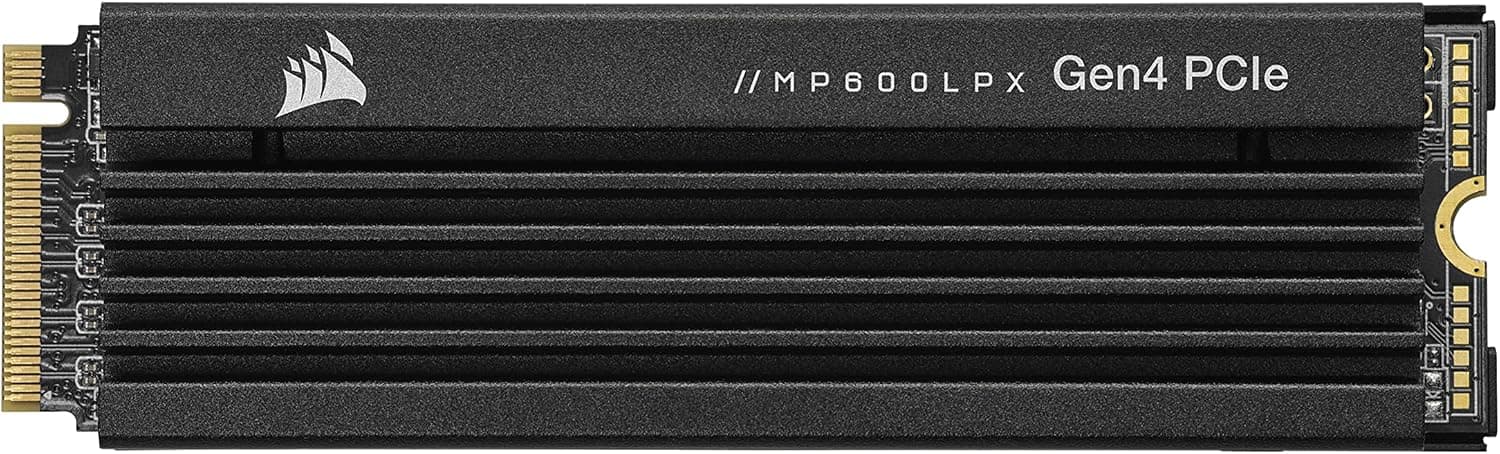
The Corsair MP600 PRO XT (Phison E18 + Kioxia BiCS5) 8 TB is an 8,000GB PCIe 4.0 x4 M.2 NVMe SSD. It pairs the Phison E18 controller with Kioxia BiCS5 TLC NAND and a generous 2,048MB DRAM cache on the 8TB model, aiming for stable sustained write performance. Designed for gamers who need massive storage and creatives handling large media files, this drive sits at the high-end tier of the PCIe 4.0 SSD market.
Launched in September 2022, it remains a compelling option for those who want a single 8TB NVMe drive. At the time of writing, the street price in Japan is around ¥210,500, reflecting its flagship positioning despite the aging interface generation.
Compatibility Guide
This drive uses the M.2 2280 form factor, so any motherboard with an NVMe-capable M.2 slot can mount it. The interface is PCIe 4.0 x4, but it will also work in a PCIe 3.0 x4 slot with reduced bandwidth. On modern AMD 600-series chipsets or Intel 700-series chipsets, you get full PCIe 4.0 speeds; inserting it into a PCIe 5.0 slot still runs it at PCIe 4.0.
Heat is a real consideration. Even though this 8TB model uses a single-sided PCB, high-density TLC NAND and the E18 controller generate significant heat, so an aftermarket M.2 heatsink or at least the motherboard's built-in heatsink is strongly recommended. Also confirm that your motherboard BIOS supports NVMe boot before using it as a system drive.
Product Info
Release date: September 2022. The reference price in Japan is about ¥210,500 (as of September 2026). With the Phison E18 controller, Kioxia BiCS5 TLC NAND, and 2,048MB DRAM cache, this is a high-end PCIe 4.0 SSD. Warranty details are not confirmed here; check Corsair's official documentation for the exact terms.
This drive is often marketed as a gaming PC part, and indeed the 8TB capacity comfortably holds dozens of AAA titles, each often exceeding 100GB.
Best Use Cases
- Gamers with large collections: If you own many 100GB+ games, 8TB lets you keep them all installed without juggling. Load times improve over a HDD, but FPS gains are minimal — this is primarily a capacity play.
- Video editors working with 4K/8K footage: Cache files and project folders can balloon quickly. A high-speed NVMe drive at 8TB gives you room to keep previews local. Be mindful of TBW if you write terabytes daily.
- Workstation or NAS expansion: If your motherboard has a spare M.2 slot, this drive adds massive fast storage. For RAID setups, ensure enough PCIe lanes and proper cooling.
- Not for everyone: If 4TB suffices, or you want the latest PCIe 5.0 speed, or you're on a tight budget, look elsewhere.
Things to Consider
The price is a major hurdle. 8TB SSDs are still expensive; while the cost per GB is lower than buying two 4TB drives, it's overkill if you don't need that much space. This is a PCIe 4.0 product — PCIe 5.0 SSDs are roughly twice as fast, though 8TB capacities in that generation are still rare and costly. Thermal management is critical, especially in laptops or compact cases with poor airflow. Always verify physical clearance and motherboard support before buying.
FAQ
Q: Can this SSD be used in a PS5?
A: Yes, the PS5 supports M.2 NVMe SSDs, and this drive is M.2 2280, fitting the physical slot. It runs at PCIe 4.0 x4, and you'll need to add a heatsink that stays within PS5's size limits. The 8TB capacity exceeds the 250GB minimum, but Sony doesn't officially guarantee 8TB compatibility, so use at your own risk.
Q: How does it compare to other PCIe 4.0 SSDs?
A: With the Phison E18 controller, this drive is among the faster PCIe 4.0 models available. Sequential speeds are officially rated in Corsair's documentation; we don't quote them here. The large DRAM cache helps maintain consistent random access performance.
Q: What is the endurance estimate?
A: TBW is rated at 6,400TB. Assuming 1TB of writes per day, that's roughly 17.5 years of use. Actual lifespan depends on usage patterns, but this drive offers ample headroom for typical consumers.