Game Overview
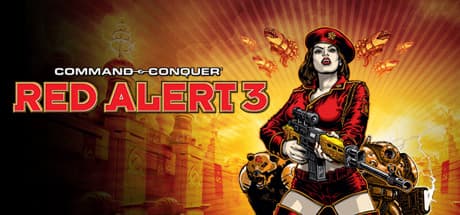
Command & Conquer™ Red Alert™ 3: Wage War Across Time is a real-time strategy game built around gathering resources, constructing a base, producing units, and breaking the enemy's position. After the desperate Soviet Union uses time travel to alter history, the Empire of the Rising Sun emerges alongside the Soviets and Allies, turning the conflict into a three-faction world war.
A typical match moves between scouting, expanding the economy, choosing production buildings, and combining infantry, vehicles, aircraft, and ships. Bases can also extend onto water, so coastlines and naval routes are meaningful parts of the map rather than decoration.
A player who watches only the main land approach can miss resources or an amphibious attack.
Released on January 8, 2009, the game deliberately favors live-action spectacle, alternate-history comedy, and improbable military hardware over realism. It is best approached as a fast, colorful RTS where quick decisions and unit control matter as much as the campaign's exaggerated presentation.
How the Three Factions Differ
The Soviets make a strong impression with armored forces, Tesla technology, and War Blimps suited to applying direct pressure. The Allies favor aircraft and teleportation technology, giving them tools for moving force toward exposed targets.
The Empire of the Rising Sun fields transforming units whose roles can change with the situation.
These factions differ in more than appearance. Their construction methods and routes to a complete army are not identical, so habits learned with one side can produce a slow or incomplete opening with another.
New players will usually learn faster by becoming comfortable with one faction's production order before switching.
Special abilities are also central to combat. Armored bears, transforming vehicles, aircraft, and naval units each have different targets and operating limits, making an army based on only one unit type vulnerable to a clear counter.
Starting with a small mixed force makes those interactions easier to understand.
Campaign and Cooperative Play
The campaign presents the war from the Soviet, Allied, and Imperial perspectives. Objectives and terrain change between missions, allowing the story mode to double as an introduction to each faction's construction system and signature units.
A defining feature is that campaign missions are structured around two commanders working together. With another player, one commander can hold the main route while the other secures resources or attacks from the side.
This division of responsibility can make a busy RTS easier to read when both players communicate.
Multiplayer modes are also included, and human opponents place greater emphasis on scouting and opening decisions than campaign missions do. Because this is an older release, check the current Steam information before relying on a particular online feature, connection method, or active player population.
Practical Tips for the Opening
Rushing directly toward expensive weapons can leave a base exposed while production infrastructure is still being built. Establish income first, add inexpensive scouting and defensive units, and then choose advanced production after identifying the opponent's army.
On maps that allow construction at sea, scouting only the land can conceal extra resource points and attack routes. Find the enemy base, production buildings, and naval expansion early.
Unit abilities should not be left unused either, since much of a unit's value may depend on timely activation rather than basic attacks alone.
System Requirements in Context
The listed minimum environment is Windows XP SP2 or 32-bit Windows Vista, with 1 GB RAM and at least 10 GB of free storage. CPU guidance includes an Intel Core Duo system; for XP it lists a 2.2 GHz Pentium 4 or Athlon XP 2100+, while Vista lists a 2.6 GHz Pentium 4 or Athlon XP 2800+.
Graphics requirements call for a DirectX 9.0c-compatible card, with a GeForce 6800 or Radeon X800 as the stated baseline.
These requirements are modest beside modern gaming hardware, but the age of the listed operating systems and GPUs means raw performance is not the only concern. Check current reports for startup, resolution, and online compatibility on a modern Windows installation.
No recommended specification is included in the supplied data, so a precise target for high resolutions or unusually large battles cannot be established here. Keeping more than the stated 10 GB available is sensible if saves and community content will also be stored on the same drive.
Reception and Player Expectations
The game has maintained a strong overall reception over time. Its appeal lies in distinct factions, brisk base building, unconventional weapons, and live-action scenes that fully embrace the absurd alternate timeline.
Players expecting modern controls or a restrained competitive simulation may notice its age. Frequent management of individual unit abilities is rewarding for people who enjoy active control, but it can feel overly busy to those who prefer issuing broad orders to an entire army.
Consult the live rating panel or Steam listing for the current reception.
Who Should Play It
It is a good match for players who enjoy base-building RTS games and want to alternate rapidly between production, scouting, expansion, and combat. Learning how each faction constructs its base and uses its units provides much of the lasting variety.
It also suits players interested in both a solo campaign and cooperative or competitive modes. A level editor and Steam Workshop integration are included, providing ways to explore community-created content beyond the standard missions.
Caveats and Who May Not Enjoy It
Players who prefer pausing to consider every decision, as in many turn-based strategy games, may dislike the pace. Economy, production, scouting, combat, and ability use continue simultaneously, so the real-time workload is an essential part of the experience.
The supplied language information confirms English, French, German, Russian, and other languages, but does not confirm Japanese support. Anyone who needs Japanese menus, audio, or subtitles should verify each language category on the current store page before obtaining the game.
The minimum requirements also come from the Windows XP and Vista era. A modern PC may easily exceed the hardware baseline while still encountering operating-system or service compatibility issues.
Confirm the current supported OS, language options, and multiplayer status against the store description before installing.