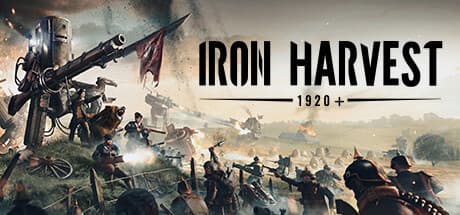
Game Overview
Iron Harvest: Dieselpunk Mechs in an Alternate WWI RTS is a real-time strategy game set in a fictional Europe inspired by the years after the First World War. Developed by KING Art and released on September 1, 2020, it puts infantry squads and enormous diesel-powered machines under the player's command.
A typical battle involves scouting, capturing resource points, reinforcing a front, and introducing heavier units once the economy can support them.
The mechs provide the spectacle, but they do not replace conventional troops. Infantry can secure territory and use cover while heavier machines supply the force needed to break defended positions.
Success therefore depends on combining unit types instead of building the most imposing machine available and sending it forward alone.
Combat and Mech Management
Positioning is central to combat. Infantry placed behind suitable cover is generally safer than a squad left in open ground, while flanking can dislodge an enemy that is difficult to defeat head-on.
Reading firing lanes and occupying useful ground before an engagement can matter as much as rapid clicking once the shooting starts.
Mechs have distinct battlefield roles, effective ranges, and mobility characteristics. Heavy machines can help advance a front, while other designs are better suited to ranged fire or infantry support.
Large units can be slow to turn or withdraw, so scouting and screening them with infantry remains important even after powerful machinery enters the fight.
Buildings and battlefield obstacles also shape engagements. A defensive position that works at the beginning of a fight may not remain secure as the battle develops.
Players who relocate damaged squads and adapt their formation will fare better than those who depend on one static line throughout the match.
Campaign, Co-op, and Multiplayer
The single-player campaign provides a structured way to learn the units while following the setting and its characters. Missions can ask the player to preserve limited forces, choose an order of attack, or manage more than one objective.
It is the most natural starting point for newcomers who want context alongside the RTS systems.
Co-op allows players to divide responsibilities. One person can hold a contested front while the other captures territory or responds to pressure elsewhere.
Coordination still matters: if both players spend resources on the same role or abandon the same approach, the remaining line can become dangerously thin.
Competitive multiplayer places greater pressure on scouting and resource control. Saving only for expensive machines can concede too much territory early, but relying exclusively on infantry leaves an army vulnerable to armored opposition.
The ability to identify an opponent's composition and adjust production is more valuable than following a single build in every match.
Practical Advice for the Opening
Keeping every unit in one group makes control simple, but it also limits map coverage and invites flanking. Separating scouts, capture squads, and the main force is more efficient, provided they remain close enough to support one another.
Excessive separation creates isolated units that an opponent can defeat in sequence.
A damaged mech represents a substantial commitment, so deciding when to stop pursuing an enemy is important. Preserving an experienced unit for the next engagement may be more valuable than completing one risky chase.
New RTS players should first focus on maintaining production, checking the minimap, and withdrawing battered squads before attempting more elaborate maneuvers.
System Requirements
The listed minimum configuration requires 64-bit Windows 10, an Intel Core i5-4460 or an AMD equivalent, and 8GB of RAM. Graphics hardware should be a GeForce GTX 960 or an AMD equivalent with 4GB of VRAM.
DirectX 11 support and 30GB of available storage are also required.
These are minimum requirements rather than a promise of consistently high settings during crowded battles. On GTX 960-class hardware, it is sensible to begin with conservative graphics options and adjust demanding features such as shadows and effects after checking performance.
No recommended specification was supplied in the article data, so players targeting higher resolutions or frame rates should confirm the current requirements before buying.
With 8GB of RAM, background browsers, streaming tools, and other applications can reduce the memory available to the game. Installing with exactly 30GB free may also leave too little room for updates and temporary files.
Allowing additional storage space is the safer approach.
Reception and Common Points of Appeal
Iron Harvest stands out through its alternate-history art direction, story-led campaign, and tactical use of infantry cover alongside giant machines. It is less about producing an anonymous mass of units and more about preserving squads while shifting the front.
Players who enjoy managing the position of individual groups are therefore more likely to appreciate its design.
Those seeking an extremely fast RTS may find the deliberate movement of heavy mechs and the need to manage several squads less immediate. Campaign, co-op, and competitive matches also emphasize different skills, so experience with one mode does not fully represent the others.
Current user sentiment can change and is best checked in the article's live rating area or the current store listing.
Who Should Play It
The game suits players interested in alternate postwar history, industrial mech design, and squad-level tactics. It is a better fit for someone who wants to move troops directly across a battlefield than for someone seeking primarily national policy and grand-strategy management.
It also offers a useful mix for players who want both a narrative campaign and matches shaped by human opponents.
It is especially rewarding for players who enjoy building an advantage through resource control rather than expecting every encounter to end in immediate annihilation. Treating infantry retreats and mech protection as part of the strategy reveals more of the game's depth.
Limitations and Who May Not Enjoy It
This is not a turn-based strategy game in which every decision can be considered while the action is paused. Production, capture points, and fights in several locations may require attention at the same time.
Players uncomfortable with real-time multitasking should expect a learning period.
It is also not a direct mech action game. The machines are commanded as part of an army, while squad control, positioning, and resource management remain fundamental.
Because only minimum hardware data was provided, PCs close to that baseline may need graphics adjustments, and players should verify current language support before purchase if localized story presentation is essential.


