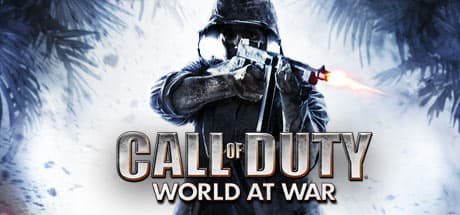
Call of Duty: World at War – Experience Gritty WWII Combat is a first-person shooter developed by Treyarch and published by Activision. Released on November 18, 2008, it follows separate soldiers across the Pacific and Eastern Fronts.
It uses the Call of Duty 4: Modern Warfare engine but replaces modern warfare with older firearms, close-range assaults, ambushes, and a much harsher battlefield atmosphere.
Game Overview
The campaign generally has you advance with friendly troops, break through machine-gun positions and trenches, and reach successive objectives. The two fronts make that familiar structure feel different.
Pacific missions emphasize concealed enemies and sudden attacks, while Eastern Front chapters feature ruined cities, fortified positions, and increasingly large offensives.
Enemies do not simply trade fire from a distance. Banzai charges and ambushes can close the gap quickly, punishing players who focus only on visible targets.
Moving between cover, checking flanks, and keeping a weapon ready for close combat are therefore essential. Graphic violence and bleak staging make this less of a light military adventure and more of a campaign about attrition.
How the Fronts Change Combat
On the Pacific Front, enemies can blend into vegetation or remain hidden until the squad passes their position. Advancing with friendly soldiers and checking likely hiding places is safer than rushing into open ground.
Weapons that can pressure enemies behind cover also have clear tactical value in these missions.
The Eastern Front moves between sniping, clearing buildings, and large infantry assaults. At long range, patience and firing when an enemy leaves cover matter more than spraying ammunition.
Indoors, short sightlines make it wise to reload behind cover before entering the next room rather than pushing forward with a nearly empty magazine.
Co-op and Zombies
The campaign supports four-player co-op, allowing a group to divide firing lanes and targets. During heavy encounters, it is usually more effective to have some players control the front while others watch for enemies rushing into close range.
Solo play better preserves the pacing of the narrative, while co-op turns the same missions into a more chaotic team challenge.
The game also includes a Zombies mode built around defending an enclosed area against successive waves. Players earn resources from kills, obtain weapons, manage entry points, and prepare for increasingly dangerous attacks.
Accurate shooting helps, but positioning, preserving an escape route, and coordinating roles become just as important.
Useful Campaign Habits
On higher difficulties, avoid exposing yourself from the same piece of cover for too long. Some encounters encourage forward movement, so trying to eliminate every opponent before advancing can leave you trapped under sustained pressure.
Watch the movement of friendly troops and the objective marker to judge when the game expects you to push.
Check your ammunition before entering buildings or trenches. Fallen weapons provide alternatives when supplies run low, so refusing to change weapon types can make a difficult section harder.
Because the campaign uses checkpoints, learning the direction of an ambush and applying that knowledge on the next attempt is a practical part of progression.
System Requirements
The listed minimum configuration specifies Windows XP, Vista, or 7; a Pentium 4 at 3GHz or AMD 64 3200+; and a 256MB GeForce 6600 or Radeon X1600. It also calls for 512MB of RAM, or 1GB on Vista, plus 8GB of free storage and DirectX 9.0c.
These requirements are modest by modern standards, but minimum specifications do not guarantee high resolutions or frame rates.
The older operating-system listing deserves more attention than the raw performance requirements. A current Windows PC may have ample power yet still encounter issues involving startup, aspect ratio, input, or online connectivity.
Players should check the game's current Steam compatibility information and be prepared to try administrator or compatibility settings if necessary.
No recommended specification is provided in the supplied data, so performance on a particular modern CPU or GPU should not be promised. Integrated graphics users should also verify DirectX 9 game compatibility and driver behavior instead of assuming that any newer device will work perfectly.
Reception and Player Impressions
The game has maintained a strong reputation for combining two distinct war fronts, bleak presentation, campaign co-op, and Zombies in one package. Its linear design also gives it a focused rhythm: major firefights arrive frequently, with little time spent on exploration or inventory management.
That direct structure can be refreshing for players who want a concentrated single-player FPS.
Common points of friction include aggressive enemies, frequent grenades, and repeated checkpoint attempts on harder settings. As an older PC release, its behavior on current systems and the availability of online opponents may also vary.
Anyone buying it mainly for competitive multiplayer should check whether players are active in their region and usual play hours.
Who It Suits
Call of Duty: World at War is best suited to players who want a grim WWII shooter rather than a bright heroic adventure. It also works well for those who enjoy a focused, linear campaign or want to tackle story missions and zombie waves with friends.
Series fans interested in the early form of the Zombies formula will find particular historical value here.
Caveats and Who Should Skip It
The listed languages are English, French, Italian, German, and Spanish; Japanese is not included. Players who need Japanese text to follow dialogue and mission instructions should treat that as a major limitation.
Verify the language options currently shown for the Steam version before purchasing.
The game may also be a poor fit for people who dislike graphic depictions of wartime violence or prefer open exploration and extensive character builds. Online functionality and compatibility for a title designed around older versions of Windows should not be assumed to remain unchanged.
It is easiest to recommend when the campaign and Zombies are the main attraction and the player accepts that some system adjustment may be required.