This article covers ASUS ROG Astral GeForce RTX 5080 OC Edition ゲーミンググラフィックスカード (PCIe 5.0.
Overview
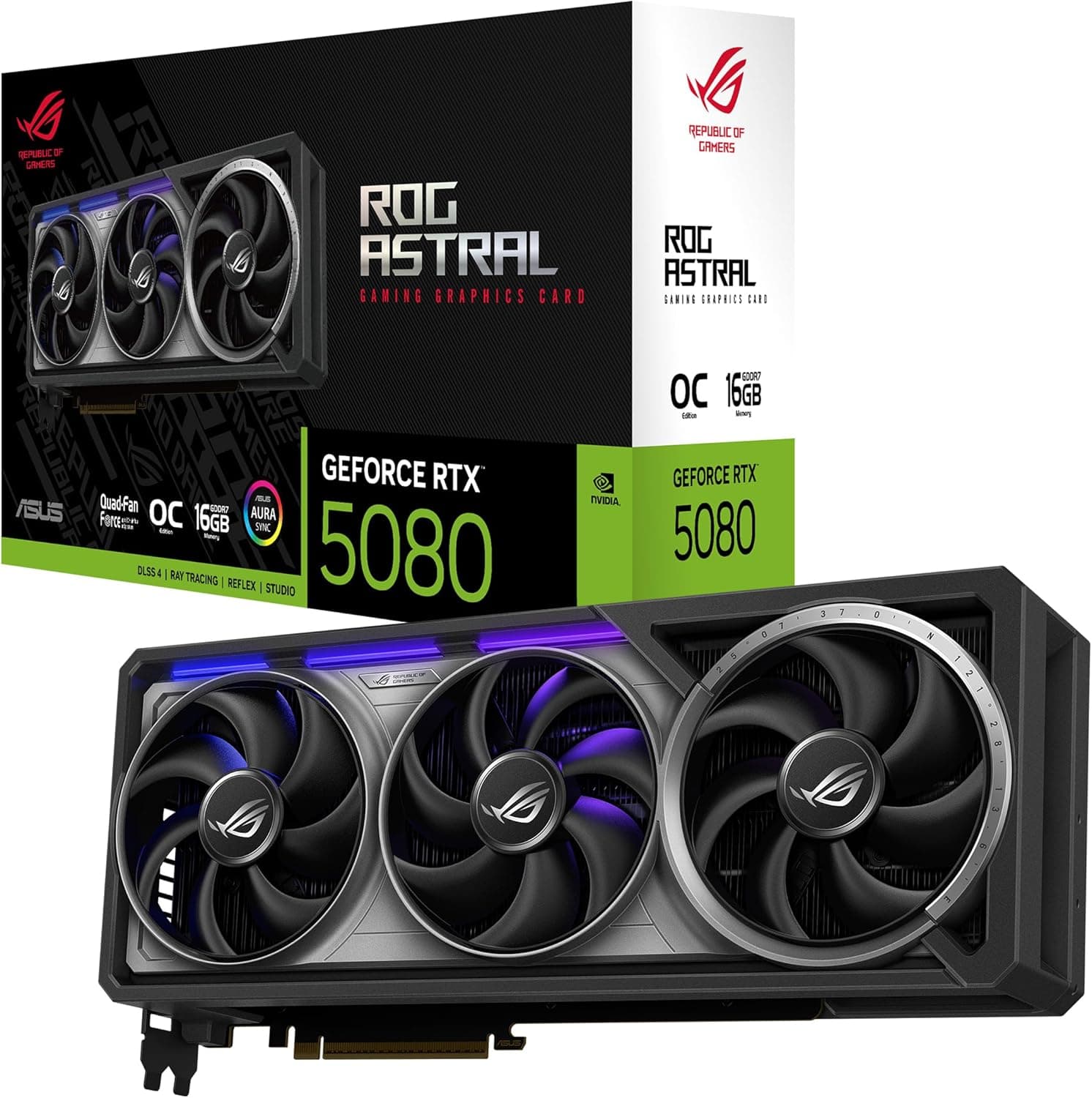
ASUS has unleashed its flagship ROG Astral GeForce RTX 5080 OC Edition, built on NVIDIA's Blackwell architecture. This card pushes the boundaries with a quad-fan cooling system—a first for the ROG lineup—combined with a patent-pending vapor chamber and milled heat spreader. The phase-change GPU thermal pad ensures optimal heat transfer over years of use, maintaining peak performance without degradation.
With 16GB of GDDR7 memory over a 256-bit bus and boost clocks reaching 2790 MHz in OC mode (default 2760 MHz), this RTX 5080 variant delivers up to 1899 AI TOPS. PCIe 5.0 x16 interface guarantees future-proof bandwidth, while the 3.8-slot heatsink and full-metal die-cast shroud keep temperatures in check even under prolonged 4K gaming or AI workloads.
The ROG Astral series targets enthusiasts who demand the absolute best in cooling, build quality, and raw performance. It sits at the high-end of the market, directly competing with other premium RTX 5080 partners and even previous-gen RTX 4090 cards in ray tracing and AI tasks.
Compatibility Guide
This graphics card requires a PCIe 5.0 x16 slot but is fully backward compatible with PCIe 4.0/3.0 motherboards. The 3.8-slot width means you need a case with at least four expansion slots of clearance—most Mini-ITX and compact MicroATX builds are out of the question.
- Slot interface: PCI Express 5.0 x16 (backward compatible)
- Recommended PSU: 850W or higher with 12VHPWR connector
- Physical dimensions: approx. 357mm length, 149mm height, 3.8 slots thick
- Memory: 16GB GDDR7 (256-bit)
Make sure your case has at least 360mm of GPU clearance and enough width to accommodate the triple-slot-plus thickness. Cable management also needs planning due to the 12VHPWR adapter.
Product Info
Released in early 2025, the ASUS ROG Astral GeForce RTX 5080 OC Edition is positioned as a high-end enthusiast card. It boasts NVIDIA's Blackwell architecture with DLSS 4 support, quad Axial-tech fans, a vapor chamber, and phase-change thermal pads.
- GPU: NVIDIA GeForce RTX 5080 (Blackwell)
- Boost clock: 2790 MHz (OC) / 2760 MHz (default)
- VRAM: 16GB GDDR7 (256-bit, ~960 GB/s bandwidth)
- Cooling: Quad-fan, vapor chamber, phase-change pad
- TDP: 360W (spikes up to 500W)
- Power connector: 12VHPWR (16-pin)
- Warranty: 3 years (registration required)
The OC Edition is factory-overclocked, offering higher stable clocks than reference models out of the box.
Best Use Cases
- 4K High-Refresh Gaming
Ideal for gamers targeting 4K 144Hz+ with maxed ray tracing. DLSS 4 Frame Generation helps push beyond 60fps in demanding titles. Pair with a fast CPU like Ryzen 9 7950X3D or Core i9-14900K to avoid bottlenecks. - AI Inference & Hobbyist Machine Learning
The 1899 AI TOPS make it a fantastic choice for running local Stable Diffusion, LLM inference (up to 7B parameter models fit in 16GB VRAM). For training, consider cards with 24GB+ VRAM. - Content Creation (Video Editing / 3D Rendering)
DaVinci Resolve, Blender, and Unreal Engine benefit hugely from this card. Note that Adobe Premiere relies more on Intel Arc or NVENC for encoding, but the raw render speed is excellent.
Things to Consider
Physical space is the #1 concern. The 3.8-slot design means you need a case with at least 4 slots of clearance and 357mm length. Many standard mid-tower cases will not close the side panel if the card is too wide. Check your motherboard’s PCIe slot alignment—adjacent slots will be unusable.
Power supply must have a 12VHPWR cable (ATX 3.0 standard). Older PSUs may require an adapter (usually included), but ensure the PSU can handle transient spikes up to 500W. A quality 850W unit is the bare minimum; 1000W recommended for overclocked systems.
Compared to the RTX 4090, raster performance is about 15% lower, but the RTX 5080 offers better efficiency and DLSS 4 advantages. If you already own an RTX 4080 SUPER or 4090, the upgrade incentive is modest unless you need Blackwell-specific features.
FAQ
Q: Does PCIe 4.0 bottleneck this card?
A: In gaming, the difference is 3-5% at most—not noticeable. For AI inference or data-heavy tasks, PCIe 5.0 bandwidth can help, but it's not a dealbreaker. If building fresh, go with a 5.0 board.
Q: Which cases are recommended?
A: The Fractal Torrent, Lian Li O11 Dynamic EVO, and Corsair 5000D Airflow are great fits. Avoid any case shorter than 360mm GPU clearance or with less than 4-slot width.
Q: How does it compare to an RTX 4090?
A: The RTX 4090 has higher raster performance, but the RTX 5080 is more power-efficient and supports DLSS 4 with superior ray tracing efficiency. For AI workloads, the 5080's Blackwell Tensor Cores offer better TOPS per watt. If budget allows, choose based on exact workload needs.
Product Disclosure (Amazon)
- Manufacturer: ASUS
- Seller: DUCK-SHOP
- Fulfilled by: DUCK-SHOP
- ASIN: B0DS643QRW
- Note: This article covers a manufacturer-made product based on Amazon listing details.