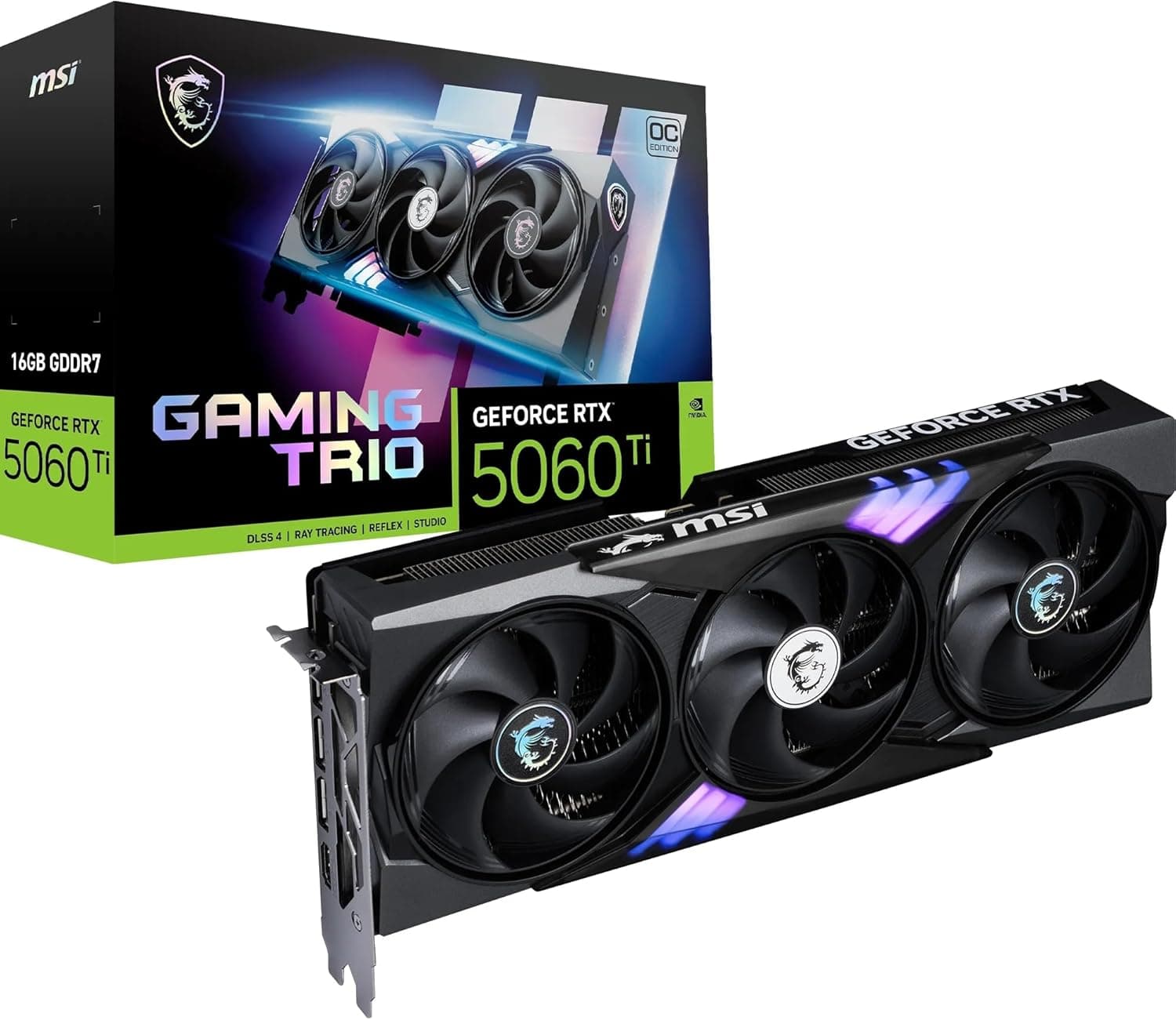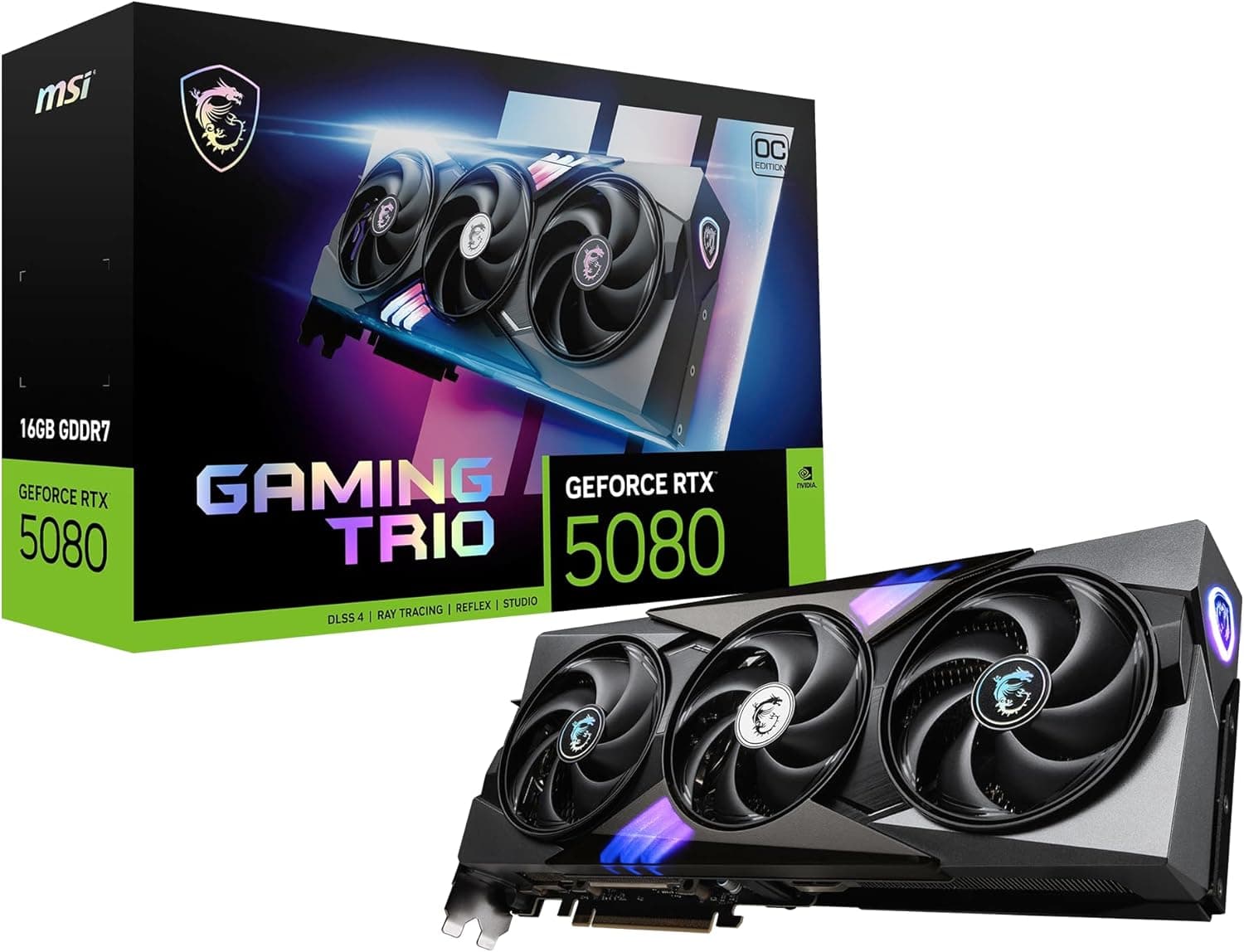
This article covers MSI GeForce RTX 5080 16G GAMING TRIO OC グラフィックスカード VD8975.
Overview
The MSI GeForce RTX 5080 16G GAMING TRIO OC is a high-end graphics card built on NVIDIA's latest Blackwell architecture. It packs 16GB of GDDR7 memory, 10,752 CUDA cores, and a boost clock of up to 2,700 MHz (Gaming Mode), with an extra 2,715 MHz available via MSI Center. This card is designed to deliver smooth 4K gaming and accelerate creative workloads like video editing and 3D rendering. MSI's flagship GAMING TRIO series is known for robust cooling, and the OC version gets the updated TRI FROZR 4 triple-fan system. Wave Curved 4.0 fins and Air Antegrade Fin 2.0 technology minimize turbulence while maximizing airflow, and a nickel-plated copper baseplate rapidly pulls heat away from the GPU and memory modules. The result is sustained performance under heavy loads with lower noise levels compared to many competitors. Positioned firmly in the enthusiast tier, the RTX 5080 sits just below the RTX 5090 but offers a much more accessible price point for those who want high-end ray tracing, DLSS 4, and PCIe 5.0 support without breaking the bank. It's a natural fit for 4K 144Hz monitors and VR applications.
Compatibility Guide
Interface: PCI Express 5.0 x16 (backward compatible with PCIe 4.0/3.0). The card requires a 16-pin (12VHPWR) power connector; a dual 8-pin to 16-pin adapter is included, but we recommend an ATX 3.0 PSU with a native 12VHPWR cable for cleaner builds and improved reliability. Recommended PSU wattage: 850W. Physical dimensions: 338 x 140 x 50 mm (2.5 slots). Ensure your case has at least 340 mm of GPU clearance. The card is quite large, so check compatibility with your case's GPU cutout and front fan/radiator clearance. Display outputs: 3x DisplayPort 2.1b, 1x HDMI 2.1b, supporting up to four displays at 7680 x 4320.
Product Info
Release: Late February 2025. Price: around ¥230,000–240,000 in Japan (approx. $1,600 USD at launch, current street price ~¥236,634). Warranty: 2 years (MSI). Available through major retailers and e-tailers like . Market positioning: High-end. The RTX 5080 is the second-fastest consumer GPU from NVIDIA's Blackwell generation, targeting 4K gaming and professional content creation. With 16GB of GDDR7 on a 256-bit bus, memory bandwidth is roughly 960 GB/s, providing ample headroom for high-resolution textures and complex scenes.
Best Use Cases
4K Gaming Enthusiasts If you own a 4K 120Hz+ monitor and want to max out settings with ray tracing enabled, the RTX 5080 delivers consistent 60–100+ fps in demanding titles. It also supports DLSS 4 for even higher frame rates. Not ideal for budget-conscious gamers who play at 1080p/1440p. Creative Professionals Video editors using Premiere Pro or DaVinci Resolve, 3D artists in Blender, and AI researchers running Stable Diffusion will benefit from the large VRAM pool and CUDA acceleration. The 16GB GDDR7 avoids memory bottlenecks for 8K video timelines or large model training. Not suitable for users who only do light office work. High-End PC Builders Pairing this card with a PCIe 5.0 motherboard and an ATX 3.0 PSU future-proofs your system for the next few years. It's a great choice for a flagship build. Not recommended for small form factor (ITX) builds due to size constraints. Who should avoid this card? - Gamers on a 1080p/1440p budget: a RTX 5070 Ti or RTX 4070 Ti SUPER offers better value. - Users wanting a silent, low-power PC: TDP 360W requires significant cooling. - Those building in compact cases: this card is 338 mm long and 2.5 slots thick. ## Alternatives
ASUS TUF Gaming RTX 5080 OC A direct competitor at a similar price. ASUS's TUF series is known for durability, but MSI's TRI FROZR 4 cooling tends to be quieter under load. The MSI card also offers a slightly higher factory overclock option via MSI Center. NVIDIA GeForce RTX 5090 Founders Edition The RTX 5090 is the absolute top-tier, but costs more than double. For most users, the RTX 5080 provides 80–85% of the performance at half the price, making it the smarter choice for high-end 4K gaming. The RTX 5090 also requires a 1000W+ PSU and more robust cooling.
Things to Consider
Power supply selection is critical. While MSI recommends 850W, a system with a high-end CPU (e.g., Ryzen 9 7950X or Core i9-14900K) can peak over 900W under full load. We recommend a 1000W ATX 3.0 PSU with a native 12VHPWR connector for maximum stability and cable management. Physical clearance: double-check your case's GPU length limit (≥340mm required) and width (2.5 slots). The card may block adjacent PCIe slots on some motherboards, particularly if they have thick heatsinks. Upgrade consideration: If you already own an RTX 4080 SUPER, the performance uplift from the RTX 5080 is roughly 15–20%, which may not justify the cost. However, coming from an RTX 30-series or older, the jump is substantial and worthwhile. ## FAQ Q: Can I use this card with a PCIe 4.0 motherboard? A: Yes, it's fully back
Product Disclosure (Amazon)
- Manufacturer: MSI
- Seller: Amazon.co.jp
- Fulfilled by: Amazon.co.jp
- ASIN: B0BX6LGM2X
- Note: This article covers a manufacturer-made product based on Amazon listing details.