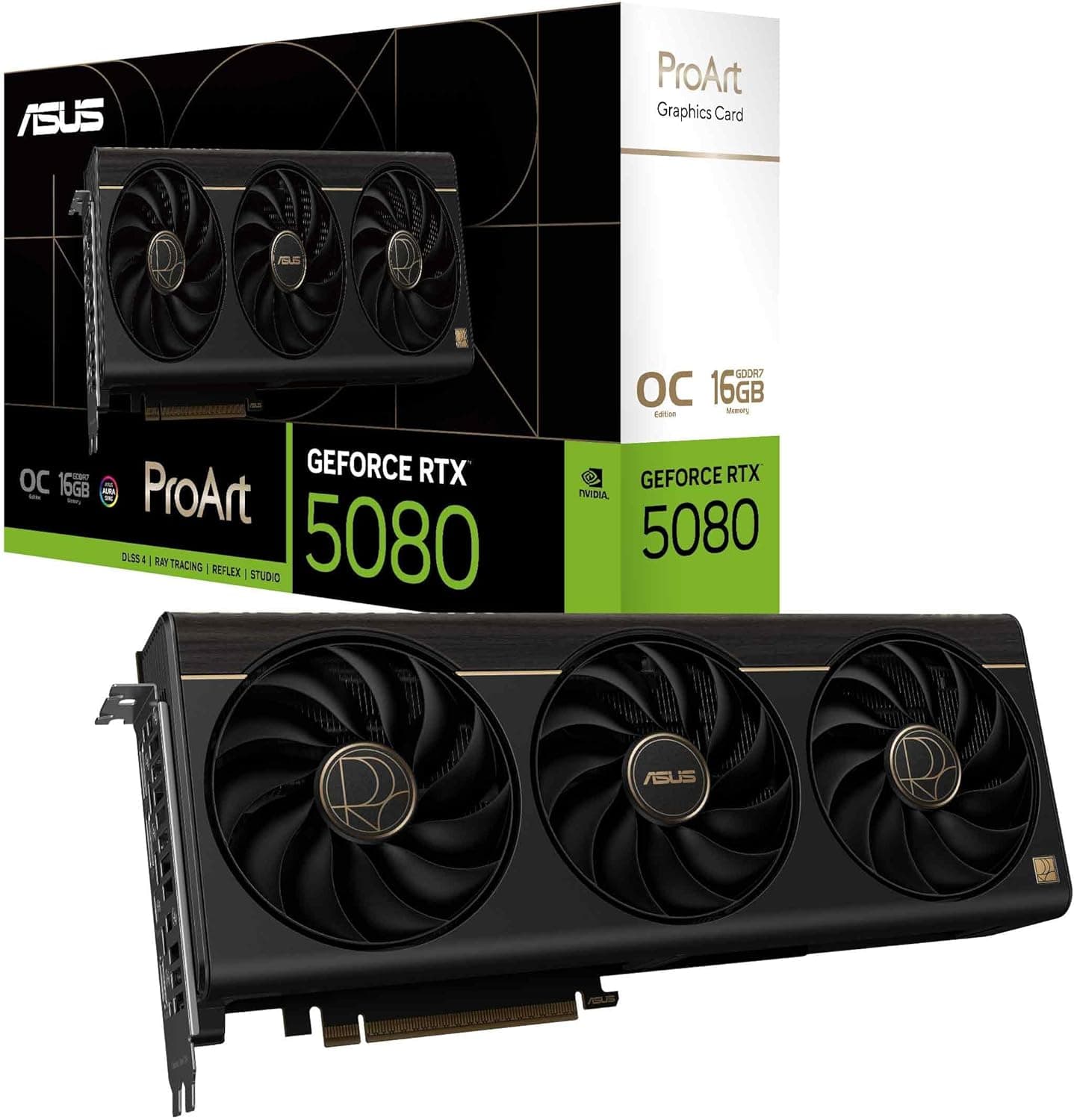
This article covers ASUS ProArt GeForce RTX 5080 OCエディショングラフィックスカード (PCIe 5.0.
Overview
The ASUS ProArt GeForce RTX 5080 OC Edition is a high-performance graphics card built on NVIDIA's latest Blackwell architecture, specifically tailored for creative professionals. It packs the GeForce RTX 5080 GPU with 16GB of GDDR7 memory, delivering 1858 AI TOPS for accelerated workflows. The OC mode boosts the core clock to 2730MHz, while default mode runs at 2700MHz. What sets this card apart is its understated, minimalist design: a wood-pattern laminate trim and a subtle ProArt logo make it a natural fit for professional workstations rather than flashy gaming rigs. It supports PCIe 5.0 and offers a versatile output configuration with two DisplayPort 2.1b ports, one HDMI 2.1b port, and one USB Type-C port. Positioned in the high-end creator segment, the ProArt RTX 5080 OC Edition sits below the flagship RTX 5090 but offers excellent value for those who need Blackwell's latest features without the extreme price tag.
Compatibility Guide
PCIe Interface: PCIe 5.0 x16; backward compatible with PCIe 4.0 and 3.0 motherboards, though bandwidth limitations may slightly affect performance on older platforms. Power Requirements: NVIDIA recommends a minimum 850W power supply. The card itself has a TDP of approximately 350W and uses a 12VHPWR (12+4 pin) connector. An adapter for traditional 8-pin PCIe cables is included, but an ATX 3.0 compliant PSU is strongly recommended. Physical Fit: The card occupies 2.5 slots and measures about 325mm in length. It fits most mid-tower and full-tower ATX cases, but compact M-ATX or ITX builds must verify clearance. Height and thickness are standard. Output Ports: DisplayPort 2.1b x2, HDMI 2.1b x1, USB Type-C x1. The USB-C port supports video output (DisplayPort Alt Mode) and is especially useful for VR headsets or direct connection to high-speed external storage.
Product Info
Released in early 2025, the ProArt RTX 5080 OC Edition carries a street price around ¥280,000–¥290,000 in Japan. It comes with ASUS's standard 3-year warranty. Available through major retailers including , large PC shops, and the ASUS official store. This card occupies the mid-high tier: it costs significantly less than the RTX 5090 but delivers much of the next-generation advantage thanks to Blackwell's architectural improvements. Cooling is handled by three Axial-tech fans, a vapor chamber, and phase-change GPU thermal pads—keeping temperatures under control even during sustained rendering sessions. The Auto-Extreme manufacturing process ensures high assembly precision and long-term reliability.
Best Use Cases
Video Editors and 3D Artists: The 16GB GDDR7 buffer and high AI TOPS dramatically accelerate tasks in DaVinci Resolve, Blender, and Adobe Premiere. The USB Type-C port simplifies connecting VR headsets or fast storage for direct editing. Ideal for timeline scrubbing, 4K/8K encoding, and GPU-accelerated rendering. Professional Workstation Builders: If you need a powerful GPU without RGB lighting or aggressive gaming aesthetics, the ProArt series fits perfectly. Its minimalist design blends into office environments or rack-mounted setups. * Enthusiast Gamers Who Want DLSS 4: While marketed toward creators, this card also excels at 4K gaming with ray tracing enabled. DLSS 4's frame generation and ray reconstruction provide smooth, high-quality experiences in demanding titles. ## Alternatives
Direct competitors include the NVIDIA GeForce RTX 4080 Super. The RTX 5080 offers DLSS 4 support and much higher AI TOPS (1858 vs ~780), making it a better choice for future-proof AI workloads. However, the RTX 4080 Super is often cheaper and still very capable for pure gaming. Another alternative is the AMD Radeon RX 9070 XT, which competes on raw rasterization performance and may offer better value in some regions. But for creators relying on CUDA, OptiX, or NVIDIA's AI ecosystem, the ProArt RTX 5080 remains the stronger option.
Things to Consider
The ASUS ProArt RTX 5080 OC Edition is a powerful card, but it has limitations. Power consumption (350W) requires a robust PSU—don't skimp on a 750W unit; go for 850W or higher with a 12VHPWR connector. The card's length (325mm) may not fit compact cases, so measure before buying. If you're doing 8K video or large-scale AI model training, the 16GB VRAM might feel cramped compared to the 24GB on an RTX 5090. Also, this card is not built for extreme overclocking; if you want the highest boost clocks, consider ASUS's ROG Strix line instead. Finally, ensure your motherboard has enough space for the 2.5-slot thickness in SLI/CF configurations (though multi-GPU is rare nowadays).
Product Disclosure (Amazon)
- Manufacturer: ASUS
- Seller: B&T(国内発送,すり替え対策済,English OK)
- Fulfilled by: B&T(国内発送,すり替え対策済,English OK)
- ASIN: B0FSB9GY9Q
- Note: This article covers a manufacturer-made product based on Amazon listing details.