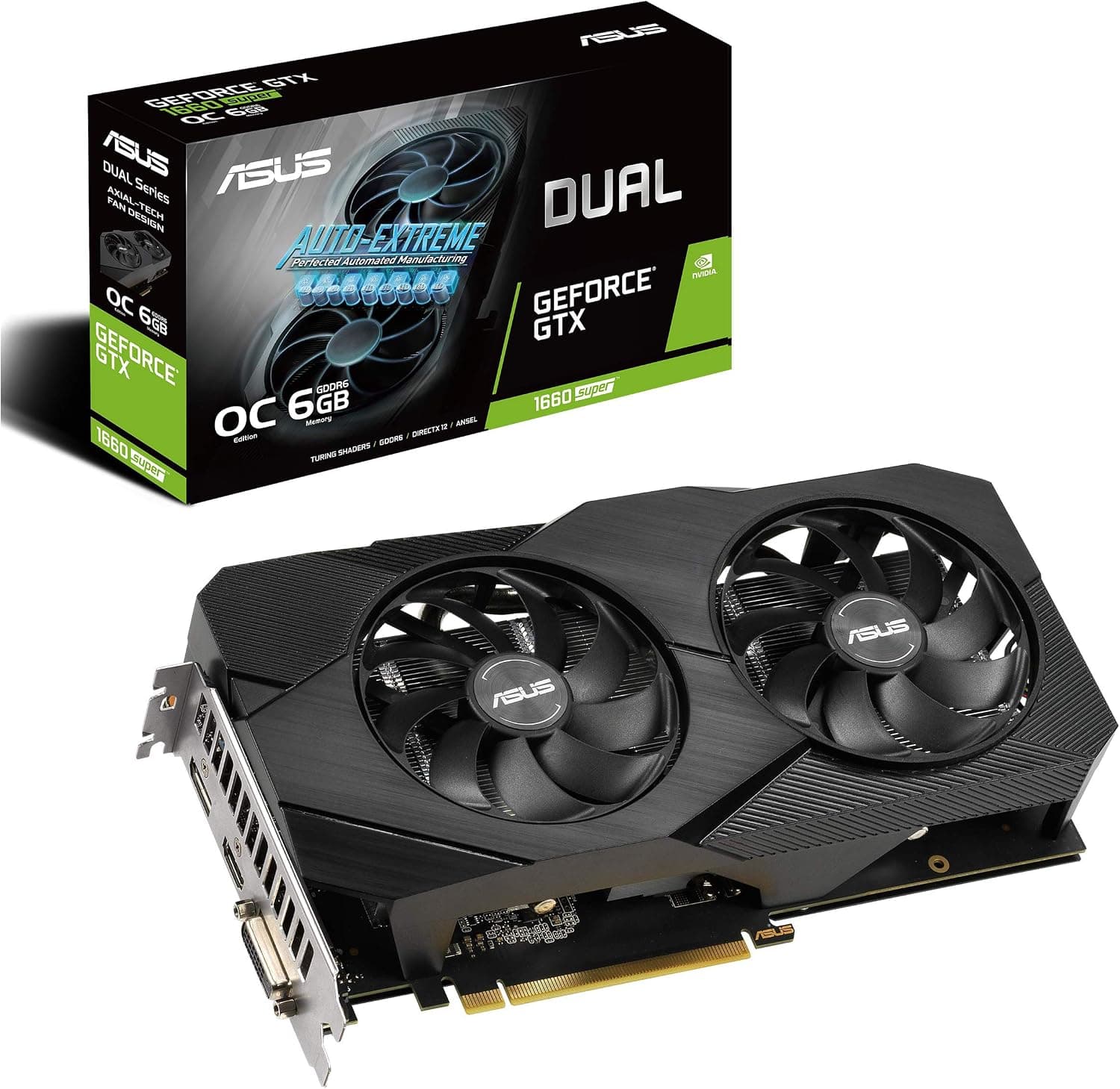
This article covers Asus GeForce GTX 1660 Super Overclocked 6GB Dual-Fan Evo Edition VR Ready HDMI DisplayPort DVI Graphics Card (DUAL-GTX1660S-O6G-EVO).
Overview
The ASUS DUAL-GTX1660S-O6G-EVO is a mid-range graphics card built around the NVIDIA GeForce GTX 1660 Super GPU. It packs 6GB of GDDR6 memory and a dual-fan cooling solution, making it an excellent choice for 1080p gaming. With a boost clock of 1785 MHz and a TDP of just 125W, it delivers strong performance without demanding a massive power supply. This card is ideal for budget-conscious gamers looking to build or upgrade a system for smooth high-refresh-rate play. ASUS employs its Auto-Extreme manufacturing process for enhanced reliability, and the dual-fan design keeps noise levels reasonable under load. The card also includes a backplate for added rigidity.
Compatibility Guide
PCIe Interface: PCIe 3.0 x16; works in PCIe 4.0 slots with full backward compatibility. Power Connector: Requires one 8-pin PCIe power connector. Recommended PSU wattage: 450W or higher. Form Factor: Dual-slot design, length approximately 242mm. Fits most ATX and MicroATX cases. Memory: 6GB GDDR6 on a 192-bit bus, delivering 336 GB/s of bandwidth. * Outputs: 1x DisplayPort, 1x HDMI 2.0b, 1x DVI-D. Supports up to three monitors simultaneously.
Product Info
Released in late 2019, the DUAL-GTX1660S-O6G-EVO remains a popular choice in the mid-range segment. It targets 1080p gaming with a strong price-to-performance ratio. ASUS offers a 3-year warranty. Pricing on Japan hovers around ¥64,428 as of September 2026. The card's 125W TDP means a quality 450W PSU is sufficient for most builds.
Best Use Cases
1080p 144Hz Gaming: Perfect for titles like Fortnite, Apex Legends, and Valorant where high frame rates matter. Not suitable for 4K or ray tracing. Light Creative Work: CUDA acceleration helps with video editing and basic 3D modeling. For heavy 4K rendering, consider a higher-tier card. * Budget or Secondary PC Builds: Low power draw and modest heat output make it a good fit for compact cases or HTPCs.
Things to Consider
No Ray Tracing Hardware: The GTX 1660 Super lacks RT cores, so hardware-accelerated ray tracing is not available. If you want that feature, look at RTX 2060 or newer. 6GB VRAM Limit: Sufficient for most 1080p titles, but some modern games with ultra textures may exceed this buffer. Monitor VRAM usage in demanding titles. Competition: The AMD Radeon RX 6600 offers slightly better raw performance at a similar price, but NVIDIA's driver stability and CUDA ecosystem give this card an edge for mixed use. Power Supply Headroom: While 450W is the minimum, a 500W+ unit provides extra headroom for overclocking or future upgrades. ## FAQ
Q: Can this card handle VR gaming? A: Yes, it meets the recommended specs for first-generation VR headsets like Oculus Rift and HTC Vive. Higher-resolution headsets may struggle. Q: Does it support multi-monitor setups? A: Yes, with three outputs (DP, HDMI, DVI-D) you can run up to three displays. Note that DVI-D does not support analog conversion. Q: How does it compare to the RTX 3050? A: In pure gaming performance, the GTX 1660 Super often outperforms the RTX 3050. The RTX 3050 adds ray tracing and DLSS, but at playable settings the GTX 1660 Super usually delivers higher frame rates at 1080p.